Website Templates vs. Custom Design: Which is Right for Your Business?
Reading time:
So, you’re thinking about getting a new website, or maybe giving your old one a much-needed facelift. Awesome! That’s a huge step for any business. But pretty quickly, you’re going to bump into a big decision: should you go with a ready-made website template or dive into a full-blown custom design?
It’s a bit like choosing between a super stylish, off-the-rack suit and a bespoke one tailored just for you. Both can look great, but they serve different purposes, come with different price tags, and offer different levels of uniqueness.
This isn’t a “one-size-fits-all” answer, folks. To help you make the best call for your business, let’s break down the nitty-gritty of each option in this comprehensive design comparison.
Website Templates: Your Digital Starter Pack
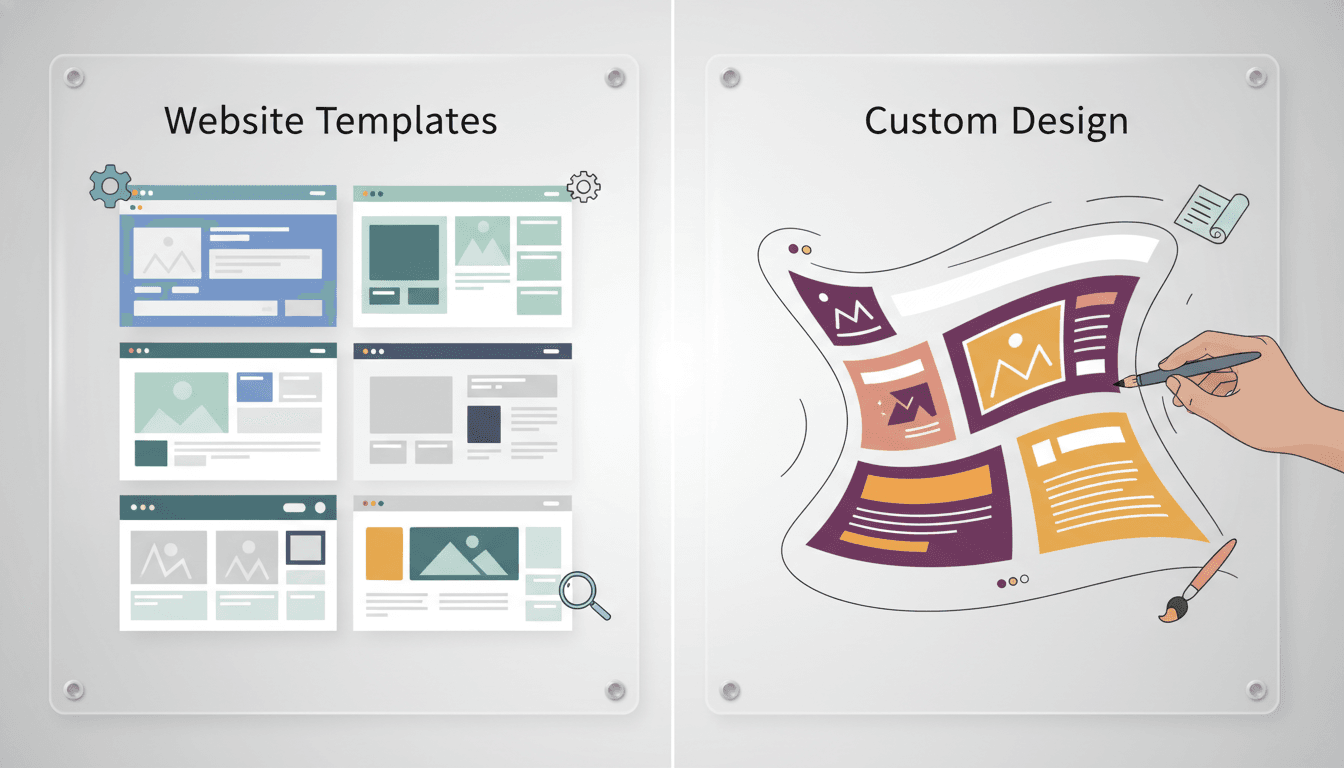
Let’s kick things off with a website templates. What are they? Essentially, they’re pre-designed layouts and structures that you can grab and plug your content into. Think of platforms like Squarespace, Wix, or WordPress themes. They come with built-in functionality and a specific aesthetic, and you customize them with your branding (colors, logos, images, text).
The Perks of Picking a Template
Why do so many businesses, especially startups and small operations, love ’em?
- Speedy Launch: Need a website yesterday? Website templates are your best friend. You can often get a basic site up and running in a matter of days, or even hours, if you’ve got your content ready.
- Wallet-Friendly: This is often the biggest draw. Templates are significantly cheaper than custom work. You’re typically paying for the template itself (sometimes free, sometimes a one-off fee) and a monthly hosting/platform subscription. Great for tight budgets!
- Ease of Use: Most template platforms are designed for the non-coder. With drag-and-drop interfaces and intuitive settings, you don’t need to be a tech guru to build a decent-looking site.
- Modern Look Out-of-the-Box: Template designers keep up with the latest trends. So, your site often looks fresh, professional, and mobile-responsive right from the get-go without you having to design a thing.
- Built-in Features: Many templates come packed with common features like contact forms, basic e-commerce functionality, and image galleries, saving you from adding them manually.
The Downsides of the Template Route
Not all sunshine and rainbows, though. There are some trade-offs to consider with website templates:
- Less Unique: This is the big one. Since thousands of other businesses might be using the exact same template, your site might not truly stand out. It can be hard to carve out a distinct brand identity when your digital storefront looks like a dozen others.
- Limited Flexibility: Templates are built with certain boundaries. If you have a specific, quirky idea for a layout or a unique functionality, a template might force you to stick to its script. Customizations often hit a wall.
- Potential for Bloat: Templates sometimes come with a lot of code and features you don’t actually need. This “extra baggage” can slow down your site’s loading speed, which isn’t great for user experience or SEO.
- Scalability Concerns: As your business grows and your needs become more complex (think advanced integrations, custom apps), you might find your template-based site struggling to keep up. Migrating later can be a headache.
- SEO Challenges (Sometimes): While modern templates are generally SEO-friendly, some older or poorly coded ones might not be. Plus, without the ability to finely tune every aspect, you might miss out on some advanced SEO optimization opportunities.
Custom Web Design: Tailored for Success
Now, let’s talk about custom design. This is where a web designer or agency builds your website from the ground up, specifically for your business. Every pixel, every line of code, every feature is crafted with your unique vision and goals in mind.
Why Go Custom? The Sweet Spot of Bespoke Design
When you choose custom design, you’re investing in something truly yours:
- Uniqueness & Brand Identity: Your website will be one-of-a-kind. It’s an extension of your brand’s personality, values, and offerings, helping you truly stand out from the competition. No twin sites here!
- Ultimate Flexibility: Got a wild idea for an interactive product configurator? Or a super-specific user journey you want to implement? With custom design, your wish is its command. The sky’s the limit for functionality and design.
- Scalability for Growth: A custom site is built to evolve with your business. Need to add a new service, integrate a complex CRM, or expand into new markets? A well-built custom site can handle it, making it future-proof.
- Optimized Performance & SEO: Because everything is built from scratch, developers can ensure the code is clean, efficient, and super fast. This directly translates to better user experience and stronger SEO performance. No unnecessary bloat, just pure, optimized power.
- Better Security: Custom sites, when developed correctly, can be more secure against common vulnerabilities than widely used template platforms, as they don’t share the same attack surface.
- Ownership & Control: You own the code and the design. This gives you complete control over your digital asset without being tied to a specific platform’s rules or limitations.
The Not-So-Glamorous Side of Custom
While awesome, custom design isn’t without its own set of considerations:
- Higher Investment: Let’s be real, it costs more. A lot more. You’re paying for design expertise, development hours, strategic planning, and ongoing maintenance. This is a significant business investment.
- Longer Timeline: Good things take time. A custom website project can take weeks or even months from initial concept to launch, depending on its complexity. It’s not an overnight solution.
- More Involved Process: You’ll be an active participant in the design and development process, providing feedback, approving mockups, and testing functionalities. It requires your time and input.
- Finding the Right Partner: Choosing a reliable and skilled web design agency or freelancer is crucial. A bad custom job can be worse than a decent template.
Website Templates vs. Custom Design: Which Corner Are YOU In?
Alright, now for the million-dollar question after our design comparison: how do you choose? It really boils down to your specific business needs, budget, timeline, and long-term goals.
You Might Lean Towards Website Templates if:
- You’re a startup or small business with a tight budget. Every penny counts, and getting something online quickly is priority number one.
- You need to launch fast. You’ve got products to sell or services to offer, and you can’t afford a long development cycle.
- Your website’s primary goal is simple: a basic online presence, a blog, a portfolio, or a simple informational site.
- You’re comfortable with minor design compromises for the sake of speed and cost.
- You’re happy to manage updates and basic maintenance yourself with user-friendly platforms.
You’re Probably a Candidate for Custom Design if:
- You have a unique brand identity that needs to shine through every aspect of your online presence.
- Your business requires complex or very specific functionalities that off-the-shelf solutions can’t provide (e.g., custom calculators, unique booking systems, advanced integrations).
- You have ambitious long-term growth plans and need a scalable, future-proof digital platform.
- Performance, speed, and advanced SEO are critical for your competitive strategy.
- You have the budget and time to invest in a bespoke solution that will serve your business for years to come.
- You want to fully own your digital asset and have complete control over its evolution.
What About a Hybrid Approach?
Sometimes, you can get the best of both worlds! You could start with a highly customizable website template (like a robust WordPress theme) and then hire a developer to implement specific custom functionalities or design elements that the template doesn’t offer. This can be a great middle ground for growing businesses.
The Final Word: Know Thyself (and Thy Business)
Ultimately, there’s no “better” option between website templates and custom design. There’s only one right option for your business right now.
Take a good, hard look at your:
- Budget: What can you realistically afford to invest?
- Timeline: How quickly do you need to be live?
- Business Goals: What do you want your website to achieve in the short and long term?
- Brand Vision: How important is a truly unique online presence to your overall brand strategy?
Once you’ve answered these questions, the path forward will become much clearer. Don’t be afraid to chat with a few web professionals – they can offer insights tailored to your specific situation and help you weigh the pros and cons in detail.
Explore all our Website templates