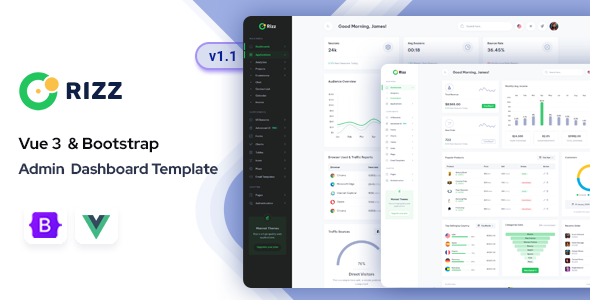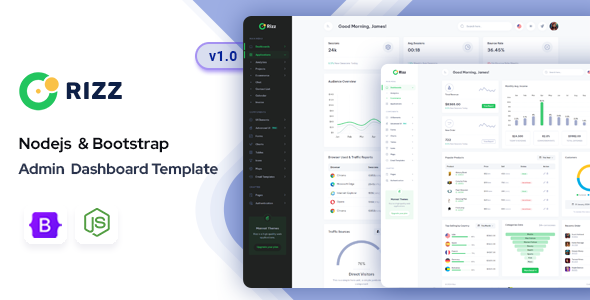
Rizz Nodejs is an admin dashboard template built with Bootstrap and Gulp, offering 96+ pages and 40+ components for custom Node.js backend interfaces. It's a solid foundation for agencies and developers needing to quickly deploy internal tools or client portals.
Rizz Nodejs: A Practical Admin Dashboard Template Overview
This template is a frontend UI kit designed to jumpstart the creation of administrative interfaces. It’s built on Bootstrap and uses Node.js for its development workflow, specifically Gulp for asset compilation and SCSS for styling. The core idea here is to provide a comprehensive set of pre-built screens and components, so you don't have to design and code every element of an admin panel from scratch.
In our experience with similar frameworks, having a ready-made UI can shave off weeks of initial development time. This product solves the common workflow problem of needing a polished, functional backend interface without investing heavily in custom frontend development for every project.
Who This Admin Template Serves Best (and Who It Doesn't)
Rizz Nodejs is primarily for agencies, freelance developers, or in-house teams who regularly build custom admin interfaces, internal dashboards, or client management portals. If you are comfortable with Node.js in your development stack and work with Bootstrap, this template provides a significant head start. It's particularly useful for projects requiring an analytics dashboard, an ecommerce website template for backend management, or a project management interface.
However, this template is not for everyone. If you're looking for a complete, out-of-the-box backend system with database integration and API logic, this isn't it; it’s a UI kit. It's also not ideal for those unfamiliar with Node.js development tooling or who prefer a different CSS framework. If your project demands extremely unique UI elements that deviate significantly from Bootstrap's conventions, you might spend more time overriding styles than building.
Design and Core UI Approach
The design philosophy here is clean and functional, typical of modern admin interfaces. It offers both dark and light modes, which can be toggled using simple data attributes. This is a practical touch because it means less digging through CSS files just to switch themes, making it easier to adapt to client preferences without deep code changes.
The template leverages Bootstrap for its responsive grid and components, ensuring a consistent look and feel across various screen sizes. While the UI is generally standard for admin panels, it’s well-executed and avoids the bloat often seen in other themes in this niche, focusing on clear data presentation.
Included Pages, Apps, and Components for Backend Workflows
Rizz Nodejs comes packed with a substantial number of pre-built assets. You get over 96 pages covering common admin panel needs, alongside 40+ components, 20+ charts, and 20+ widgets. This extensive library is where the real time-saving comes in for building custom Node.js admin interfaces.
- Core Applications: It includes layouts for analytics, ecommerce, project management, calendar, chat, invoice, and task management. These are essentially pre-designed screens that handle the typical data display and interaction for these common backend functions.
- Utility Pages: Beyond the core apps, there are also authentication pages, error pages, profile settings, timelines, pricing, and FAQ sections. This covers almost every standard page an admin dashboard would need, reducing the need to design these common elements from scratch.
Code Quality and Developer Workflow
From a developer's perspective, the template's structure is a strong point. It uses a Gulp-based workflow, which is a standard approach for managing assets, compiling SCSS, and optimizing code. This setup generally means faster build times and more efficient asset loading, which translates to better Core Web Vitals for the end-user.
- SCSS Variables: Customization is made easier through SCSS variables. Changing primary colors or fonts can often be done by tweaking a few lines in a variable file, rather than searching and replacing across multiple CSS files. This significantly lowers maintenance costs for ongoing projects.
- Folder Structure: The "well organized folder structure" is a crucial detail. It means new developers can onboard quickly and find what they need without a steep learning curve. The code is described as lightweight, clean, and commented, which is essential for long-term maintainability and future updates.
- W3C Validation: The W3C Validated HTML pages suggest attention to web standards, which is a good sign for semantic accessibility and basic SEO readiness.
Responsiveness and Browser Support
The template is fully responsive, meaning it adapts well to desktops, tablets, and mobile devices. This is a given for any modern web product, but it's important that the implementation is solid. Based on its Bootstrap foundation, the responsive behavior should be consistent and reliable across different screen sizes, ensuring a good user experience for anyone accessing the admin panel.
Browser compatibility is standard, supporting Chrome, Firefox, Safari, and Microsoft Edge. This covers the vast majority of users and ensures the interface will function as expected across mainstream environments.
SEO Considerations for Admin Panels
While admin panels are typically not public-facing and thus less directly concerned with public SEO, the underlying code quality still matters. W3C Validated HTML pages indicate a clean semantic structure, which is a good practice. Clean, lightweight code and an optimized Gulp workflow contribute to faster page load times. Even for internal tools, better performance means a smoother user experience, which is always a win.
The use of standard Bootstrap components also implies a degree of inherent accessibility, though specific accessibility audits would still be needed for full compliance. A clean codebase generally makes it easier to implement further accessibility improvements if required for specific internal policies or user needs.
Final Thoughts on Rizz Nodejs for Your Projects
Rizz Nodejs delivers on its promise of providing a solid, comprehensive admin dashboard template. It’s a practical investment for any developer or agency frequently building custom Node.js admin interfaces or internal tools. The Gulp workflow, SCSS customization, and extensive page library genuinely save time and effort on the frontend UI. You get a well-structured foundation that’s easy to pick up if you're familiar with Bootstrap and Node.js tooling.
While it won't write your backend logic, it handles the visual heavy lifting effectively. If you need to quickly deploy a professional-looking, functional admin panel without starting from zero, Rizz Nodejs is a smart choice that will streamline your development process and reduce initial project costs.
FAQ
Is Rizz Nodejs a complete backend application or just a UI?Rizz Nodejs is a frontend UI kit for admin dashboards. It provides all the visual elements and pages, but you will need to integrate your own backend logic, database, and APIs.
Can I use this template with a backend technology other than Node.js?Yes, absolutely. While it uses Node.js for its development workflow (Gulp, SCSS compilation), the generated HTML, CSS, and JavaScript are standard and can be integrated with any backend technology like PHP, Python, Ruby on Rails, or .NET.
How easy is it to customize the design and colors?Customizing colors and basic styling is straightforward due to the use of SCSS variables. For more extensive design changes beyond Bootstrap's defaults, you will need to work with the SCSS files directly.
Does this template include any database functionality?No, this template is purely a frontend user interface. It does not include any database setup, server-side code, or API endpoints. You will need to build and connect these components yourself.