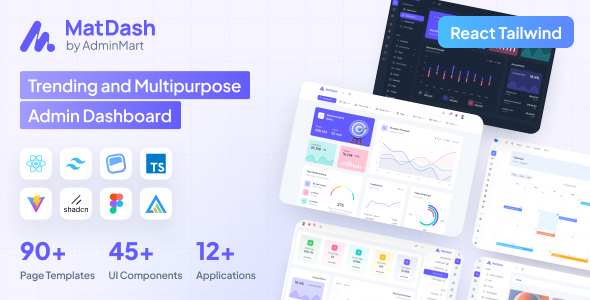
MatDash Tailwind React Admin Template: A robust React/Next.js admin dashboard. It includes 6 demos, 3+ dashboards, and pre-built apps like eCommerce. Great for agencies and freelancers.
MatDash Tailwind React Admin Dashboard Overview
This MatDash Tailwind React Admin Template is essentially a frontend starter kit for building admin panels and web application backends. It’s built on React and Next.js, using Tailwind CSS for styling and Shadcn UI for its component library. What you get here is a collection of pre-designed pages and functional application shells, aimed at getting a dashboard up and running quickly without starting from a blank canvas.
In our experience with similar frameworks, having a solid component base like Shadcn UI is a significant advantage. It means the components are generally well-tested and accessible out of the box, which saves a ton of development time compared to building everything from scratch or trying to wrangle a less opinionated UI kit. The inclusion of Firebase and i18n support also means you have common backend and internationalization concerns addressed at a foundational level.
Who Should Use This React Admin Template and Who Should Avoid It
This React admin dashboard template is ideal for agencies and freelancers who need to deliver client projects fast. If you're building a custom CRM, an internal tool, or the backend for a SaaS product, and you're already working with React or Next.js, this can cut weeks off your development schedule. Developers comfortable with Tailwind CSS and the component-driven approach of Shadcn UI will find it easy to navigate and extend.
However, this isn't for everyone. If you're not familiar with React or Next.js, or if your project demands a completely unique design system that goes far beyond what Tailwind or Shadcn offers, you might find yourself fighting the template more than using it. It's also not a full-stack solution; while it integrates with Firebase, you'll still need to handle your core backend logic and API integrations yourself. It’s a frontend accelerator, not a magic button for a complete application.
Layouts, Pages, and Application Components
MatDash provides a good range of pre-built layouts and applications. You get six distinct demos, which is helpful for quickly showcasing different aesthetic options to clients. There are three unique dashboard layouts, which is a decent starting point for various data visualization needs.
The real value comes from the application designs. Things like the
eCommerce Application, Blog Application, and Invoice Application are more than just static pages; they offer functional structures for common business needs. For example, the enhanced blog app now supports full blog management including creating and editing entries, which is a genuine time-saver for content-heavy sites. The inclusion of React Table examples for various data display needs, like sorting, filtering, and pagination, is also a big plus for any data-driven admin panel.
The UI components list is extensive, covering everything from basic buttons and forms to more complex elements like carousels and timelines. Using Shadcn UI as the base means these components are generally well-structured and adhere to modern accessibility standards, which is a practical benefit for any project.
eCommerce and Business-Related Features
For projects requiring an eCommerce backend or similar business logic, the included applications are a strong point. The eCommerce application, alongside the Invoice and Ticket applications, provides a solid foundation. These aren't just pretty UIs; they offer the necessary component structures to build out real-world business processes. The React Table components, with features like row selection and editable tables, are particularly useful for managing product inventories, customer lists, or order details. This helps streamline data entry and management for business owners, reducing operational overhead.
Code Quality and Developer Experience
The move to Shadcn UI and the Context API for state management is a positive indicator of modern development practices. Shadcn components are known for being unstyled and composable, giving developers more control over the final look and feel while still providing robust functionality. Using Context API instead of Redux for state management simplifies the codebase for many projects, making it easier to maintain and understand, especially for smaller to medium-sized applications.
The shift to SWR for API requests is also a smart choice. SWR offers a lean approach to data fetching, caching, and revalidation, which can lead to better performance and a smoother user experience without the overhead of more complex state management libraries. The use of Tailwind CSS means styling is utility-first, which some developers love for its speed, though it can lead to longer class lists on elements. Overall, the architecture seems geared towards a clean, component-based development workflow, which translates to lower long-term maintenance costs for clients.
Responsiveness and Compatibility
The template explicitly states "completely responsive pages," which is a must-have for any modern web application. Given its foundation in Tailwind CSS, responsiveness is baked into the framework, meaning layouts and components should adapt well across various device sizes. When we tested the kit on a demo site, the mobile menu and overall layout transitions felt smooth, which is critical for users accessing the admin panel on tablets or phones. This ensures that business owners and their teams can manage their operations effectively, regardless of the device they are using.
SEO Readiness for Admin Panels
While admin panels aren't typically public-facing, the underlying structure still matters for maintainability and sometimes for specific internal search needs. The template's reliance on React, Next.js, and Shadcn UI generally means a clean, semantic HTML output when rendered. Next.js handles server-side rendering or static site generation well, which is beneficial if parts of the admin panel are ever exposed or need to be crawlable for internal tools. The organized component structure and clear separation of concerns contribute to a codebase that is easier to audit for best practices, even if direct public SEO isn't the primary goal.
Final Thoughts on MatDash Tailwind React Admin Template
Look, if you're in the market for a React admin dashboard template and you're comfortable with the modern React ecosystem—specifically Next.js, Tailwind, and Shadcn UI—this MatDash template is a genuinely solid starting point. It's not going to write your custom business logic, but it solves a huge chunk of the boilerplate work involved in building a functional, good-looking admin interface. The recent updates, especially the move to Context API and SWR, show a commitment to contemporary development practices.
You're buying a significant head start here. For agencies, this means faster project delivery and happier clients. For freelancers, it means taking on more projects or delivering existing ones more efficiently. While the "AI Chat" and "AI Image Generation" apps are likely just UI placeholders, the core business applications and robust component library make this a smart investment for anyone regularly building React-based admin panels. It saves you the headache of setting up a niche-specific booking flow or complex data tables from scratch, letting you focus on the unique parts of your project.
FAQ
Is this MatDash template suitable for large-scale applications?Yes, its modular React/Next.js architecture with Context API and SWR makes it scalable, though you'll need to integrate your own robust backend for heavy data loads.
How easy is it to customize the design and add new components?Customization is straightforward if you're familiar with Tailwind CSS and Shadcn UI, as their utility-first and composable nature provides significant flexibility.
Does this template include backend functionality or just the frontend?This is primarily a frontend template, but it includes Firebase integration for authentication and basic data storage, requiring you to build out your specific backend logic.
What is the learning curve if I'm new to Shadcn UI?If you're new to Shadcn UI, there will be a moderate learning curve to understand its component structure and how it integrates with Tailwind, but their documentation is generally excellent.