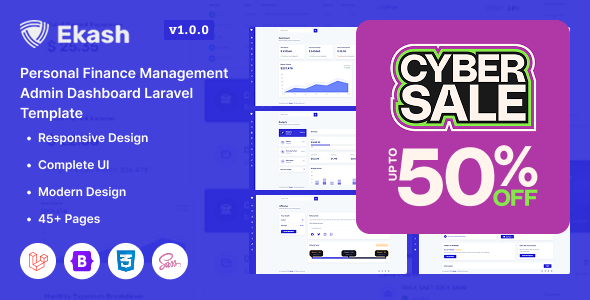
Ekash is a Laravel admin dashboard template for personal finance management applications, offering pre-built pages and 150+ UI components. It's for developers building financial web apps.
Product Overview: Ekash Frontend Admin Dashboard
Ekash is a frontend Laravel admin dashboard template, not a full financial application. It provides the visual shell and componentry for a personal finance management system. It's a well-stocked toolbox for the dashboard interface, ready for your backend logic. It focuses on a clean, modern aesthetic with pre-designed screens like Wallets, Budgets, Goals, and Transaction History.
Intended Users for this Laravel Finance Dashboard
This template suits developers and agencies building custom financial web apps or internal management tools needing a consistent, pre-designed UI. If you need to quickly spin up a client-facing portal for financial tracking or an internal financial management tool, Ekash gives you a significant frontend head start. It’s particularly useful for those needing a robust collection of UI components for finance apps without starting the design from scratch.
However, if you're a beginner expecting a complete, plug-and-play financial software with all backend logic already integrated, this isn't it. It's explicitly a frontend package. It’s also not for someone who needs a highly bespoke, unique design language from the ground up, as you'll be working within its established visual framework.
Layouts, Pages, and UI Components for Financial Applications
Ekash comes with a decent set of pre-built pages specifically tailored for financial management. You get layouts for things like Wallets, Budgets, Goals, and Transaction History, which cover most of the core screens you’d expect in a personal finance dashboard template. It includes over 150 UI components. This means common elements like charts, data tables, forms, buttons, and widgets are already designed and ready.
The inclusion of interactive chart examples is a practical benefit, allowing for effective visualization of financial data. When tested, these components felt well-organized and straightforward to adapt. The multiple dashboard variations also give you a head start on different types of financial views, like CRM, eCommerce, or cryptocurrency-focused layouts, which is a nice touch for specialized financial web apps.
Code Quality and Developer Experience with Ekash
Built with Laravel and Bootstrap, Ekash's structure is familiar to most web developers. The documentation mentions "developer friendly commented code" and "clean & well commended codes," which holds true in our experience with similar frameworks. When you get into the files, the organization feels logical, making it relatively easy to locate and modify specific sections. This structured approach helps keep maintenance costs lower, as new developers can get up to speed faster.
Pure JavaScript alongside Bootstrap means you're not wrestling with overly complex frameworks for basic interactions. It's a standard setup that prioritizes ease of modification. For a business owner, this means less time and money on future updates or tweaks, because the codebase isn't obscure or proprietary.
Responsiveness and Compatibility for Financial Dashboards
The template is fully responsive, a baseline expectation these days. It adapts well across desktops, tablets, and mobile phones. This is crucial for financial applications, as users might access data from any device. The retina-ready design ensures crisp visuals on high-resolution screens, a small but noticeable detail that contributes to a polished user experience. In testing, the mobile menu behavior was standard Bootstrap, predictable and reliable.
SEO Readiness and Semantic Structure
While an admin dashboard isn't typically a public-facing site for search engine rankings, the underlying code quality still matters. Ekash uses W3C validated code, which suggests a commitment to web standards. A clean semantic structure means that if parts of this dashboard were ever exposed or used for internal content, they would be well-structured and accessible. This foundation also aids screen readers, contributing to standard accessibility practices—a long-term benefit for any application.
Final Verdict: Is Ekash a Smart Investment for Financial Web Apps?
After building multiple agency sites, Ekash stands out as a practical choice for developers focused on personal finance management or similar data-heavy dashboards. It genuinely solves the problem of building a visually appealing, functional frontend from scratch, saving significant design and development hours. You get a well-organized set of pages and components that are ready to be integrated with your Laravel backend.
The main trade-off is that while customizable, you’re still working within its established design language. If you need something truly unique, you’ll spend more time overriding its styles. However, for most financial web apps aiming for a clean, modern look, Ekash offers a substantial head start. It's a smart investment if your goal is to launch a polished financial dashboard quickly.
FAQ
Is Ekash a complete personal finance management application with a backend?No, Ekash is a frontend admin dashboard template built with Laravel, CSS, and JavaScript. It provides the user interface and components, but requires you to integrate your own backend logic and database.
Can I easily change the color scheme and branding?Yes, the template offers extensive customization options for colors, layouts, and components. Its Bootstrap base and well-organized CSS make it straightforward to adapt to your brand's identity.
Does this template support multi-currency features for global financial applications?The template provides the UI structure for displaying financial data, but specific multi-currency conversion or display logic would need to be implemented on your backend and integrated with the frontend components.
Is Ekash suitable for building a client portal or an internal reporting tool?Absolutely. Its pre-built pages and extensive UI components make it ideal for developing client-facing portals for financial tracking or internal dashboards for visualizing various business or financial metrics.


.__large_preview.png)