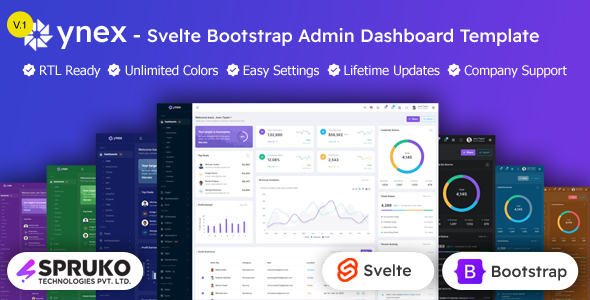
Ynex is an Inertia.js and React admin dashboard template for Laravel developers. It's designed to help you build admin interfaces quickly.
Ynex: A Laravel Inertia React Admin Dashboard Template for Faster Development
Let's cut to the chase. If you're building a Laravel application that needs an admin panel, and you're using Inertia.js with React, this template, Ynex, is worth a look. It's essentially a pre-built front-end structure with a ton of components and pre-designed pages. Think of it as a head start on your admin interface, saving you from styling everything from scratch.
In my experience building multiple agency sites with tools like this, the biggest win is time. Instead of spending days on basic layouts, navigation, and form elements, you get a solid foundation. This can shave off a significant chunk of development time, especially for projects with tight deadlines or for freelancers managing multiple clients. The core problem it solves is the repetitive grunt work of setting up standard admin UI elements.
Who Should Consider Ynex and Who Should Look Elsewhere
This template is a good fit for developers and agencies who are already comfortable with Laravel, Inertia.js, and React. If you need to spin up a functional admin dashboard quickly for a CRM, SaaS platform, or any internal tool, Ynex provides a lot of pre-built functionality. It's particularly useful if you're working on projects where a clean, functional interface is more critical than deeply custom backend logic. For those needing to quickly build an ecommerce website template or an HVAC service layout, the included pages and components offer a strong starting point.
However, if you're looking for a template that dictates a very specific, unique design aesthetic, or if your project requires a highly custom backend that won't map easily to the provided components, this might not be the best choice. It's also not for absolute beginners who are still learning the fundamentals of Laravel or React. You'll need a basic understanding of these technologies to effectively integrate and customize it.
Layouts, Pages, and Components for Practical Use
Ynex comes with a substantial number of pages and components. You get multiple dashboard variations like CRM, Ecommerce, and Analytics, which is handy. The template includes things like data tables, charts, forms, and even some e-commerce specific pages like a shopping cart and checkout. When we tested the kit on a demo site, the organization of these components felt standard for a template of this nature. The inclusion of features like Firebase authentication and various chart libraries (ApexCharts, Chart.js, ECharts) means you're not starting from zero on common functionalities.
The variety of layout options, including vertical and horizontal menus with different behaviors (fixed, scrollable), and dark/light themes, offers flexibility. The CSS is organized using Sass, which is a standard practice and makes it easier to manage styles if you need to make modifications. The mobile menu behavior is generally what you'd expect, collapsing into a hamburger icon and sliding out, which is crucial for responsive design.
Code Quality and Developer Experience
The template is built with React Bootstrap and avoids jQuery, which is a positive sign for modern development practices and better performance. The developers mention "well-commented code" and a "clean, well-structured file organization." In our experience with similar frameworks, this usually means that finding and modifying code is less of a headache. The W3C validation is also a good indicator that the basic HTML structure is sound, which helps with accessibility and SEO.
One area where this type of template can sometimes fall short is in the depth of documentation for truly custom integrations. While the documentation is described as "extensive," the real test is how easily you can adapt it to unique project requirements. The starter kit is a good addition for quickly getting a project off the ground.
Responsiveness and Compatibility
The template is designed to be responsive, meaning it should adapt to different screen sizes. This is essential for any web application today, ensuring a good user experience on desktops, tablets, and phones. The inclusion of RTL support is also a thoughtful touch for internationalization, which is becoming increasingly important.
Browser compatibility is mentioned, which is standard for these types of templates. The practical benefit here is that your users will have a consistent experience regardless of the browser they use, reducing support queries related to display issues.
SEO Readiness
The template is W3C validated and uses a clean semantic structure for its HTML. This is a good starting point for SEO. While a template itself doesn't guarantee high rankings, a clean, well-structured foundation makes it easier for search engines to crawl and understand your content. The lack of jQuery dependency can also contribute positively to Core Web Vitals, which are a factor in search rankings.
Final Thoughts on Ynex for Your Next Project
Ynex offers a solid set of pre-built components and pages for developers working with Laravel, Inertia.js, and React. It's a practical investment if your primary goal is to accelerate the development of your admin dashboard and avoid reinventing the wheel for common UI elements. While it's not a magic bullet, it provides a well-organized and feature-rich starting point that can save significant time and effort, especially when building multiple projects or for clients who need a professional-looking interface fast.
FAQ
Is Ynex suitable for non-technical users to customize?No, Ynex is designed for developers. A basic understanding of Laravel, Inertia.js, and React is required for effective customization and integration.
Does Ynex include backend code or is it just a frontend template?Ynex is primarily a static front-end solution. It provides the UI structure and components, but you will need to build the backend logic and integrate it with your Laravel application.
How does the template handle custom data fetching and state management?The template is built with React and Inertia.js, which are well-suited for data fetching and state management. You'll integrate your own data fetching methods and use React's state management capabilities or libraries like Redux.
What is the main benefit of using Inertia.js with this template?Inertia.js allows you to build modern single-page applications using server-side routing and controllers without building a separate API. This template leverages Inertia.js for a more integrated development experience.