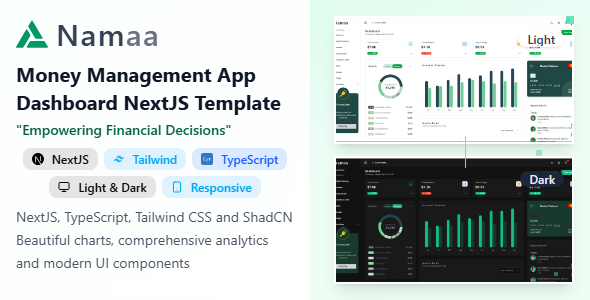
The Namaa Money Management App Dashboard NextJS Template is a pre-built UI kit for developers creating financial dashboards, suitable for quickly launching an MVP or a client project.
Addressing common challenges in building a financial dashboard UI
One significant workflow problem this template solves is the sheer time investment required to build a functional and visually consistent money management app dashboard from scratch. Setting up responsive layouts, ensuring accessibility for data tables, and integrating common financial UI patterns like transaction lists or budget trackers can consume weeks. This Namaa NextJS template provides a solid foundation, allowing developers to bypass much of that initial frontend setup. It's a smart investment for agencies or individual developers aiming to deliver a minimum viable product or client project faster, significantly reducing the initial development sprint.
Evaluating the code quality and technical foundation of Namaa
From a technical standpoint, this template uses Next.js with the App Router, Tailwind CSS, and Shadcn/ui components. This is a current and widely adopted stack, which means the codebase is relatively easy to pick up for most frontend developers. The use of semantic HTML and attention to ARIA attributes for accessibility is a standard practice that's present, contributing to a better user experience and better search engine visibility. For a business owner, this means lower long-term maintenance costs and a more inclusive product. The internal structure for handling things like transaction logging, budget allocation, and goal tracking seems well-thought-out for typical personal finance scenarios.
- The component organization is logical, making it straightforward to find and modify specific UI elements without digging through convoluted files.
- Leveraging Next.js Server Components where applicable can lead to better initial page load performance, which translates to a smoother experience for users.
- The mobile menu behavior is standard and functional, adapting well across different device sizes without unexpected layout shifts.
- Support for LTR and RTL languages is included, which is useful for broader market reach without additional styling effort.
- The CSS structure, being Tailwind-based, is utility-first, making styling changes quick and consistent across the application.
What truly stands out about this NextJS financial dashboard template
What impresses most about Namaa is its focus on providing a complete set of financial management components. You get pre-built screens for wallets, budgets, bills, savings goals, and reports. This comprehensive collection means you're not just getting a shell; you're getting a functional blueprint for a personal finance app. The integration of modern UI components from Shadcn/ui ensures a clean look and good user interaction right out of the box, which is a major time-saver when building a money management app dashboard.
Is Namaa the right fit for your personal finance app project?
This template is for developers and agencies who need to quickly launch a financial application, whether it's a personal finance tracker, a budgeting tool, or a client-facing financial data visualization platform. It's particularly useful for those who want to leverage the Next.js ecosystem with Tailwind CSS for rapid development. Projects requiring highly custom backend logic or unique, non-standard UI designs that deviate significantly from common component libraries should avoid this template.
Areas where the Namaa template feels standard or could improve
While the template is solid, its design, being heavily reliant on Shadcn/ui, can feel somewhat generic without further customization. The reporting section, though functional for displaying basic charts, might require more advanced data manipulation or complex chart types for deeper financial analysis. The initial data fetching setup is a standard placeholder, meaning you will need to implement your own API integrations and data models to make it fully dynamic.
Final Thoughts: Is it worth it?
For anyone looking to accelerate the development of a financial application frontend, this Namaa Money Management App Dashboard NextJS Template is a pragmatic choice. The time saved on building core UI elements, ensuring responsiveness, and implementing common financial features justifies the investment. It allows developers to focus their efforts on the unique business logic and backend services rather than reinventing the wheel on the frontend.
FAQ
Can I easily integrate this with my existing API?Yes, the template provides a frontend structure, and you will connect it to your own API endpoints for data fetching and submission. The code is organized to make this integration straightforward.
How flexible is the UI for branding changes?The template uses Tailwind CSS and a theme provider, making it relatively easy to change primary colors, typography, and switch between light and dark modes to match your brand identity.
Does it support real-time data updates?The template itself provides the UI for displaying data. For real-time updates, you would need to implement your own real-time data fetching mechanisms, such as websockets or polling, and integrate them with the existing component structure.
What kind of data structure does it expect for transactions and budgets?While not strictly enforced, the components are designed around typical financial data structures, expecting fields like amount, category, date, and description for transactions, and allocated amounts for budgets. You'll map your backend data to fit these structures.