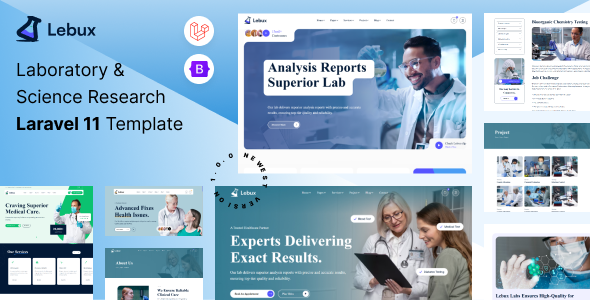
Labux is a Laravel 11 template for science and research websites, offering 4 homepages, 20 PHP pages, and Bootstrap integration for rapid development.
Labux: A Practical Laravel Template for Science Websites
This Labux template is a front-end kit built on Laravel, designed specifically for the science and research sector. It's not a full-stack application with pre-built backend logic, but rather a collection of well-structured views and assets. The goal here is to give developers a solid head start on the visual and structural aspects of a specialized website without starting from scratch.
Who Benefits from This Science Website Development Toolkit?
Labux is a good fit for Laravel developers and agencies who regularly build sites for research institutions, laboratories, or academic projects. If you need to quickly spin up a professional-looking front end for a scientific client and integrate it with your own Laravel backend, this template saves significant design and setup time.
However, it is not for those looking for a complete content management system out of the box. If you lack Laravel experience or need a drag-and-drop WordPress solution, this isn't the right choice. It also isn't for projects requiring extremely deep, custom front-end logic that deviates heavily from Bootstrap's framework.
Design and Visual Approach for Research Platforms
The design leans into a clean, professional aesthetic suitable for scientific content. It uses Font Awesome and Flaticon for iconography, which is standard but effective for conveying complex information visually. The inclusion of WOW and AOS animations adds a layer of visual polish, though as with any animation, careful use is key to avoid distracting from the serious nature of scientific content or impacting Core Web Vitals if overused.
From a practical standpoint, the design provides a credible foundation for showcasing research breakthroughs and lab equipment, which is crucial for a science-focused platform.
Layouts and Pages for Scientific Communication
You get 4 distinct homepages and 20 PHP pages. This provides a good variety for common sections like 'About Us,' 'Services,' 'Team,' 'Publications,' and 'Contact.' Having these pre-built layouts means you can quickly populate content relevant to a research institution, saving hours on initial page construction.
- 4 Home Pages: Offer different entry points to a site, useful for A/B testing or catering to slightly different sub-niches within science.
- 20 PHP Pages: Cover a broad range of internal content, from detailed service descriptions to team profiles, which are essential for any comprehensive research website.
Blog Pages for Sharing Discoveries
The template includes well-structured blog pages and single blog post examples. For scientific and research institutions, a blog is vital for sharing updates, recent discoveries, and thought leadership. This setup ensures that your content, whether it's a new research paper or an event announcement, is presented clearly and consistently. It's a standard but necessary component for any modern online presence in this niche.
Code Quality and Developer Experience
This is where Labux shows its value for developers. It’s built with Bootstrap and Laravel, which means many developers will find the structure familiar. The files are not minified, which is a huge plus for customization; you can easily read, understand, and modify the CSS and JavaScript without fighting through compressed code. This directly translates to lower maintenance costs and easier content updates down the line.
The "well documented" claim holds up, providing guidance on how to work with the Laravel 11 aspects of the template. It's also W3C Validated, which means the HTML structure is clean and semantically correct, contributing positively to SEO readiness and overall site health.
Responsiveness and Compatibility
The template is fully responsive across all screen sizes and compatible with various browsers. This is a baseline expectation for any modern web project, but it’s good to confirm it’s handled competently here. For a science website, ensuring accessibility on mobile devices means researchers and potential collaborators can access information easily, regardless of their device, leading to a better mobile experience for all users.
SEO Readiness for Scientific Content
While a template alone doesn't guarantee top search rankings, Labux provides a solid foundation. The clean, W3C Validated code ensures a semantic structure that search engines can easily crawl and understand. The focus on clear content presentation and a responsive layout also contributes to better user experience signals, which are increasingly important for search engine optimization. This helps ensure your research findings and institutional information are discoverable.
Final Thoughts on This Customizable Lab Website Builder
After building multiple agency sites with tools like this, Labux stands out as a practical Laravel template for research institutions. It genuinely solves the initial setup headache for specific niche websites, especially if you’re already in the Laravel ecosystem. While the animations might be a bit much for some, they are easily adjustable. The core value lies in its clean code, good documentation, and comprehensive page layouts that save significant development time on the front-end. For a Laravel developer needing a solid starting point for a science or research client, this is a smart investment that will cut down on project hours.
FAQ
Is this a full Laravel application with a backend?No, Labux is a front-end template built with Laravel Blade views and assets; you will need to integrate your own Laravel backend logic.
Can I use this template with an older version of Laravel?While built for Laravel 11, the core HTML, CSS, and JavaScript are largely independent, but you would need to adapt the Blade views and asset pipeline for older Laravel versions.
Are the images included in the download package?No, the images used in the demo are not included in the download package due to licensing, but placeholders are provided.
How easy is it to change the overall color scheme?Since it's built with Bootstrap and the CSS files are unminified, changing the primary color scheme is straightforward by modifying the relevant Bootstrap SASS variables or custom CSS rules.