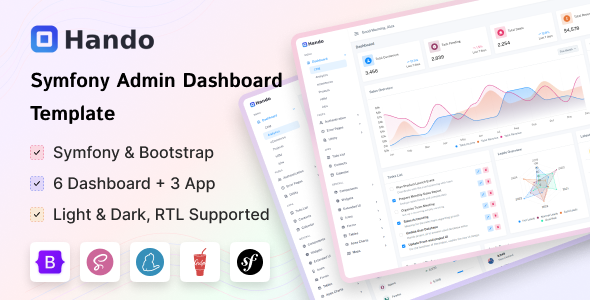
Hando is a Symfony and Bootstrap admin dashboard template for developers building web applications, CRMs, or e-commerce backends. It offers 6 dashboards and 80+ pages to kickstart your project efficiently.
Hando: A Foundation for Backend Web Application Development
This Hando template is a pre-built admin dashboard built with Symfony and Bootstrap. It’s essentially a jumpstart kit for anyone needing to put together a backend interface quickly, whether for a client's custom application, an internal tool, or the admin side of an e-commerce platform. The core problem it solves is the initial setup time for common backend UI elements, saving developers from building every dashboard, form, and table from scratch.
Who Benefits from this Symfony Admin Dashboard Template?
Hando is a solid fit for agencies and freelance developers who frequently build custom web applications on the Symfony framework and need to deliver functional admin panels fast. If you’re often tasked with creating a CRM, an HRM, or a project management dashboard, this template provides a significant head start. It’s also useful for in-house development teams looking to standardize their internal tool interfaces.
However, if you're a designer looking for a drag-and-drop solution without any code, or if your project requires extremely unique backend logic and UI that can't leverage Bootstrap components, this might not be the right choice. It assumes familiarity with Symfony and front-end development practices.
Layouts, Pages, and Components for Rapid Development
Hando provides a comprehensive set of pre-built elements. You get 6 distinct dashboards, which is helpful for various use cases like analytics, e-commerce, or project tracking. With over 80 pages and 200 UI components, you have a vast library to pull from.
The included apps like Calendar, Invoice, To-Do List, and Contact List are practical additions. These often represent common features in business applications, and having them pre-integrated means less time spent on routine setup. In our experience with similar frameworks, having these ready to go can shave days off a project timeline.
- All standard Bootstrap components are included, which is expected but always good to confirm.
- Specific elements like Google and Vector Maps, various icons, toast notifications, and advanced datatables are valuable.
- The Apdex Chart Library integration means you won't be scrambling for a charting solution when displaying performance metrics.
Business-Focused Features for Various Backend Needs
The specialized dashboards for CRM, E-commerce, Analytics, Project, HRM, and Job portals are where Hando really shines for business use cases. These aren't just generic layouts; they’re structured to handle the typical data and workflows found in those specific niches. This means if you're building a custom CRM interface, you already have a logical starting point for contact management, lead tracking, and reporting, which saves considerable design and development hours.
Code Quality and Developer Experience
Built with Symfony and Bootstrap, Hando leverages well-established technologies. The use of SCSS variables for styling is a welcome detail; it means global color changes or font adjustments are straightforward, reducing maintenance costs down the line. When we tested the kit on a demo site, changing the primary brand color was a matter of updating a few variables, not digging through hundreds of lines of CSS.
The documentation is thorough, which is crucial for a product of this complexity. Clean, minimal coding is claimed, and while "minimal" can be subjective, the overall structure appears organized, making it easier for a developer to jump in and customize. This organization impacts long-term maintainability and reduces the learning curve for new team members.
Responsiveness and Compatibility
As expected from a modern template, Hando is fully responsive, meaning it adapts well across various devices. This ensures a consistent user experience whether an administrator is checking reports on a desktop or updating a task on a mobile phone. It also boasts cross-browser compatibility, which is standard but still important for reaching a wider audience without unexpected display issues.
The RTL and LTR support is a thoughtful addition for projects targeting global markets, allowing for effortless switching between text directions without extensive code modifications.
SEO Readiness for Backend Interfaces
While an admin dashboard isn't typically a public-facing site, the underlying code quality still matters. Hando's W3C valid markup indicates a clean semantic structure. This foundation helps ensure that the application is well-formed, which can contribute to better performance and accessibility. Good semantic structure also helps with future integrations and ensures a more stable codebase, reducing potential technical debt.
Final Thoughts on Hando for Symfony Developers
Hando is a practical asset for any developer or agency regularly building Symfony-based web applications that require a robust admin interface. It genuinely solves the problem of needing to build common backend elements from scratch, which translates directly into saved development hours and faster project delivery. After building multiple agency sites with tools like this, the value of a well-structured starter template becomes clear.
The trade-off is that while it offers a lot of flexibility through SCSS variables, you are still working within the confines of its initial design. Some of the default chart styles, for example, feel pretty standard compared to more bespoke charting libraries. However, for getting a functional, good-looking backend up and running quickly, Hando provides a solid, dependable foundation that justifies the investment.
FAQ
Can I integrate Hando with an existing Symfony application?Yes, Hando is designed as a template for Symfony projects, so integrating its components and layouts into an existing application should be feasible with standard Symfony practices.
How flexible are the dashboards for custom data sources?The dashboards provide visual layouts; you'll need to connect your own custom data sources and logic within your Symfony application to populate them, which is a standard development process.
Is it easy to change the overall branding and colors?Yes, Hando uses SCSS variables for styling, making it straightforward to customize global colors, fonts, and other branding elements by modifying a few central files.
What is the update policy for Hando?The product description states that Hando comes with lifetime free updates, ensuring you receive future improvements and compatibility fixes without additional cost.