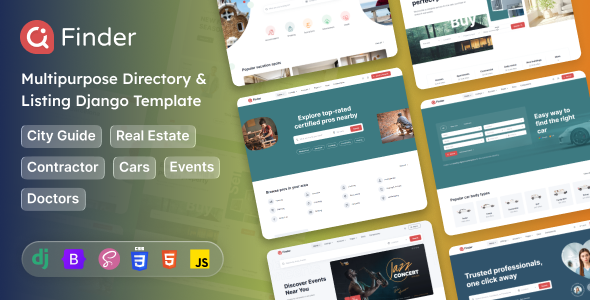
Finder is a Django and Bootstrap 5 template for building directory and listing websites, suitable for developers needing a pre-built structure for niches like real estate, car sales, or job boards. It offers multiple demos and pre-designed pages to accelerate development.
A Django Directory and Listings Template for Niche Websites
Finder is a Django template built on Bootstrap 5, designed to get you a directory or listings website up and running without starting from scratch. If you're building something like a real estate portal, a car marketplace, a job board, or a city guide, this template gives you a solid foundation.
Who This Finder Template is For and Who Should Skip It
This template is a good fit for developers or agencies who need to quickly launch a directory-style website for specific niches. If you're comfortable with Django and want to save time on the frontend structure and common listing page layouts, Finder can be a smart choice. It’s particularly useful for those who need a real estate website template with property filters or a car finder template with vehicle details.
However, if you're looking for a template that offers deep backend customization or a highly unique, bespoke frontend design that deviates significantly from standard Bootstrap patterns, this might not be the best option. It's not for developers who prefer to build every component from the ground up or those who need extensive custom JavaScript interactions beyond what Bootstrap offers.
Solving the Directory Website Build Headache
Building a directory website involves a lot of repetitive work: creating listing pages, filter systems, user account sections, and category views. Finder tackles this head-on by providing pre-built demos for several popular niches. For example, the real estate demo includes pages for property listings, agent accounts, and wishlists, saving you potentially dozens of hours of development time for these common features.
The template also addresses the need for clear navigation and filtering, crucial for any directory site. The advanced search and filter options are implemented using standard Bootstrap components, making them relatively easy to understand and adapt. This means less time spent wrestling with complex search logic and more time focusing on the unique aspects of your project.
Layouts, Pages, and Components Included
Finder comes with a variety of pre-designed pages and components across its demos. You get multiple homepage variations, detailed listing pages for properties, cars, and jobs, and user account dashboards. There are also supporting pages like About Us, Contact, and Help Center, which are standard but necessary for most websites.
The template also includes a PWA (Progressive Web App) capability, which can offer a more app-like experience on mobile devices. This is a nice addition for user retention, making it easier for visitors to access your site from their phones without needing to go through a browser every time.
eCommerce and Business-Related Features
While Finder isn't primarily an eCommerce template in the traditional sense of selling products, it does include features that support business operations. The vendor or user account sections allow for managing listings, which is a core function for many business directories. The inclusion of a blog section is also a standard practice for content marketing and engaging with users.
The structure for these business-related features is built using familiar Django patterns. This means that if you're familiar with Django's approach to user management and content organization, you should find it straightforward to integrate your own data and business logic.
Code Quality and Developer Experience
Built with Django and Bootstrap 5, the code organization follows common practices for these frameworks. This means you'll find a relatively clean structure for templates and static files, which is important for maintainability. The use of Bootstrap 5 ensures that the frontend is built with a well-established and documented CSS framework.
In our experience with similar frameworks, the CSS is generally well-organized, making it easier to override styles when needed. The template also mentions W3C validation, which is a good sign for clean HTML and semantic structure, beneficial for SEO and accessibility.
Responsiveness and Compatibility
The template is fully responsive, meaning it should adapt well to different screen sizes, from desktops to mobile phones. This is a standard expectation for modern web templates, and Finder appears to meet this requirement. It also includes support for Right-to-Left (RTL) languages, which is a valuable feature for projects targeting a global audience.
SEO Readiness
The use of Bootstrap 5 and a clean HTML structure contributes to the template's SEO readiness. A well-structured semantic layout helps search engines understand your content better. While the template itself doesn't guarantee high rankings, it provides a solid technical foundation that developers can build upon for optimization, especially for niche search terms like "directory website template with user accounts" or "real estate listing website Django."
Final Thoughts on the Finder Template
Finder is a practical template for anyone needing to build a directory or listings website quickly using Django. It provides a strong starting point for common niches, saving significant development time on repetitive tasks. If your project aligns with the included demos and you're comfortable with the underlying technologies, it's a sensible investment to accelerate your workflow and launch faster.
FAQ
Is this template suitable for a highly customized frontend design?While you can customize it, Finder is based on Bootstrap, so extensive deviations from its styling might require significant effort. It's best suited for projects that benefit from its pre-defined structure.
What is the practical benefit of the PWA feature?The PWA capability allows users to "install" your website on their devices, offering faster loading times and an app-like experience, which can improve user engagement and retention.
How easy is it to integrate custom backend logic with this template?Since it's built with Django, integrating custom backend logic is generally straightforward for developers familiar with the framework, as the template provides a standard Django project structure.
Does this template include built-in features for user roles and permissions?Yes, the template includes user account sections for different roles within its demos, such as property vendors or job seekers, which can be adapted for your specific needs.