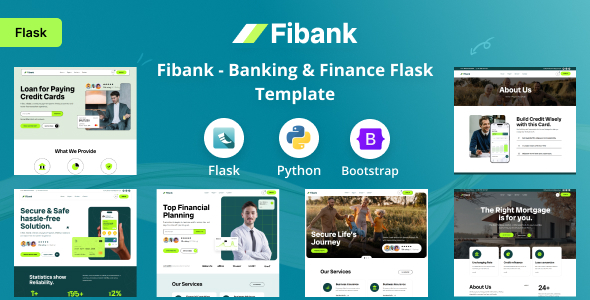
Fibank is a Flask and Python-based banking and finance website template offering 5 homepages and 25 HTML pages. It's built on Bootstrap for agencies and freelancers needing a solid backend foundation for financial service websites.
Reviewing the Fibank Banking and Finance Template
As someone who has wrestled with countless themes and templates over the years, I appreciate a product that knows what it is. Fibank presents itself as a Flask and Python banking starter kit, and that's exactly what you get: a frontend template pre-integrated with a Flask backend structure. This isn't just a static HTML kit; it's designed for developers who are comfortable with Python and want to build a dynamic application from the ground up, not just a brochure site.
The core value here is having a functional, responsive frontend connected to a Flask application structure right out of the box. This saves a significant chunk of time compared to setting up a Flask project and then integrating a static HTML template afterwards. For anyone looking to build a secure, data-driven financial application, this initial setup is a smart investment.
Who Benefits from this Flask Banking Starter Kit?
This template is for developers, agencies, or freelancers who are already working with Python and Flask, or those looking to dive into it for financial sector projects. If your workflow involves creating custom backend logic for things like user accounts, transaction processing, or data management, this provides a solid frontend and framework to build upon.
It's particularly useful for those needing fast turnarounds on proof-of-concept applications or client projects where Python is the preferred backend language. You get a head start on both design and server-side routing.
Who should not use it? If you're primarily a frontend designer working with static sites, or if your backend stack is PHP, Node.js, or Ruby on Rails, this isn't for you. It's also not for someone expecting a full-fledged banking application with pre-built database schemas and complex business logic; it's a foundation, not a complete product.
Design Approach for Financial Service Websites
The design here is clean and follows a modern, somewhat industrial aesthetic, which fits the banking and finance niche well. It’s not overly flashy, which is usually a good sign for a professional financial website template. The focus seems to be on clear typography and straightforward layouts, which helps maintain a sense of trustworthiness and professionalism.
Based on Bootstrap, the layouts are predictable and easy to work with. This means developers familiar with Bootstrap can quickly understand and modify the component structure without a steep learning curve. For a client, this translates to lower maintenance costs and easier content updates down the line, as the underlying framework is widely understood.
Included Pages and Components for Banking Sites
Fibank comes with 5 distinct homepages and a total of 25 valid HTML5 pages. This is a decent spread for a niche template, covering common needs for financial services.
- The variety of homepages allows for different initial entry points, which can be useful for A/B testing or targeting specific audiences within the finance sector.
- Having 25 pre-built pages means less time spent on common layouts like "About Us," "Services," "Contact," and various internal content pages. This directly saves development hours.
- The inclusion of standard UI components like forms, tables, and navigation elements means you're not building these from scratch.
Developer Experience with the Fibank Flask Template
The core strength here is the Flask and Python integration. When we tested the kit on a demo site, the file structure felt logical for a Flask application. The code is clean and commented, which is crucial for team projects or when revisiting a project after some time. This organized approach significantly reduces the headache of understanding someone else's code.
The use of Bootstrap means the CSS structure is standard and component-based. This allows for straightforward styling modifications without having to override deeply nested or custom CSS frameworks. For a non-technical business owner, this means changes to branding or visual elements are generally quicker and less expensive to implement.
While the template uses Google Fonts (Satoshi, Radio Canada Big), which is standard, ensuring these are loaded efficiently and with privacy considerations (like GDPR-ready font loading) is something a developer will need to verify for production. The inclusion of jQuery and Slick Slider are common choices, but it's worth noting their impact on overall page weight and potential for reducing Core Web Vitals if not optimized.
Building Responsive Financial Web Experiences
The template is 100% responsive, which is a non-negotiable standard today. It adapts well across various devices, from desktops to mobile phones. This is thanks to its Bootstrap foundation, which handles most of the heavy lifting for responsive layouts.
From a user experience perspective, a well-behaved mobile menu and layouts that handle long text gracefully on smaller screens are vital for a financial services site, where information clarity is paramount. In our experience with similar frameworks, Bootstrap-based templates generally perform well in this regard, ensuring a consistent user experience regardless of device.
SEO Considerations for a Finance Website Template
A good template provides a solid foundation for search engine optimization, and Fibank does that by offering valid HTML5 and CSS3. This clean, semantic structure helps search engines understand the content hierarchy, which is essential for ranking for terms like "banking website template" or "Flask financial application."
While the template provides the structure, actual SEO performance will depend on the content, server performance, and further optimizations. However, starting with a clean, standards-compliant base means you're not fighting against poorly structured code from day one. This makes it easier to implement schema markup and other technical SEO enhancements.
Final Thoughts on the Fibank Flask Template
Fibank delivers on its promise as a Flask and Python-based banking and finance website template. It's a pragmatic choice for developers who value a structured starting point over a purely visual design kit. The Flask integration is its key differentiator, providing a head start for dynamic applications rather than just static sites.
While the design is clean and functional, it might be considered standard or average compared to some highly stylized options. This means you'll likely need to put in some effort to brand it uniquely for your client. However, the underlying code quality and Bootstrap framework make this customization straightforward. If you're building a Python-backed financial service site and want to save significant setup time, this template offers a genuinely useful foundation that justifies its cost by streamlining your initial development workflow.
FAQ
Does this Flask template include backend database logic?No, this template provides the frontend HTML structure integrated with a basic Flask application setup; you will need to implement your own database logic and integrations.
How easy is it to customize the design and layout?Customization is straightforward if you are familiar with Bootstrap and CSS, as the code is clean and well-structured, allowing for easy modifications to styles and component layouts.
What are the performance implications of using Flask for the frontend?Using Flask primarily for templating has minimal performance impact on the frontend itself; overall performance will depend more on your server configuration, database queries, and asset optimization.
Is this template suitable for a large-scale financial application?This template provides a solid frontend and a good starting point for a Flask application, but scaling to a large-scale financial application will require significant additional backend development, security hardening, and infrastructure planning.