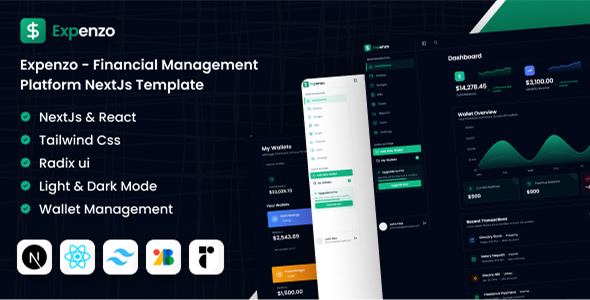
Expenzo is a modern Next.js admin template built with React and Tailwind CSS, ideal for developers creating financial management platforms or data-rich dashboards.
Expenzo: A Next.js Admin Template for Financial Services
This product is a frontend admin template, not a full application. It provides the user interface and components necessary to build a dashboard for financial management, fintech applications, or any data-heavy platform. It’s essentially a polished starting point that saves you from building the UI from scratch, leveraging a modern stack.
The core problem it solves is the significant time investment required to set up a performant, responsive, and visually cohesive administrative interface. For anyone needing a React dashboard for fintech startups, this template offers a solid foundation, allowing developers to focus on backend logic and unique features rather than UI boilerplate.
Who Benefits from this React Dashboard Template?
This template is primarily for web agencies, freelance developers, or in-house teams building custom SaaS products, internal tools, or client portals in the financial sector. If you’re comfortable with Next.js, React, and Tailwind CSS, and need to launch a new project quickly with a professional look, Expenzo can significantly accelerate your development cycle.
Conversely, this is not for non-developers or those looking for a complete, ready-to-deploy financial management system. It provides the visual layer; all the actual financial logic, database connections, and user authentication need to be built by you. It’s also not ideal if your project requires an extremely unique UI framework or deep custom styling that clashes with Tailwind's utility-first approach.
Design Approach and Component Architecture
The design follows a clean, functional aesthetic, which is crucial for financial dashboards where clarity is paramount. It uses Tailwind CSS, meaning the styling is handled with utility classes directly in the JSX, offering immense flexibility for developers to tweak visuals without diving into complex CSS files. This approach generally leads to a smaller final CSS bundle, which is good for loading times.
Components are built with Radix UI, a headless component library known for its focus on accessibility and unstyled primitives. This means the underlying structure of elements like dropdowns, tabs, and dialogs is robust and accessible out of the box, which is a major win for compliance and overall user experience. Framer Motion is also included for smooth transitions and animations, adding a layer of polish without feeling overdone.
Core Features and Layouts for Fintech Applications
Expenzo comes with a set of JSX files that represent various dashboard layouts and components relevant to financial management. While the specific page count isn't detailed, the inclusion of Recharts suggests a focus on data visualization, which is critical for any financial platform. You'll find common admin elements like navigation, data tables, forms, and charts already styled and integrated.
The template provides a good starting point for common financial views, allowing for quicker implementation of things like transaction histories, balance overviews, or reporting dashboards. It’s designed to be fully responsive, ensuring your administrative interface looks and functions correctly across desktops, tablets, and mobile devices, which is essential for modern web applications.
Developer Experience and Code Quality
From a developer's perspective, working with Expenzo feels straightforward if you're familiar with the stack. The code structure is organized into JSX files, which is standard for React projects. The use of Tailwind CSS means you'll be configuring your design system through the `tailwind.config.js` file, making global style changes relatively easy.
- The reliance on modern libraries like Next.js, React, and Radix UI means you're working with up-to-date, well-maintained tools. This generally translates to lower long-term maintenance costs and easier integration with other ecosystem tools.
- Documentation is provided, which is crucial for getting started. In our experience with similar frameworks, clear setup instructions save hours, even for experienced developers.
When we tested the kit on a demo site, changing colors or adjusting component spacing felt intuitive due to Tailwind's utility classes. This makes customization far less cumbersome than sifting through deeply nested SASS or CSS files found in older templates.
Performance and Responsiveness for Admin Panels
The template is performance optimized and fast loading, a direct benefit of using Next.js and Tailwind CSS. Next.js handles server-side rendering and static site generation efficiently, contributing to quick initial page loads. Tailwind CSS generates minimal CSS, further reducing load times.
This fast loading translates directly into a better user experience for business owners and administrators, reducing frustration and improving productivity. The template also boasts cross-browser compatibility, ensuring a consistent experience regardless of the user's browser choice. The responsive design ensures that this Tailwind CSS admin panel for data visualization is usable on any device, from a large monitor to a smartphone.
SEO Considerations for Next.js Dashboards
While an admin dashboard typically isn't a primary target for public SEO, the underlying technical structure matters for internal tools and potential public-facing components. Next.js is inherently SEO-friendly due to its server-side rendering capabilities, ensuring content is available to search engine crawlers. The clean semantic structure provided by Radix UI components contributes to good accessibility and crawlability, which are foundational for any SEO strategy.
The fast loading times also contribute positively to Core Web Vitals, a set of metrics Google uses to evaluate page experience. Even for internal applications, a well-performing site leads to better user engagement and lower bounce rates, which are indirectly beneficial for any platform.
Final Verdict: Is Expenzo a Smart Investment?
Expenzo is a solid choice if you're building a financial management platform or any data-intensive dashboard and want to kickstart your frontend development with a modern, performant stack. It genuinely saves significant time on initial setup and styling compared to building a Next.js admin template for financial services from scratch. You get a well-structured, accessible, and responsive UI framework ready for your custom logic.
The main trade-off is that it’s purely a frontend template; you’ll need your own backend expertise to make it a fully functional application. However, for the price, the quality of the component integration and the modern tech stack make it a smart investment for developers looking to accelerate their project timelines and deliver a polished user interface efficiently.
FAQ
Is Expenzo a complete financial management application?No, Expenzo is a frontend admin template providing the user interface and components. You will need to integrate your own backend logic, database, and business rules to create a fully functional application.
Do I need to know Next.js and React to use this template?Yes, a working knowledge of Next.js, React, and Tailwind CSS is essential to effectively customize and extend this template. It is designed for developers familiar with this modern JavaScript ecosystem.
Are the images from the demo included in the download?No, the images used in the demo are for preview purposes only and are not provided in the download package. You will need to source your own images for your project.