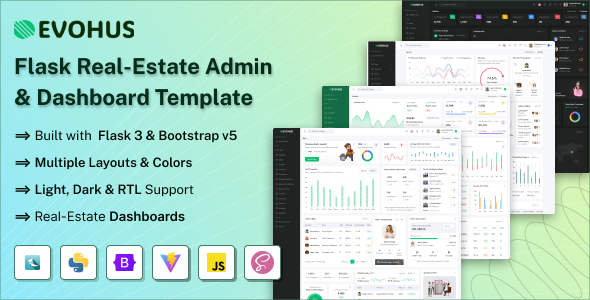
Evohus is a Flask admin dashboard template designed for real estate professionals and property management platforms, offering a robust set of features for managing listings and client data. This template is ideal for developers and agencies needing a fast, well-organized foundation for a real estate focused application. Evohus Flask Admin Template: A Developer's Take When we look at admin templates, especially for niche applications like real estate, the primary concerns are usually speed, organization, and how much time it saves on repetitive styling tasks. Evohus, built with Flask, Python, and Bootstrap, aims to hit those marks. It provides a pre-built structure for property listing pages, agent profiles, and analytics views, which can significantly cut down the initial setup time for a real estate website template. The template's use of Vite for its build process is a practical advantage. Vite generally offers much faster development server start times and hot module replacement compared to older build tools. This translates to quicker iterations when we’re making changes, a tangible benefit for daily workflow. The SCSS architecture is also well-organized, making it straightforward to adjust global styles, colors, and typography without digging through dozens of individual CSS files. This is crucial for maintaining brand consistency across a real estate management system. Streamlining Real Estate Data Management The core value proposition for Evohus lies in its specialized pages for real estate. We found the property listing pages, complete with filter and search functionalities, to be a good starting point. They handle common data points like price, location, and property type efficiently. For those building a complex real estate website template or a custom CRM for agents, having these pages ready to go saves considerable effort. The template also includes several dashboard variations, offering different perspectives on property inventory, sales figures, and agent performance, which is useful for data visualization in a real estate context. The inclusion of various UI components and widgets is standard for an admin template, but Evohus organizes them logically. We appreciate that the components are built using pure JavaScript, avoiding unnecessary dependencies that can sometimes bloat a project and impact performance. This focus on clean code is important for long-term maintenance and for ensuring the application remains responsive, especially on mobile devices where many users will access property listings. The template adheres to standard accessibility practices, which is a baseline expectation for any professional application. Who Should and Shouldn't Use Evohus Evohus is a strong contender for agencies and freelancers who are building custom real estate management platforms or dashboards for clients in the property sector. If you need a solid foundation for an HVAC service layout or a general business dashboard, you might find it overkill, but for anything property-related, it’s a good fit. It’s particularly useful if you’re looking to quickly develop a functional prototype or a minimum viable product for a real estate application. However, this template is not ideal for developers who require deep backend customization or need to integrate with highly specific, non-standard third-party services without significant refactoring. While the front-end is well-structured, the template itself doesn't dictate backend logic, so you’ll still need to build that out yourself using Flask. If your project involves complex custom logic beyond property management and standard analytics, you might find yourself stripping out more than you keep. Developer Experience and Code Organization From a developer’s perspective, the file structure is clean and follows common conventions for Flask applications. The use of Vite means that asset management is generally straightforward, and the build process is fast. We found the SCSS variables for theming to be well-documented and easy to override, which is a significant plus for customization. The code for the components is generally readable, and the template provides a good starting point for understanding how to structure data-heavy interfaces. One area that feels standard, rather than exceptional, is the default styling. While clean, it doesn’t push many boundaries. This is often the case with admin templates; they provide a solid base, but achieving a truly unique visual identity will require custom styling on top of the provided components. This is a trade-off for the speed and convenience the template offers, and it’s a common expectation when choosing an admin template for a real estate website template. Final Thoughts on Evohus for Real Estate Applications Evohus offers a practical and efficient starting point for anyone developing a real estate administration dashboard or management system. Its specialized pages and clean code organization save valuable development time, allowing teams to focus on core functionality rather than reinventing the wheel for common real estate website template needs. The performance benefits from Vite and the ease of customization through SCSS make it a sensible investment for projects in this niche. FAQ Is Evohus suitable for building a public-facing real estate listing website?
Evohus is primarily an admin dashboard template. While you could adapt its components, it's not designed out-of-the-box as a public-facing website template and would require significant modification.
How easy is it to integrate custom backend logic with Evohus?The template provides a clean front-end structure. Integrating custom backend logic with Flask is standard, but the template itself doesn't offer specific hooks or abstractions for complex integrations.
What is the learning curve for customizing the SCSS and layouts?If you have basic familiarity with SCSS and Bootstrap, the learning curve for customizing Evohus is relatively low. The variables are well-defined, making theme adjustments straightforward.
Does Evohus include features for handling sensitive client data securely?Evohus provides authentication pages, but it does not include specific built-in features for data encryption or advanced security protocols; these would need to be implemented in your backend logic.