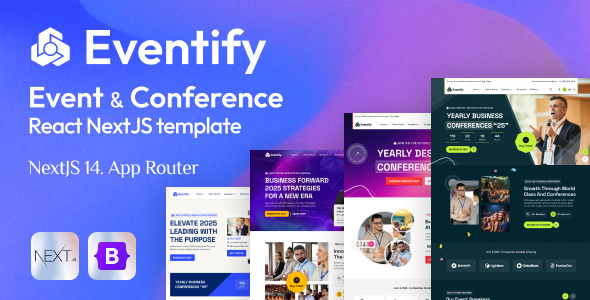
Eventify is a Next.js and Bootstrap template for event and conference websites. It offers 10 homepages, various inner pages, and a Figma file, ideal for agencies and developers building event platforms quickly.
Eventify: A Next.js Front-End for Conference Websites
This template is a front-end UI kit built with Next.js, React, and Bootstrap. It gives you a solid starting point for event and conference websites, handling the typical sections like schedules, speaker profiles, and ticket information. Think of it as a pre-built set of polished pages and components, not a full-stack application with a backend.
After building multiple agency sites with tools like this, I see Eventify as a clear time-saver for the visual and structural setup of an event site. It solves the initial headache of designing and coding common event-specific layouts from scratch, letting developers focus on integrating any necessary backend logic.
Who Should Use This Next.js Event Template
Eventify is primarily for web agencies and freelance developers who need to quickly deploy a front-end for a client's event or conference. If you are comfortable with Next.js, React, and TypeScript, and you need a polished, ready-to-go user interface, this template is a good fit. It significantly reduces the initial development time for creating a visually appealing event website.
This template is not for non-technical users looking for a drag-and-drop website builder. It also isn't for those who expect a complete, integrated backend for ticket sales, attendee management, or payment processing. You will need to bring your own backend solutions and integrate them with this front-end.
Layouts and Components for Event Planning
The template comes with 10 distinct homepages, which is a decent variety for different event types. Beyond that, it includes essential inner pages like About, Speakers, Speaker Details, Event Schedule, Event Details, Blog, Blog Details, Memories, Pricing Plan, and FAQ sections. This covers most of what a standard event or conference website needs.
Having a dedicated event schedule layout and speaker profile pages is crucial for this niche. Eventify provides a clean structure for these, which in our experience saves considerable time compared to adapting a general-purpose template. The inclusion of a Figma design file is also a practical bonus, allowing designers to start customizing visuals without waiting for code implementation.
Code Quality and Developer Experience
Eventify is built with Next.js using the `app` directory, TypeScript, and React. This is a modern stack that offers good performance characteristics out of the box. The use of Bootstrap means a familiar and well-documented CSS framework for styling, which makes customization relatively straightforward if you know Bootstrap.
The W3C validated code suggests a focus on web standards, which is good for search engine indexing and general browser compatibility. While the description mentions easy color and font changes, in practice, this usually means leveraging Bootstrap's theming capabilities, which is a standard but effective approach. For a business owner, this means lower maintenance costs and better long-term compatibility.
Responsiveness and Compatibility for All Devices
The template is designed with a mobile-first approach and claims full responsiveness across various devices. This is a baseline expectation for any modern web project, but it is good to confirm it has been thoroughly tested. A well-implemented responsive design means a consistent user experience for attendees, whether they are browsing on a phone, tablet, or desktop. This directly impacts engagement and conversion rates for event registrations.
Cross-browser compatibility is also listed, ensuring the site looks and functions correctly across major browsers. This reduces the risk of users encountering broken layouts or functionality, which can be frustrating for potential attendees and reflect poorly on the event organizer.
SEO Readiness for Event Promotion
With its Next.js foundation, Eventify provides a good base for technical SEO. Server-side rendering or static site generation (depending on your Next.js configuration) can lead to faster initial page loads and better indexability by search engines compared to purely client-side rendered applications. The clean semantic structure, particularly for event-specific content like schedules and speaker bios, helps search engines understand the content better.
While the template itself doesn't guarantee top rankings, its technical underpinnings support good search engine optimization practices. This means better visibility for your event website in search results, helping potential attendees find your conference more easily.
Final Thoughts on Eventify
Eventify offers a solid, modern front-end solution for anyone building event or conference websites with Next.js. It's not a revolutionary product, but it does what it sets out to do well: provide a well-structured, responsive UI kit that saves significant development time on the front-end. The inclusion of the Figma file is a smart move for agencies managing design workflows.
The main limitation is that it's just a front-end. You'll need to factor in the development time and cost for integrating any custom backend logic for things like advanced booking systems, user accounts, or payment gateways. However, for getting a polished event user interface up and running quickly, especially if you're already in the Next.js ecosystem, Eventify is a practical and smart investment. It effectively solves the initial design and coding hurdle for event platforms.
FAQ
Is Eventify a full website solution with a backend?No, Eventify is a front-end template built with Next.js, React, and Bootstrap. It provides the user interface and structure, but you will need to implement your own backend for features like ticket booking, user accounts, or payment processing.
How easy is it to customize the design and colors?Since it is built with Bootstrap, changing colors and fonts is relatively straightforward by modifying Bootstrap variables or custom CSS. Developers familiar with React components and styling will find it manageable to adapt the design to specific brand guidelines.
Can I integrate a payment gateway for ticket sales?Yes, you can integrate a payment gateway, but you will need to develop the backend logic for processing payments and managing ticket sales yourself. Eventify provides the front-end UI for displaying ticket options, but not the transactional backend.
Does this template support multiple languages for international events?The template does not include built-in internationalization (i18n) functionality out of the box. You would need to integrate a library like `next-i18n` or similar to handle multiple languages for your event content.