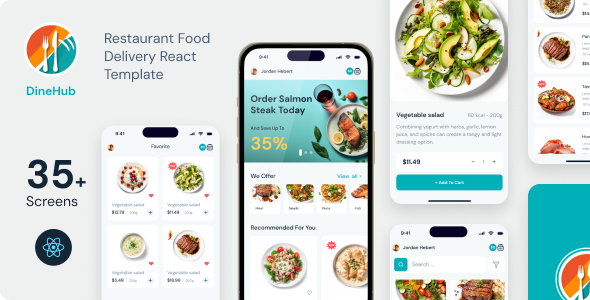
DineHub is a PWA for restaurant food delivery, built with React and a Laravel backend. It's a solid starting point for agencies and developers building custom food ordering systems.
DineHub: A Foundation for Custom Food Delivery Platforms
As web developers, we often see templates that promise the moon but deliver a basic frontend. DineHub stands out because it's a full-stack solution, offering both a React-based Progressive Web Application (PWA) frontend and a Laravel backend. This isn't just a pretty UI; it's a functional core for anyone looking to develop a custom food ordering platform development without starting from absolute zero.
The package provides a ready-to-go structure for managing menus, orders, and user interactions, which is a significant time-saver compared to building these systems from scratch. For a business owner, this means getting a sophisticated system online faster, translating to quicker market entry and revenue generation.
Who Benefits from this React Food Delivery App Template?
This `react food delivery app template` is ideal for development agencies and freelance developers who need to deliver custom restaurant or food delivery applications efficiently. If your client requires a modern, app-like experience without the overhead of native app store submissions, a PWA is a smart choice, and DineHub provides that foundation.
It's also well-suited for businesses that have in-house developers comfortable with React, TypeScript, and Laravel, aiming to build a proprietary food ordering system. The included Laravel backend with Orchid is a robust administrative panel, making it easier to manage the operational side of a restaurant or delivery service.
However, this is not for the non-technical small restaurant owner looking for a plug-and-play solution. You will need development expertise to set it up, customize it, and integrate it with payment gateways or other third-party services. It's also not for those who need a simple brochure site; this is a transactional application.
Design and Frontend Architecture for Food Ordering
The frontend is built with React and TypeScript, utilizing functional components and hooks. This means the code is modern, generally easier to read, and more maintainable for developers familiar with current React practices. All icons are in SVG format, which ensures they look sharp on any screen size and can be easily styled with CSS, providing a consistent and professional brand image for the end-user.
The use of Redux for state management is a standard practice in larger React applications, helping to keep complex data flows organized. From a practical standpoint, this architecture means the application should be responsive and perform well, contributing to a good user experience and potentially higher conversion rates for restaurant customers.
The Laravel PWA Restaurant System Backend
One of DineHub's strongest points is the inclusion of a Laravel backend, paired with Orchid. This is crucial for a `laravel pwa restaurant system` because it handles all the heavy lifting of data management. Orchid provides a ready-made, extendable administrative interface where restaurant owners or managers can manage menus, track orders, handle user accounts, and potentially manage delivery logistics.
This integrated backend saves hundreds of hours compared to building an API and admin panel from scratch. For a business, this means lower development costs and a faster path to having a fully operational system, capable of handling the complex logic of food ordering and delivery.
Code Quality and Developer Experience
The product emphasizes functional React components, TypeScript, and well-structured code, which are all indicators of a developer-friendly codebase. When we've worked with similar frameworks, this approach typically leads to fewer bugs and makes future updates or feature additions much smoother. The inclusion of documentation, while brief in the listing, is essential for any developer diving into a new codebase.
The use of a preloader is a small but important detail that improves perceived performance, giving users immediate feedback while content loads. This attention to detail contributes to a more polished user experience, which is critical for customer retention in the competitive food delivery market.
SEO Readiness and Performance Potential
As a Progressive Web Application, DineHub inherently offers advantages for SEO and user engagement. PWAs are designed for lightning-fast performance, which directly impacts Core Web Vitals—a key ranking factor for Google. Their ability to work offline and offer home screen installation also boosts user retention and re-engagement through push notifications, all contributing to a stronger online presence.
While the template itself provides a clean technical foundation, ensuring optimal content SEO and schema markup for menus and locations would be the developer's responsibility. The underlying structure supports these best practices, making it easier to implement robust SEO strategies for a food delivery business.
Final Thoughts on DineHub for Food Delivery Development
DineHub is a genuinely useful starting point for developers and agencies tackling custom food delivery application development. It solves the significant workflow problem of building both a modern frontend PWA and a robust backend from scratch, saving considerable time and resources. The combination of React, TypeScript, Redux, and Laravel with Orchid offers a modern, maintainable, and scalable foundation.
While the default UI might require substantial branding and design customization to truly stand out, the underlying technical architecture is solid. The biggest trade-off is that it demands strong developer expertise, so it's not a solution for those without a technical team. However, for anyone building a serious food delivery platform, this package provides a head start that justifies the investment by significantly reducing initial development overhead.
FAQ
Does DineHub support multiple restaurants or vendors?The included Laravel backend with Orchid provides an administrative panel that can be extended to manage multiple entities, but out of the box, you would need to implement the specific logic for multi-vendor support.
How difficult is it to customize the user interface and branding?Since the frontend is built with React and uses well-structured components, a developer familiar with React and CSS will find it relatively straightforward to customize the look and feel to match specific branding requirements.
Can I integrate custom payment gateways with DineHub?Yes, the Laravel backend provides the ideal environment for integrating various payment gateways. You would need to write the specific integration code for your chosen payment provider, but the framework supports such extensions.
What kind of hosting is required for DineHub?You will need a hosting environment that supports both a Node.js application for the React frontend (or static file hosting after build) and a PHP/Laravel application for the backend, typically a VPS or cloud hosting solution.