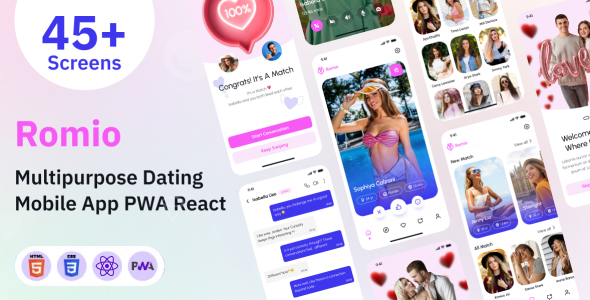
Romio: A React PWA template for mobile dating and social apps. This is for developers needing to quickly build a functional MVP for social connection platforms.
Romio: A React PWA Template for Building Social and Dating Apps Quickly
This product is essentially a pre-built user interface kit for mobile-first social and dating applications. It's built using React and designed as a Progressive Web App (PWA), meaning it can be installed on a user's device without going through an app store. Think of it as a significant head start for anyone looking to develop a Tinder-like app, a friend-finding platform, or a niche community app. It provides a substantial library of pre-designed screens and components, aiming to cut down the initial development time significantly.
Who Should Consider Romio and Who Should Look Elsewhere
This template is a solid choice for agencies or freelancers who need to deliver a functional dating or social app prototype or Minimum Viable Product (MVP) very quickly for a client. If your client has a clear vision for a social app and wants to get it into users' hands fast without the complexities of native app development, Romio makes a lot of sense. It's also beneficial for startups bootstrapping their initial product and needing to validate their concept with minimal upfront investment in UI development. If you're building a simple friend-finding app or a local dating service, this kit will get you there.
However, if you're aiming for deep, custom backend logic, complex user management systems beyond standard profiles, or a highly unique, non-standard user experience, this template might not be the best fit. Developers who prefer building every UI element from scratch or those working on projects that don't align with typical dating or social app workflows should probably look elsewhere. It's also not for those who need a full backend solution out of the box; this is purely a frontend UI kit.
Solving the Speed-to-Market Problem for Social Apps
The primary problem Romio solves is the sheer amount of time and effort required to build a polished, mobile-first social or dating app interface from scratch. Developing screens for profile discovery, user profiles, chat, notifications, and settings is repetitive work. By providing over 45 pre-designed and coded screens, Romio effectively eliminates this foundational development. This means you can focus on integrating your specific business logic, connecting to your backend, and refining the user flow rather than reinventing common UI patterns. For those needing to build a dating app template, this offers a good starting point.
Design and Visual Approach
The design of Romio leans towards a clean and engaging user interface, which is crucial for social applications where user experience and visual appeal drive engagement. It utilizes standard Google Fonts, which is a practical choice for ensuring good readability and a professional look without introducing unusual dependencies. The layouts are organized in a way that makes sense for mobile interactions, like swiping for discovery and clear navigation for profiles and chats. It’s a contemporary look, not groundbreaking, but certainly fits the bill for a modern social app.
Layouts, Pages, and Components Included
Romio comes packed with over 45 well-designed app screen layouts. This covers the essential user journeys for a dating or social app:
- Discovery and matching screens (think swiping interfaces).
- Detailed user profile views.
- Real-time chat interfaces.
- Notification screens.
- Settings and account management pages.
This comprehensive set of pre-built components means you're unlikely to need to design many of the core screens yourself. The structure is component-based, which is standard for React development, making it easier to reuse and modify elements.
eCommerce or Business-Related Features
While Romio is not an eCommerce template, its design and structure are well-suited for applications that might eventually incorporate premium features or subscription models. The focus is on user interaction and profile management, which are foundational for many subscription-based social platforms. The React architecture allows for straightforward integration with payment gateways or backend services that handle monetization if you plan to add such features later.
Code Quality and Developer Experience
Built with React, Romio benefits from a component-based architecture, which generally leads to more organized and maintainable code. The description mentions it's fully layered and customizable, implying that the code is structured logically and assets are well-organized. This is important for developers as it means less time spent deciphering complex code or hunting for specific styles. For a developer, this translates to a smoother experience when making modifications, adding new features, or troubleshooting issues. The inclusion of a HELP file is a standard but appreciated addition for templates.
Responsiveness and Compatibility
The template is designed to be fully responsive, meaning it adapts to various screen sizes, from small mobile phones to larger tablets. This is non-negotiable for any mobile app template today, and Romio delivers on this front. Being a PWA also means it functions well across modern web browsers. The practical benefit for a business owner is that their app will look good and work correctly for a wider range of users without needing separate development for iOS and Android apps.
SEO Readiness
As a PWA, the SEO considerations are different from a traditional website. However, the underlying React structure, if implemented correctly with server-side rendering or appropriate meta tag management, can be indexed by search engines. The template's focus is on the app experience, not necessarily on ranking for organic search terms in the traditional sense, but a clean semantic structure for the HTML it generates is a good baseline for any web-based application.
Getting a Social App Off the Ground
If your goal is to launch a mobile social or dating app quickly and efficiently, Romio offers a substantial head start. It provides a well-designed foundation of common UI elements, saving you weeks of development time. For developers needing to build a functional MVP for a dating app or social platform, this is a practical investment that allows you to focus on what makes your app unique rather than the basic building blocks of the interface. It's a sensible choice for getting a project moving without getting bogged down in repetitive UI coding.
FAQ
What kind of backend can I connect Romio to?Romio is a frontend UI kit, so you can connect it to virtually any modern backend technology or API that can serve data to a React application.
Is this template suitable for building a dating app for a specific niche, like professional networking?Yes, the template's flexible design and component structure make it adaptable for niche dating or social networking concepts. You would customize the profile fields and discovery logic to fit your specific niche.
How does the PWA functionality affect app store presence?PWAs can be "installed" directly from the browser onto a user's home screen, bypassing traditional app stores. This means no app store review process or fees, but also means it won't be discoverable in app store searches.
Will I need to be a React expert to use this template?While a solid understanding of React is beneficial for customization and integration, the template is designed to be manageable. The included documentation should help guide developers through the setup and modification process.