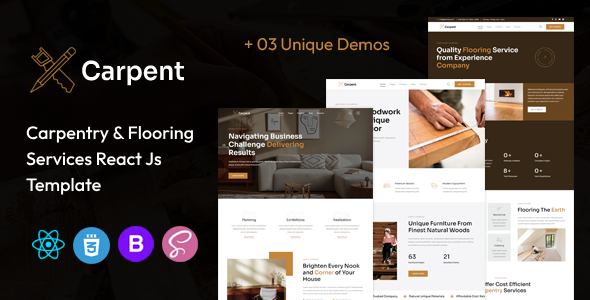
Carpent is a React.js template for carpentry, woodworking, and flooring service websites, offering three homepages and a clean structure for agencies and freelancers building niche-specific sites.
Carpent: A React Template for Niche Service Websites
After building multiple agency sites with tools like this, Carpent stands out as a straightforward React template aimed squarely at the carpentry, woodworking, and flooring services niche. It’s essentially a pre-built frontend, ready to be populated with content and connected to your chosen backend or served statically. This approach solves the initial design and development hurdle for specific service industries, offering a solid starting point without the bloat often found in larger, multi-purpose themes.
Who Benefits from This Woodworking Website Template?
This template is for agencies and freelance developers who need to deliver a modern, performant website for a client in the woodworking or related service industry without starting from scratch. If you're looking for a dedicated React template for carpentry services, this gives you a significant head start on the frontend. It's particularly useful if your workflow already involves React and you prefer a component-based structure over a traditional CMS theme.
However, this is not for someone without React or general frontend development experience. It's a code template, not a drag-and-drop builder. If your client expects to edit content directly without developer intervention or a headless CMS setup, this might not be the most direct path without further integration work.
Design and Visual Approach for Service Providers
Carpent’s design is clean and minimal, which is a breath of fresh air compared to many over-designed templates in this niche. It focuses on clear typography and a sensible layout, which helps in showcasing services and project portfolios effectively. The "pixel perfect" claim holds up, and the overall aesthetic is professional without being overly flashy. This approach ensures content remains the focus, which is crucial for service businesses trying to convey trust and expertise.
Layouts and Core Components for Carpentry Websites
The template includes three distinct homepages, which provide enough variety to suit different brand aesthetics within the carpentry and woodworking sectors. Beyond the homepages, you get a standard set of internal pages necessary for a service business, like about us, services, projects, and contact sections. This means you’re not just getting a landing page; you’re getting the foundational structure for a complete site.
- Three Modern Homepages: Offers variety for different client needs.
- Standard Internal Pages: Covers typical service business requirements.
Code Quality and Developer Experience with Carpent
This template is built on React, leveraging Bootstrap for its foundational CSS and JavaScript components, and uses Sass for a more organized stylesheet architecture. In our experience with similar frameworks, this combination provides a familiar and robust environment for most frontend developers. The use of React means a component-based structure, which makes it easier to manage and update individual sections of the site. For a business owner, this translates to lower maintenance costs in the long run, as changes are more isolated and less likely to break other parts of the site.
The code is well-commented, which is always a plus, making it easier for new developers to jump in and understand the structure without excessive guesswork. The comprehensive documentation also helps streamline the setup and customization process. This is a step above many market-average templates that often skimp on clear code organization or helpful comments.
Responsiveness and Cross-Browser Compatibility
The template is fully responsive, meaning it adapts well across various devices, from desktops to mobile phones. This is a standard expectation today, but it’s executed well here. The mobile menu behaves predictably, and content scales appropriately without awkward breaks or overflows, even with longer service descriptions. This ensures a consistent user experience for potential clients, regardless of how they access the site, which is vital for lead generation.
SEO Readiness for Service Businesses
Carpent is built with valid HTML5 and is described as "SEO Optimized." While a frontend template alone doesn't guarantee top rankings, a clean semantic structure is a strong foundation. The use of Google Fonts and a lean codebase generally contributes positively to page load times, which are a factor in Core Web Vitals. The component-based nature of React also allows for efficient content rendering, which is beneficial for search engines when properly implemented. This helps ensure the site is easily discoverable by potential clients searching for local carpentry or flooring services.
Final Verdict: A Practical Choice for Niche React Projects
Carpent is a solid, practical choice if you need to quickly deploy a modern, clean website for a carpentry or woodworking business using React. It saves significant time on initial setup and design, letting you focus on content and specific client integrations. The trade-off, as with any React template, is that it requires developer expertise for customization and content management beyond static updates. While it doesn't reinvent the wheel, its focus on clean code and a specific niche makes it genuinely useful. We'd recommend it for agencies or freelancers who want to deliver a performant, specialized site efficiently.
FAQ
Is this a WordPress theme or an Elementor template?No, Carpent is a standalone React.js template. It's built with JavaScript and is not designed to integrate directly with WordPress or Elementor without significant custom development.
Can I easily connect this template to a content management system (CMS)?Yes, you can connect it to a headless CMS like Strapi, Contentful, or Sanity.io. However, this requires custom development to integrate the API calls and display dynamic content.
What are the typical hosting requirements for a React template like Carpent?React templates are typically deployed as static sites, so they can be hosted on platforms like Netlify, Vercel, or even a simple web server like Apache or Nginx. Some setups might use a Node.js server for server-side rendering, but static hosting is common.
How difficult is it to customize the visual design of this template?Customizing the design requires knowledge of React, HTML, CSS (specifically Sass), and Bootstrap. While the code is well-commented, it's a developer-level task, not a point-and-click customization.