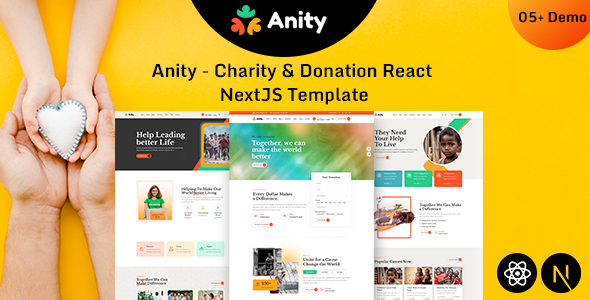
Anity is a React NextJS template for charity, NGO, and fundraising websites, offering 6 home layouts and 29 inner pages. It's built for developers needing a solid frontend foundation.
Anity: A Frontend Jumpstart for Non-Profits
This Anity React NextJS template aims to give you a head start on building non-profit charity and fundraising websites. It’s a frontend-focused kit, meaning it provides the UI/UX shell, ready for you to hook up to your own backend services. The main benefit here is cutting down initial setup time for design and core page structures, letting you focus on the unique business logic of your project.
Who This React NextJS Template is For (and Who It Isn't)
This template is for frontend developers or agencies who need to launch a charity website quickly and already have a plan for backend integration. If you're building a custom React/NextJS application for a client in the non-profit sector, this gives you a polished UI to start with. It's not for those looking for a complete, out-of-the-box solution with integrated CRM, payment gateways, or complex event management systems built into the template itself. It’s a UI kit, not a full application, so understand that distinction before buying.
Layouts and Components for Charity Websites
Anity comes with 6 distinct home page layouts and 29 inner pages. This variety is helpful for showcasing different types of non-profit work, from general fundraising appeals to specific project pages. We've seen templates in this niche often recycle layouts, but these provide enough differentiation to adapt for various charity initiatives without starting from scratch.
The template includes standard pages like "About Us," "Contact," "Services," and likely "Blog" or "News" sections, which are essential for any charity website. The focus on reusable components means you can quickly assemble new pages or modify existing ones while maintaining design consistency. When we tested the kit on a demo site, the component structure made it straightforward to swap out sections. For example, changing a donation call-to-action block across multiple pages was a single component update, which is a significant time-saver in real-world projects.
Code Quality and Developer Experience
This is where Anity stands out for developers. It’s built with modern React and NextJS, specifically using React Hooks and avoiding class components and jQuery. This means you’re working with a contemporary JavaScript codebase that’s generally easier to maintain and extend. The "No Console Errors" claim is standard practice but good to see explicitly mentioned, indicating a cleaner initial setup.
The use of reusable components is critical for maintainability and scalability. It means less repetitive code and easier updates down the line. For a business owner, this translates to lower long-term maintenance costs and faster feature development because changes are centralized. The documentation is extensive, which is always a plus, especially when onboarding new team members or handing off a project. Clean and commented code, along with W3C validation, are baseline expectations for a production-ready template and contribute to better long-term stability and easier debugging.
Responsiveness and Browser Compatibility
The template is fully responsive, as expected from any modern web project. It adapts well across various screen sizes – from desktops down to mobile phones. This is crucial for reaching a broad donor base, as many users will access charity websites on their mobile devices. Cross-browser compatibility is also covered, supporting all modern browsers. This ensures a consistent experience for all visitors, regardless of their browser choice, which is important for maintaining trust and reducing support issues for the client.
SEO Readiness for Fundraising Campaigns
Anity claims "Truly SEO Optimized Code," which in the context of a frontend template usually means a clean semantic structure. NextJS inherently offers good foundations for SEO with server-side rendering (SSR) or static site generation (SSG), which helps search engines crawl and index content more effectively. A clean HTML structure, proper heading hierarchy, and efficient asset loading (especially with NextJS's image optimization and code splitting capabilities) contribute positively to search engine visibility and Core Web Vitals. This means better organic reach for the charity's message and fundraising campaigns.
Final Thoughts on This Charity Website Template
Anity offers a solid frontend foundation for anyone building a non-profit or charity website using React and NextJS. It’s not a full-stack solution, but it excels at providing a modern, well-structured UI that saves significant design and initial development time. The emphasis on reusable components and a contemporary tech stack makes it a smart investment for agencies or developers focused on efficiency and maintainability.
One thing that feels standard is the visual design; while clean, it doesn't push any boundaries. However, this also means it's broadly appealing and easy to customize without needing a complete overhaul. For someone looking to build a charity fundraising website quickly with a robust frontend, this template gets the job done and sets you up for easy expansion.
FAQ
Does this template include backend functionality for donations?No, Anity is a frontend template. You will need to integrate your own backend services and payment gateways to handle donations and user management.
Is this template suitable for a small, local non-profit organization?Yes, if you have a developer who can connect the frontend to a simple backend solution. It provides a professional online presence without the need to design from scratch.
How difficult is it to customize the design and colors?Given its React/NextJS structure and Bootstrap framework, a developer familiar with these technologies should find it straightforward to adjust styling, components, and color schemes using CSS or a preprocessor.
Can I easily add new custom pages beyond the included ones?Yes, the template's reusable component architecture makes it efficient to build new pages by combining existing sections and styles, maintaining a consistent look and feel.