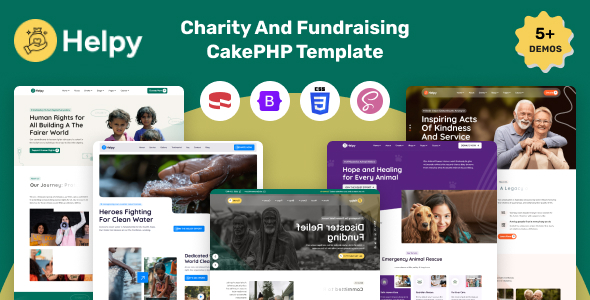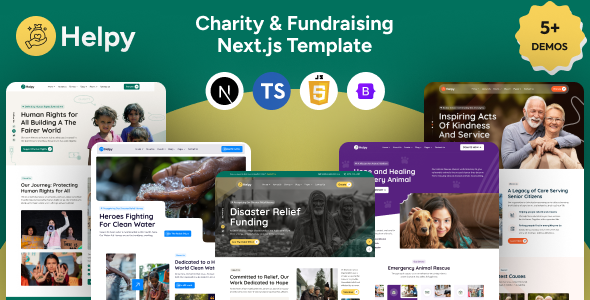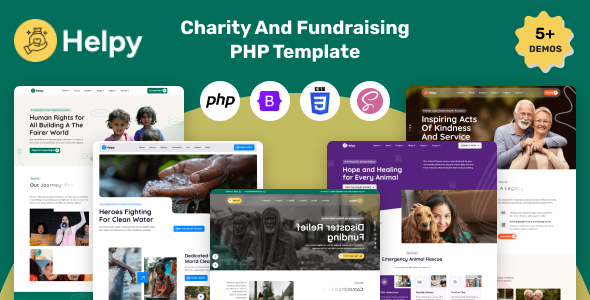
Helpy is a PHP and Bootstrap template for charity and fundraising websites, offering 5+ demos and 30+ pages to quickly launch donation-focused sites for NGOs and nonprofits.
Helpy Template Overview for Fundraising Websites
This product is essentially a collection of pre-built HTML, CSS, and JavaScript files, structured to be easily managed with PHP includes. It's a front-end package designed for charity and fundraising website design for NGOs, providing a solid visual foundation rather than a full dynamic application. You get a set of pages and components ready to be populated with your specific content.
Who Helpy is For and Who Should Look Elsewhere
Helpy is a good fit for freelancers and small agencies who need to deliver a functional, presentable website quickly without building every component from scratch. If you're working with a small non-profit or a local charity that needs an online presence fast, this template gives you a head start. It's also suitable for those looking for a clean, responsive base for a PHP charity website template that they can then extend.
However, if you require deep, custom backend logic for donation processing, user accounts, or complex content management out of the box, this isn't your solution. This template provides the visual shell; you'll need to integrate any dynamic functionality separately. It is not for those expecting a complete CMS or a ready-to-deploy donation system.
Design and Visual Approach for Nonprofits
The template follows a clean, straightforward design philosophy. It avoids excessive animations or overly complex layouts, which is often a good thing for charity sites where clarity and trust are paramount. The visual presentation is professional and feels current, using Google Fonts like Quicksand and Nunito Sans for readability. From our testing, the layouts handle different content lengths reasonably well, maintaining a consistent look.
Layouts, Pages, and Components for Quick Launch
Helpy includes over 30 individual page files and more than 5 distinct demo layouts. This means you have a decent variety of pre-designed sections for common charity site needs, such as "about us," "causes," "events," and contact pages. These layouts provide a solid starting point, saving significant time compared to coding each section from scratch.
Business-Related Features for Fundraising Efforts
While Helpy doesn't include a built-in donation processing system, it provides the necessary front-end layouts for donation pages and calls to action. This means the visual components are there to encourage giving. You would typically integrate a third-party payment gateway or a donation platform like PayPal, Stripe, or a dedicated fundraising solution into these static pages. The template focuses on presenting the fundraising opportunity clearly.
Code Quality and Developer Experience
The template is built with Bootstrap, which means a familiar and well-documented framework for most developers. The inclusion of SCSS support is a definite plus. This allows for more organized and maintainable CSS, making it easier to change colors, fonts, and other global styles efficiently. When we tested the kit on a demo site, customizing the primary color scheme via SCSS variables was straightforward.
Documentation is mentioned, which is always important for understanding the structure and making modifications. While "easy to customize" is a common claim, the Bootstrap base and SCSS do genuinely simplify the process for anyone familiar with those tools. This translates to lower maintenance costs and easier content updates for the business owner down the line.
Responsiveness and Compatibility for All Devices
Helpy is advertised as 100% responsive and mobile-friendly, which is standard for any modern web template. Based on our experience with Bootstrap-based templates, this usually means layouts adapt well across various screen sizes, from desktops to mobile phones. Cross-browser optimization is also a standard expectation, ensuring consistent appearance in Chrome, Firefox, Safari, and Edge. This ensures a better mobile experience for potential donors and volunteers.
SEO Readiness and Semantic Structure
A clean, well-structured HTML template like Helpy provides a good foundation for search engine optimization. The semantic use of HTML tags helps search engines understand the content hierarchy, which is crucial for a nonprofit site quick launch. While a static template won't handle all aspects of SEO, it avoids common pitfalls like excessive use of non-semantic divs or inline styles, making it easier for search engines to crawl and index your content effectively.
Final Thoughts on Helpy for Nonprofits
Helpy is a practical front-end template for anyone needing to get a charity or fundraising website up and running without a massive budget or timeline. It saves considerable design and front-end development time by providing polished, responsive layouts. The biggest takeaway is that while it's a "PHP template," this primarily means it uses PHP for includes to assemble static pages, not for dynamic backend functionality. You will need to integrate your own donation system.
Considering its purpose, the template offers a solid, clean base. If your workflow involves building out a front-end quickly and then integrating specific backend services, Helpy is a smart investment to shortcut the initial design and coding phases. It handles the visual presentation well, letting you focus on the crucial dynamic elements later.
FAQ
Does Helpy include a functional donation system?No, Helpy is a front-end template. It provides the visual layouts for donation pages, but you will need to integrate a separate payment gateway or donation platform for actual processing.
Is this template easy to convert into a full Content Management System (CMS) like WordPress?The clean HTML and CSS structure make it easier to adapt to a CMS compared to poorly coded templates, but it still requires a developer to manually convert the static pages into CMS templates.
What's involved in customizing the template's design?With SCSS support, you can easily customize colors, fonts, and other global styles by modifying SCSS variables and recompiling the CSS. Basic HTML and CSS knowledge is needed for more specific layout changes.
What does "PHP Template" mean in this context?It means the template uses PHP for including header, footer, and other common sections across multiple pages, helping with maintenance. It does not imply built-in dynamic server-side functionality for features like user management or database interactions.