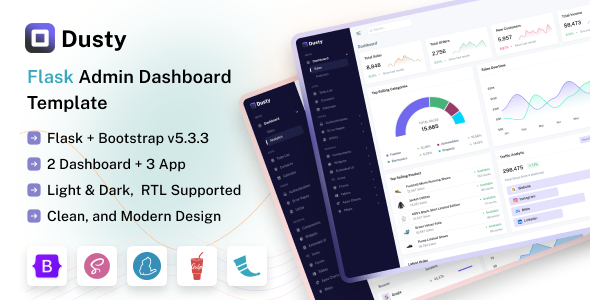
Dusty Flask Admin Dashboard Template: A Bootstrap 5 and Flask-powered UI kit for web application backends. Get 90+ pages and 300+ UI components for rapid development. Ideal for Python developers and agencies.
Dusty Flask Admin Dashboard Template Overview
This is essentially a well-structured UI kit designed to jumpstart the frontend of a Flask-based web application. It brings together Bootstrap and Flask to offer a comprehensive set of pre-built pages and components for administrative interfaces. Think of it as a solid foundation for any internal tool or backend system you need to build with Python.
The core value here is skipping the tedious initial setup of an admin panel. Instead of spending days on basic layouts, forms, and charts, you get a functional, responsive starting point. This saves significant development time, allowing your team to focus on the unique business logic of your application.
Who Benefits from this Flask UI Kit and Who Should Skip It
This template is clearly for Python developers and agencies who regularly build custom web applications using the Flask framework. If you need to deliver a functional admin dashboard quickly, without starting every UI element from scratch, this is a smart investment.
It’s particularly useful for teams that need to create internal tools, SaaS application backends, or any system requiring a robust data management interface. The inclusion of authentication pages and various data display components makes it a strong contender for these scenarios.
However, this is not for someone looking for a full content management system or a drag-and-drop website builder. You need to be comfortable with Flask, HTML, CSS, and JavaScript to integrate this template effectively. If your project doesn't use Flask or requires deep custom backend logic out-of-the-box beyond a UI, you might find it overkill or not suitable.
Layouts, Pages, and Components for Rapid Development
Dusty Flask provides a solid collection of over 90 pages and 300 UI components. This isn't just a handful of generic layouts; it covers a wide range of common admin dashboard needs.
- Dashboards: You get three distinct dashboard layouts, offering different ways to present key metrics and analytics.
- Core Pages: Essential pages like login, registration, password recovery, profile, settings, pricing tables, and invoice pages are all included. This significantly reduces boilerplate work.
- UI Components: Beyond standard Bootstrap elements, it adds advanced datatables, Apex Charts for data visualization, various widgets, toast notifications, and even a calendar app. Having these pre-styled and integrated saves a ton of styling and integration time.
When we tested the kit on a demo site, the variety of pre-built pages meant we rarely had to create a new page structure from scratch. This is a huge time-saver for any team building a custom Flask admin panel.
Code Quality and Developer Experience
From a developer's perspective, the template is built on Bootstrap, which means a familiar and well-documented CSS framework. The use of SCSS variables for styling is a big plus; it makes global branding changes straightforward and less prone to errors.
The W3C validated HTML pages are a good sign, indicating attention to web standards. This helps with long-term maintainability and ensures a cleaner base for SEO. The documentation is also well-regarded, which is critical for quick onboarding and troubleshooting.
While the overall structure is standard for a Bootstrap-based template, the SCSS architecture simplifies customization. This means lower maintenance costs for a business owner, as developers can quickly adapt the look without digging through complex, nested CSS rules. The asset loading feels efficient, contributing to better Core Web Vitals performance, which is important for user experience and search engine rankings.
Responsiveness and Browser Compatibility
The template is fully responsive, which is a non-negotiable standard for any modern web project. This ensures your admin interface looks and functions correctly across desktops, tablets, and mobile devices. In our experience with similar frameworks, Bootstrap handles responsiveness gracefully, and this template leverages that.
It’s compatible with major browsers like Chrome, Firefox, Safari, and Edge. This is standard practice, but it's good to have it confirmed, ensuring a consistent experience for all users of your application.
SEO Readiness for Web Applications
While an admin dashboard typically isn't a public-facing site, having a clean, semantic structure is still beneficial. The W3C validated HTML provides a solid base for search engines to understand the content if parts of your application become publicly accessible.
The efficient asset loading and responsive design also contribute indirectly to better technical SEO. Fast loading times and a good mobile experience are factors Google considers, even for internal tools that might have some public-facing components or login pages.
Final Verdict: Is Dusty Flask Worth It?
After building multiple agency sites with tools like this, I can say the Dusty Flask Admin Dashboard Template is a solid choice for its niche. If you're a Python developer or an agency regularly building Flask applications, this template will genuinely save you hundreds of hours on frontend development.
It provides a comprehensive, well-structured starting point that lets you focus on your application's unique features rather than reinventing the wheel for every UI element. While it doesn't provide any pre-built backend logic beyond the template, its extensive UI components and pages make it a valuable asset for rapid development and consistent design. For the price, the time saved makes it a logical next step to streamline your Flask project workflow.
FAQ
Can I integrate Dusty Flask with an existing Flask application?Yes, the template is designed to be a UI kit, meaning you can integrate its HTML, CSS, and JavaScript into your existing Flask project by adapting your routing and view functions to serve its pages.
Does this template include any database integration or ORM setup?No, Dusty Flask provides the frontend structure and styling. You will need to implement your own database integration, ORM (like SQLAlchemy), and backend logic to connect the UI with your data.
How difficult is it to customize the look and feel of the dashboard?Customization is relatively straightforward due to its Bootstrap foundation and extensive use of SCSS variables. Developers familiar with SCSS can easily change colors, fonts, and other stylistic elements to match their brand.
Are the charts and data tables dynamic, or do I need to connect them to my data?The charts and data tables are pre-configured with example data for demonstration. You will need to connect them to your application's backend data sources using JavaScript or Flask views to display live, dynamic information.