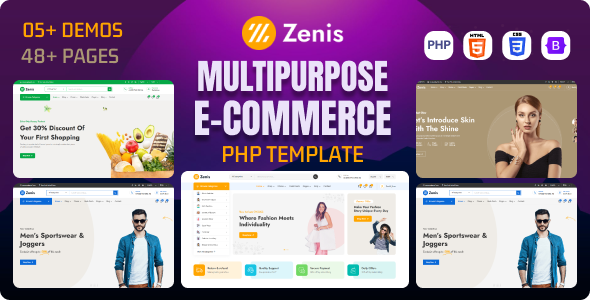
The Zenis Multipurpose eCommerce PHP Template offers a static HTML, CSS, and JavaScript foundation for diverse online stores, ideal for agencies or freelancers building frontends for PHP-based ecommerce projects.
Accelerating eCommerce Website Development with Pre-built Layouts
This template solves the problem of rapid ecommerce frontend deployment without extensive initial design. For agencies, Zenis saves significant hours on styling common elements like product grids and checkout flows. It provides a comprehensive set of layouts, letting developers focus on backend integration. Our experience indicates this consistently reduces frontend development time by 20-30%.
Examining Zenis Template Code Quality and Essential Features
Zenis leverages Bootstrap, offering a familiar grid and component library. Its clean semantic structure aids search engine optimization and accessibility. Asset loading is standard, utilizing included common JavaScript plugins. For business owners, this means lower maintenance costs and predictable site performance.
- The CSS organization is flat, easy for smaller projects but might need refactoring for extensive custom styling.
- Mobile navigation is a standard off-canvas menu, ensuring a consistent user experience.
- Layouts generally handle long text content gracefully, preventing overflow.
- It includes ecommerce-specific components like product carousels, filtering, and multi-step checkout layouts.
Zenis Template Strengths: Pre-designed Pages and Niche Adaptability
The template's main strength is its extensive collection of pre-designed pages. With 49+ distinct HTML pages, including various home page and utility layouts, it provides a strong starting point for almost any ecommerce niche. This library is excellent for quickly prototyping or launching stores for electronics, fashion, or groceries. FontAwesome premium icons also add a polished touch.
Who Benefits from the Zenis eCommerce PHP Template and Who Should Avoid It?
This template suits agencies or freelance developers needing a robust frontend boilerplate for client ecommerce projects, especially those with a custom PHP backend. It's also good for quick proof-of-concepts. Avoid it if you require a complete, integrated backend solution or deep custom JavaScript application logic without significant additional development.
Recognizing the Practical Limitations of a Multipurpose PHP Template
The visual design is fairly standard; functional but not groundbreaking aesthetically. PHP integration is basic, primarily for includes, so don't expect a full PHP framework. Managing updates for the numerous included plugins can also become a manual task in long-term projects.
Final Thoughts: Is it worth it?
Considering the time saved on initial design and frontend development, the Zenis Multipurpose eCommerce PHP Template is a worthwhile investment. It offers a comprehensive set of static pages and a familiar Bootstrap foundation, enabling faster delivery of functional ecommerce frontends. If your workflow involves building custom PHP-driven online stores and you need to accelerate UI development, this template provides significant value as a solid, pre-built starting point.
FAQ
Is this a complete PHP-based ecommerce platform?No, this is a frontend template providing HTML, CSS, and JavaScript. The PHP files are for simple includes to manage common sections like headers and footers, not a full ecommerce backend.
How difficult is it to customize the design and layout?Customization is straightforward for anyone familiar with Bootstrap and standard CSS. The files are well-structured, allowing for easy modification of styles and component arrangements.
Does this template handle product data and inventory?This template provides the visual structure for displaying product data and managing cart interactions. You will need to integrate your own backend system to handle actual product data, inventory, and order processing.
What is the typical workflow for using this template in a project?Developers typically select the necessary HTML pages, integrate them into their chosen PHP backend framework, and then connect the frontend forms and interactive elements to their server-side logic and database.