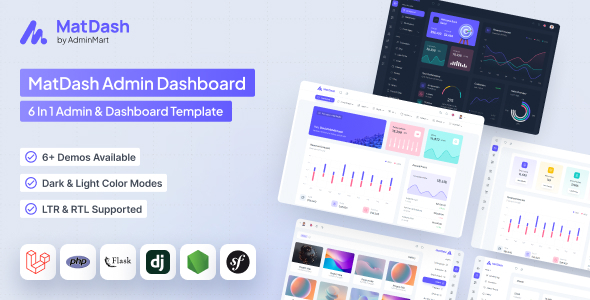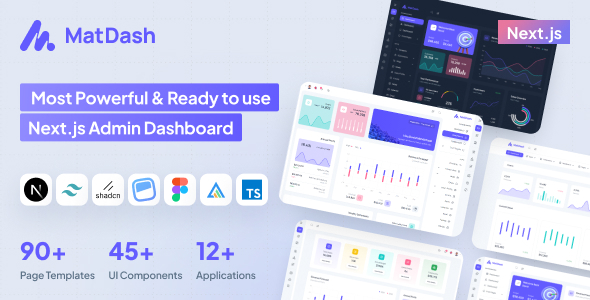
MatDash Tailwind Next.js Admin Template is a comprehensive starter for building admin dashboards and web applications with Next.js, Tailwind, and Shadcn/UI. It includes Firebase, Next-Auth, and multiple application designs, ideal for agencies and freelancers needing quick, robust backend setups.
MatDash Tailwind Next.js Admin Template: A Modern Backend Starter Kit
This isn't just another template; it's a well-structured Next.js admin dashboard starter kit built on modern tech. It uses Tailwind CSS for styling and Shadcn/UI for its component library, which is a smart combination. The package also integrates Firebase and Next-Auth out of the box. For anyone looking to spin up an admin interface or a backend for a web application quickly, this saves a ton of initial setup time.
When we tested the kit on a demo site, the core setup felt solid. You get six unique demos and three distinct dashboards, which provide a good starting point without feeling overly prescriptive. It solves the headache of setting up a consistent UI framework, authentication, and basic data integration from scratch, which can easily eat up a week of development time.
Who Needs This Next.js Admin Dashboard Starter Kit?
This template is for developers, agencies, and freelancers who frequently build internal tools, SaaS dashboards, or complex web application backends. If you're comfortable with Next.js, Tailwind CSS, and a component-based approach, you'll get a lot of mileage here. The included Firebase and Next-Auth integrations are a big plus for projects that align with those technologies, cutting down on initial configuration significantly.
However, this is not for absolute beginners to the Next.js ecosystem or those who need a deeply customized backend logic that deviates heavily from Firebase. If your project requires a completely unique design system or a different authentication flow, you'll spend time modifying rather than just building on top. Similarly, if you're not planning to use Tailwind or Shadcn/UI, much of the value will be lost.
Exploring MatDash's Components and Application Designs
The strength of MatDash lies in its extensive collection of pre-built components and application UIs. You get a broad set of Shadcn/UI elements, which are known for their accessibility and clean design. This means less time spent on basic button styles or modal interactions, and more on core features.
- Dashboards: Multiple layouts offer different ways to visualize data, which is useful for various business intelligence needs.
- Application Designs: There are pre-built UIs for common features like eCommerce, Chat, Kanban, Invoice, User Profile, and even AI Chat and AI Image Generation interfaces. These are mostly UI shells, but they provide a solid starting point for integrating your own business logic.
- UI Components: A comprehensive set of Shadcn/UI elements including buttons, forms, tables, dropdowns, and modals, ensuring a consistent design language across your application.
- Tables: The template includes robust table implementations, featuring React Table examples with sorting, filtering, pagination, and row selection. This is a huge time-saver for any data-heavy application.
Having these components ready means you can focus on the unique aspects of your application rather than reinventing standard UI patterns. The logical grouping of components helps in understanding the structure and extending it.
Business Application Logic and Integrations in MatDash
The template provides a good foundation for common business applications. The included eCommerce, Invoice, Contact, and Ticket applications are more than just static pages; they offer structured UIs ready for data integration. This is particularly useful for building an internal tool or a client portal where these functionalities are often required.
The integration with Firebase handles common backend needs like database interactions and file storage, while Next-Auth provides a secure and flexible authentication layer. For a business owner, this translates to lower development costs and faster time-to-market for data-driven applications, as much of the groundwork for secure user management and data handling is already done.
Developer Experience with MatDash: Code Structure and Setup
From a developer's perspective, the code organization feels clean. It follows standard Next.js conventions, so navigating the project structure is intuitive if you're familiar with the framework. Tailwind's utility-first approach means styling is largely done with classes, which makes it straightforward to modify or extend the visual design without diving deep into complex CSS files. Customizing colors or fonts is as simple as updating the `tailwind.config.js` file, a practical benefit that means less maintenance overhead in the long run.
The Shadcn/UI components are well-implemented, offering a good balance between pre-built functionality and customization potential. The inclusion of `i18 React` for internationalization is a thoughtful addition, making it easier to build applications for a global audience. Overall, the developer experience is geared towards efficiency, allowing for quick iterations and consistent styling.
Responsive Design and Cross-Device Performance
The claim of "completely responsive pages" holds up in practice. Tailwind CSS is inherently mobile-first, and the components are designed to adapt well to various screen sizes. When we tested the template on different devices, the layouts maintained their integrity and usability. This ensures a consistent user experience whether someone is accessing the admin dashboard from a desktop, tablet, or mobile phone, which is crucial for engagement and productivity across devices.
Technical SEO Foundations with Next.js and Semantic Structure
For an admin dashboard or web application, technical SEO might not always be the primary concern, but it's still important for any public-facing pages or content. Next.js offers robust capabilities for server-side rendering or static site generation, which ensures that search engines can easily crawl and index content. This is a significant advantage over client-side rendered applications for search engine optimization.
The semantic HTML structure provided by the Shadcn/UI components also helps search engines understand the page content and hierarchy, potentially contributing to better visibility. Furthermore, optimized asset loading and efficient code contribute to faster page loads, which is a key factor for Core Web Vitals and overall user experience, leading to better engagement and lower bounce rates.
Final Thoughts on the MatDash Tailwind Next.js Admin Template
MatDash Tailwind Next.js Admin Template is a solid accelerator for anyone needing to build a Tailwind CSS admin template with authentication and a rich UI component set. It’s not a magic bullet that writes your entire application, but it provides a robust, modern foundation that genuinely saves development time on boilerplate and common features. The integration of Firebase and Next-Auth is a huge plus for specific project types.
While comprehensive, the sheer volume of included "applications" might mean some are less polished or require more customization to fit specific business logic perfectly. The "AI applications" are essentially UI shells, so don't expect a fully integrated AI backend. However, for getting a secure, functional, and good-looking Shadcn UI dashboard for web applications off the ground quickly, this is a smart investment that can genuinely reduce project hours and maintenance costs.
FAQ
Is MatDash suitable for a multi-tenant SaaS application?Yes, its Next.js and Firebase architecture, combined with Next-Auth, provides a good base for implementing multi-tenancy, though you'll need to build out the specific logic for tenant isolation and management.
How easy is it to customize the visual design beyond the provided color skins?Customizing the visual design is straightforward due to Tailwind CSS; you can easily modify the `tailwind.config.js` file for global changes or override utility classes for specific components.
Does this template support different database backends other than Firebase?While it comes pre-integrated with Firebase, Next.js allows for flexible data fetching. You can certainly integrate other databases like PostgreSQL or MongoDB by building out your own API routes and data fetching layers.
What is the learning curve for integrating custom features into MatDash?If you're already familiar with Next.js, Tailwind CSS, and React, the learning curve for integrating custom features is moderate. The component-based structure makes it easy to add new functionality while maintaining consistency.