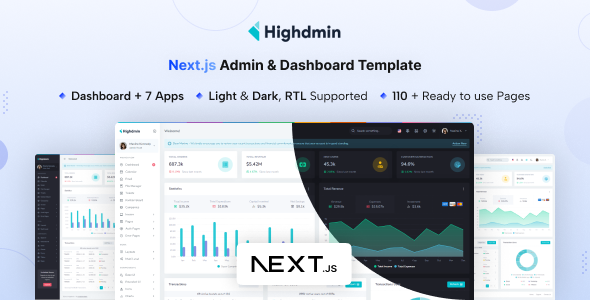
Highdmin is a comprehensive NextJS admin dashboard template designed to provide a solid frontend foundation for internal tools, SaaS backends, or any application requiring a robust administrative interface.
Streamlining Internal Tool Development with a NextJS Admin Dashboard
Building administrative interfaces from scratch is often a repetitive task, consuming valuable developer hours on boilerplate UI elements. This Highdmin NextJS admin dashboard template addresses that directly by providing a complete, pre-built user interface.
It solves the workflow problem of starting every dashboard project with an empty canvas, saving significant time on initial setup and styling. For agencies or product teams needing fast turnarounds on internal tools or client dashboards, this is a smart investment that lets you focus on the unique business logic rather than recreating common components.
Assessing the Technical Foundation of Highdmin NextJS Template
Highdmin is built on NextJS and Bootstrap, which means it follows widely understood conventions. The use of SCSS for styling is a practical choice, allowing for efficient customization through variables and organized stylesheets, which translates to lower maintenance costs down the line for a business owner.
The template includes a wide array of components, from advanced data tables with pagination and search to various chart types, which are essential for any data-driven admin panel. The pre-built applications like Calendar, Kanban, and Invoice are particularly useful, offering ready-to-integrate features that would otherwise take days to build out, accelerating the path to a functional product.
- The SCSS architecture is well-structured, making it straightforward to override default Bootstrap styles or introduce custom themes. This organization helps keep CSS manageable as the project grows.
- Mobile responsiveness is standard, adapting layouts predictably across devices. The mobile navigation behaves as expected, collapsing cleanly and providing a usable experience on smaller screens.
- Data handling elements, like the advanced data tables, are robust, offering common features like sorting and filtering out of the box. This is crucial for managing large datasets efficiently.
- The asset loading strategy benefits from NextJS, typically resulting in optimized bundles and faster initial page loads, positively impacting Core Web Vitals and overall user experience.
- The inclusion of various authentication pages provides a secure and conversion-ready flow for user login and registration, which is a common requirement for any internal system.
What Impresses in this NextJS Admin Dashboard Template
What stands out most is the sheer breadth of components and pre-built applications. Unlike some templates that offer a few pages and call it a day, Highdmin provides a truly comprehensive starting point. The integration of NextJS means you benefit from modern web development practices like server-side rendering or static site generation, which can improve performance and SEO for public-facing components.
The focus on essential admin features, like robust forms, charts, and data tables, makes it genuinely useful. It avoids excessive visual fluff, instead concentrating on functional components that developers will actually use to build a working system.
Who Benefits Most from Highdmin's Admin Dashboard Features
This NextJS admin dashboard template is ideal for development agencies, solo developers, or small product teams building SaaS backends, CRMs, internal dashboards, or any application that needs a solid, functional administrative interface quickly. If you need a reliable foundation for a NextJS dashboard template that handles common UI patterns, this is a strong contender.
It is not for projects requiring a highly bespoke design that deviates significantly from Bootstrap's aesthetic, or for those needing deep, custom backend logic tightly coupled with unique frontend components right out of the box.
Practical Limitations of a Pre-built Admin Template
While comprehensive, the template's reliance on Bootstrap means that without significant custom styling, the overall design can feel fairly standard. The aesthetic is clean and functional, but it might not win awards for groundbreaking visual design. Integrating the included applications, like the Calendar or Kanban board, with your specific backend APIs will still require custom development effort; they provide the UI, not the data layer.
The large number of included components, while a strength, means you'll need to be mindful of bundle size if you're only using a fraction of them. Proper tree-shaking and code splitting with NextJS will be important to maintain optimal performance.
Final Thoughts: Is it worth it?
For anyone regularly building admin panels or internal tools, Highdmin offers a significant head start. The time saved on setting up basic UI, integrating common components, and ensuring responsiveness easily justifies the investment. It provides a solid, maintainable foundation, allowing your team to focus on the core value proposition of your application rather than repetitive frontend work.
FAQ
How easy is it to customize the styling and theme?Customizing the styling is straightforward due to the extensive use of SCSS variables. You can quickly change colors, fonts, and other visual aspects by modifying these variables without diving deep into the core CSS.
Does this template include backend integration?No, this template provides only the frontend UI components and structure. You will need to integrate it with your own backend API and database to make the applications and data displays fully functional.
Is this suitable for a multi-tenant SaaS application?Yes, the template provides a solid UI foundation that can be adapted for a multi-tenant SaaS application. You would need to implement your own user role management and data segregation logic on the backend, connecting it to the template's frontend components.
What about performance with all these components?Built with NextJS, the template benefits from optimizations like server-side rendering and static site generation. While the number of components is high, NextJS helps manage asset loading efficiently, though careful code splitting for unused components is always recommended for optimal performance.