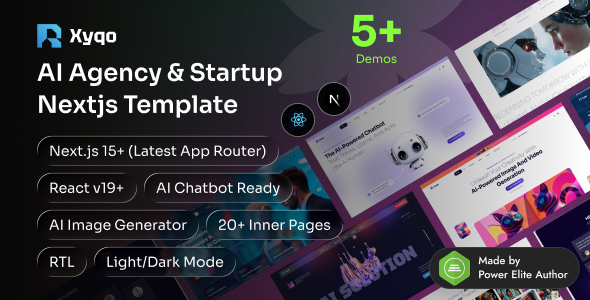
The Xyqo AI agency Next.js template is a pre-built frontend kit designed for tech startups and digital agencies that need to get a modern website up quickly using a React-based stack.
Solving Workflow Challenges for AI Agency Websites
For agencies or freelancers tasked with launching a new AI startup or tech company site on a tight deadline, this template directly addresses the initial setup time sink. Instead of building common layouts like service pages, contact forms, or team sections from scratch, Xyqo provides these components ready to go.
In our experience building multiple agency sites, getting the basic structure and responsive design dialed in for a modern Next.js application can easily consume 20-30 hours. This template aims to cut that down significantly, letting you focus on the unique content and specific integrations for an AI-focused business rather than foundational styling and component creation. It’s a smart investment if your goal is rapid deployment for a client who needs a polished, functional site without a custom design system budget.
Technical Standards and Practical Code Structure
Xyqo is built with a solid, modern stack: Next.js, TypeScript, Material UI, and Sass. This combination is generally a good sign for maintainability and performance. TypeScript provides type safety, which helps catch errors during development, leading to more stable code in production and lower long-term maintenance costs. Material UI offers a consistent design system, meaning less time spent on individual component styling and a predictable user experience.
The use of Sass for styling is a practical choice, allowing for organized and modular CSS, which makes global theme changes or component-specific adjustments much more manageable than flat CSS files. It also leverages Next.js image optimization, which is crucial for Core Web Vitals and delivers a better mobile experience for end-users by ensuring images load efficiently.
- The Sass architecture is reasonably structured, making it straightforward to override styles or introduce new global variables without fighting the framework.
- Mobile menu behavior is standard for Material UI, providing a predictable drawer navigation that adapts well across devices.
- The template uses ESLint and Prettier, which is a welcome detail. This ensures code consistency across a team and helps enforce best practices, reducing potential bugs.
- Dynamic routing via Next.js App Router is a modern approach, offering good flexibility for content structure and SEO-friendly URLs.
- The AI Chat Assistance and Image Generation features are mostly frontend placeholders, acting as a starting point. They will require significant backend integration with actual OpenAI or similar APIs, which is standard for a frontend template.
- Asset loading feels efficient, benefiting from Next.js optimizations. This contributes positively to overall site speed and user perception.
Strengths of Xyqo for Rapid Development
What impresses most about Xyqo is its adherence to a modern development workflow. The inclusion of TypeScript and a well-known UI library like Material UI means you're starting with a robust foundation. The array of pre-built inner pages and demo variations gives you a head start on content layout, especially for common pages an AI startup or digital agency website would need. The responsive layout is well-handled out of the box, which is a significant time-saver, ensuring a good experience across various devices.
Who Benefits from this Next.js Template and Who Should Pass
This template is for development agencies, freelance developers, or small internal teams needing to launch a professional-looking AI agency or SaaS marketing site quickly. It's particularly useful if your client's brand aesthetic aligns well with Material UI's clean, modern design language. If you are specifically looking for a Next.js template for AI startup marketing, this offers a solid starting point.
However, it is not for those requiring deep, highly customized backend logic integrated directly into the template or for brands with a very distinct, non-Material UI design system that would require extensive overriding.
Limitations and What Could Be Improved
While the Material UI foundation offers consistency, it also means the default aesthetic can feel a bit generic without significant customization. You'll need to invest time in adjusting the theme to make it truly unique to a client's brand, especially if they want to stand out from other Material UI-based sites. The "AI-powered" features, while a good marketing point, are essentially frontend UI components. Integrating them with actual AI APIs will be a separate, substantial development task. Additionally, while the code is clean, navigating the Material UI theming system can have a slightly steeper learning curve for developers not already familiar with it, compared to a pure utility-first CSS approach.
Final Thoughts: Is it worth it?
If you're in the business of delivering modern websites for tech-focused clients on a deadline, the Xyqo AI agency Next.js template is a solid contender. It provides a strong, well-structured starting point with a modern tech stack, significantly reducing the initial development overhead. The time saved on foundational setup and responsive design alone makes it a logical choice to help you deliver projects faster and more efficiently, allowing you to focus on client-specific features and content.
FAQ
Can I easily change the primary colors and fonts to match my brand?Yes, Material UI's theming system allows for straightforward global color and typography adjustments, though deeper styling changes may require more direct Sass modifications.
How difficult is it to integrate custom backend APIs with this template?The template is API-ready, meaning its components are structured to consume data from external sources. Integrating custom REST or GraphQL APIs should be a standard development task.
Does this template support server-side rendering (SSR) or static site generation (SSG)?Yes, it is configured to support both static export and server-side rendering, giving you flexibility depending on your project's content and performance requirements.
Are the AI chat and image generation features fully functional out of the box?No, these features provide the frontend UI elements. You will need to connect them to actual backend AI services like OpenAI through API calls to make them fully functional.