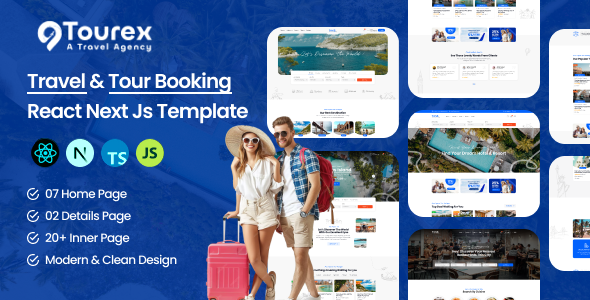
Tourex is a React Next.js template for travel and tour booking websites, offering 7 homepages and 30+ inner pages. It provides a solid Bootstrap frontend, ideal for agencies and freelancers.
Tourex: A React Next.js Frontend for Travel Booking Websites
This isn't a full-stack booking system; let's get that clear upfront. Tourex is a frontend template built with React and Next.js, sitting on a Bootstrap foundation. Think of it as a pre-built user interface kit for any kind of travel-related site, whether that's tour operators, flight booking, or hotel listings. It gives you the visual shell and interactive components without the backend logic for processing payments or managing inventory.
For anyone working with modern JavaScript frameworks, this provides a head start on the visual layer. It solves the initial headache of setting up a responsive, component-based layout from scratch, specifically tailored for the travel niche. In our experience, starting with a well-structured frontend like this can shave weeks off a project's initial development phase.
Who Should Use This React Next.js Travel Template
Tourex is definitely for agencies and freelancers who are building custom travel booking UI for clients and prefer a modern JavaScript stack. If you have an existing backend API for bookings, or you're planning to build one from scratch using something like Node.js or Python, this template gives you a robust and visually complete frontend to plug into. It is a smart investment if your goal is to deliver a sleek, fast user experience without spending months on UI development.
However, this template is not for everyone. If you're looking for an all-in-one, ready-to-launch booking platform that handles payments, user accounts, and database management out of the box, Tourex isn't it. It also isn't suitable for non-developers or those who prefer traditional CMS platforms like WordPress or Shopify, as it requires a good understanding of React and Next.js to customize and integrate.
Page Layouts and Core Components for Travel Sites
The template comes with 7 distinct homepage layouts and over 30 inner pages. This covers most common scenarios for a travel website, from tour listings and detail pages to search results and contact forms. The variety means you can pick a starting point that closely matches your client's vision, rather than forcing a design.
These pre-built sections are a major time-saver. For a business owner, this means faster deployment and lower initial development costs because much of the visual grunt work is already done. When we tested the kit on a demo site, adapting existing components for specific content felt straightforward, which is crucial for maintaining project timelines.
Developer Experience and Code Structure of Tourex
Tourex uses a Bootstrap base, which means a familiar grid system and component styling for many developers. The code is clean and commented, which always helps when you're diving into someone else's work. The React component architecture is fairly standard, making it easier to understand how different UI elements are structured and how to extend them.
Using Next.js is a significant advantage here. It enables server-side rendering or static site generation, which directly translates to better initial load performance for end-users and improved crawlability for search engines. This means potential customers see your content faster, and Google has an easier time indexing your travel offerings. The template integrates Google Fonts, Font Awesome, and Flat Icon, which are standard choices and generally perform well in terms of asset loading.
Responsive Design for All Devices
As expected from a Bootstrap-based template, Tourex offers a fully responsive layout. This means the design adapts well across desktops, tablets, and mobile phones without extra effort. For any business, this is non-negotiable; a good mobile experience ensures potential customers can browse and interact with your site regardless of their device, which is key for conversion rates in the travel industry.
Technical SEO Benefits of a Next.js Travel Template
The choice of Next.js for this travel booking template inherently provides several SEO benefits. With server-side rendering or static generation, search engine crawlers can easily access and index your content, unlike purely client-side React apps. The template's semantic HTML structure is also a good foundation for search engines to understand the hierarchy and context of your content, aiding in better visibility for specific tour operator website searches.
While no template guarantees top rankings, Tourex provides a clean technical base. The standard approach to font loading and asset management also aligns with modern performance best practices, which indirectly supports SEO efforts by contributing to faster page load times.
Is Tourex the Right React Next.js Travel Template for Your Project?
If you're an agency or freelancer building a custom travel booking frontend and need a solid, modern React Next.js base, Tourex is a genuinely useful starting point. It solves the problem of building a responsive, niche-specific UI from scratch, saving significant development time on the visual layer. The clean code and component-based structure make it maintainable and extendable.
The main trade-off, and it's a significant one, is that you are buying a frontend only. The "booking" features are purely design and user experience; you will need to develop or integrate your own backend logic for actual bookings, payments, and data management. For projects where you need a modern JavaScript frontend to connect to a custom or existing API, Tourex offers a strong foundation and is a worthwhile investment to accelerate your development workflow.
FAQ
Does Tourex include a functional booking system?No, Tourex is a frontend template. It provides the user interface for a booking process but does not include any backend logic for processing payments, managing inventory, or handling user accounts.
How easy is it to customize the design and colors?As a React Next.js template, customization requires familiarity with these technologies and CSS. Changing colors and basic styling is generally straightforward if you understand the underlying Bootstrap and React component structure.
Is this template suitable for a large travel agency with many tours?The template provides a robust frontend structure that can handle a large volume of content visually. However, you will need to integrate a powerful backend system to manage the data and logic for a large-scale operation.
What level of technical skill is needed to use Tourex?You need a solid understanding of React, Next.js, and general web development principles. It is not a no-code or low-code solution and requires developer expertise to implement and customize effectively.