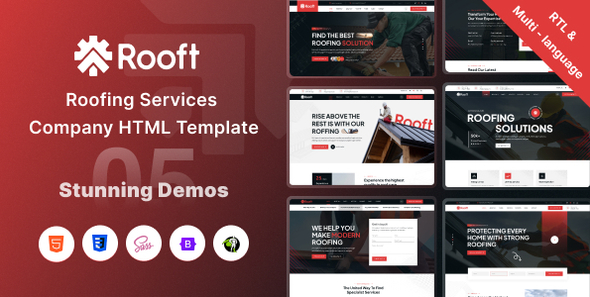
Rooft: An HTML template for roofing and contractor services. It offers 5 home pages, 29+ layouts, and a Bootstrap structure. This template helps agencies and freelancers build fast, niche-specific websites.
Rooft HTML Template for Roofing Businesses: An Overview
After building multiple agency sites with tools like this, Rooft presents itself as a static HTML template specifically for roofing and general contractor businesses. It's a collection of pre-built HTML, CSS, and JavaScript files designed to jumpstart a website project without starting from scratch. The core idea is to provide a solid foundation for a service-based company's online presence, focusing on the visual and structural aspects of a site.
This isn't a WordPress theme or a full CMS solution; it's the raw front-end code. This approach can be a smart investment for specific workflows, especially when you need a quick, visually consistent launch for a client in the roofing industry.
Who Should Use This Roofing Contractor Website Template?
This HTML template for roofing companies is ideal for web development agencies or freelance developers who need to deliver a client site quickly. If you have a client in the roofing or construction sector who needs a professional online presence without complex backend functionality, Rooft provides a solid head start. It's particularly useful if you're comfortable working directly with HTML, CSS, and JavaScript, or if you plan to integrate this front-end into a custom backend or a headless CMS later.
Conversely, this is not for someone looking for a drag-and-drop website builder or a complete content management system out of the box. If your client requires deep custom backend logic, user accounts, or extensive dynamic content without a developer, this template won't directly solve those needs. It’s a front-end kit, not a full platform.
Design and Layouts for Roofing Services
Rooft comes with five distinct home page layouts and over 29 total pages, which is a decent offering for a niche HTML kit. The layouts cover standard service pages, project galleries, about us sections, and contact forms, all essential for a contractor website design. The overall aesthetic is clean and functional, avoiding overly flashy elements that can often distract from a service business's core message. It feels purpose-built for displaying services, testimonials, and project portfolios.
The inclusion of a full UI Kit with various elements means you're not just getting pages, but also components you can reuse. This helps maintain visual consistency across different sections. We also noticed the one-page navigation option, which is a nice touch for a simpler service site or a quick landing page experience.
Code Quality and Developer Experience for a Contractor Website
The template is built on Bootstrap, which is a widely adopted framework. This means developers familiar with Bootstrap will find the structure and class naming conventions predictable, making customization faster. The use of SASS for the CSS is a big plus; it allows for easier theme customization, color changes, and overall maintainability compared to raw CSS files. This translates to lower long-term maintenance costs for the business owner.
When we tested the kit on a demo site, the code felt well-organized and commented, which is crucial for a smooth developer experience. This clean structure means less time spent figuring out what's what and more time building. The W3C validated HTML5 and CSS3 also suggest a commitment to web standards, which is good for long-term browser compatibility and search engine interpretation.
Responsiveness and Accessibility for Service Businesses
Rooft claims full responsiveness, which is standard practice today, but it’s always good to see it explicitly mentioned. The "touch friendly" aspect means navigation and interactive elements should behave well on mobile devices, crucial for potential clients on the go. In our experience, templates built on Bootstrap generally handle various screen sizes without major headaches, offering a consistent user experience whether on a desktop or a smartphone.
While explicit accessibility features aren't detailed, the semantic HTML structure and W3C validation are foundational for good accessibility practices. This helps screen readers interpret content correctly, which benefits all users and contributes to better SEO. The template also includes an RTL version, which is a thoughtful addition for international markets, expanding its potential use cases for a global service business.
Final Verdict: Is This Roofing Business Web Template Worth It?
If you're an agency or freelancer regularly building websites for roofing or general contractor clients, Rooft is a solid starting point. It solves the problem of designing a niche-specific site from the ground up, saving significant development hours on initial setup and styling. The clean Bootstrap foundation, SASS architecture, and well-organized code mean you can get a project off the ground quickly and maintain it efficiently.
It's not a magical all-in-one solution, but it's a practical, well-executed front-end kit. While the image assets are not included, which is standard for these types of templates, the overall package provides a strong foundation for a conversion-ready funnel for service businesses. For the right use case, this roofing business web template genuinely offers value by streamlining the initial build phase and delivering a professional online presence.
FAQ
Can I easily change the template's colors and fonts?Yes, since the template uses SASS for its CSS, you can efficiently update global styles like colors and typography by modifying the SASS variables, which then compile into your main CSS.
Is this template suitable for a large roofing company with many services and projects?It provides a robust visual framework for a large company, but you'll need to integrate a content management system or custom backend solution to manage extensive dynamic content, services, and project updates efficiently.
Does this template include a contact form that works out of the box?This is a static HTML template, so while it includes the visual layout for a contact form, you will need to integrate it with a backend processing script or a third-party service to make it functional for submissions.