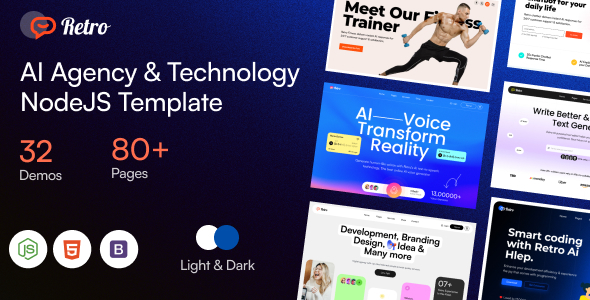
Retro is a NodeJS template for AI agencies and tech startups, offering 86+ pre-built pages and 32 home variations to kickstart your project fast.
Retro AI Agency Template: What it is and What it Solves
This "Retro" template is a static site kit, not a WordPress theme, built on Bootstrap and designed to be served via NodeJS. Think of it as a comprehensive set of HTML, CSS, and JavaScript files pre-styled for AI agencies, tech startups, or similar modern businesses that want a distinct, slightly nostalgic visual identity.
For agencies and freelancers, this product solves the initial design and frontend build headache. Instead of hand-coding common sections like services, portfolios, or team pages from scratch, you get a solid foundation. This means you can launch a polished `AI agency website` much faster than if you started with a blank canvas.
Who This NodeJS Template is For (and Who It's Not)
This template is for developers, agencies, and freelancers comfortable with a static site workflow. If you're building `tech startup landing pages` or full informational sites where content isn't constantly changing, and you prefer to manage your own backend or integrate with a headless CMS, this is a strong contender.
It's particularly useful if you appreciate a well-structured frontend and are happy to deploy a site that doesn't rely on a traditional CMS like WordPress. However, if your client expects a drag-and-drop editor, a built-in admin panel, or deep custom backend logic, this isn't for them. This is absolutely not a WordPress theme, so don't try to install it there.
Design and Visual Approach for Tech Companies
The design leans into a "retro" aesthetic with vibrant colors and specific graphics, aiming to stand out from the typical minimalist tech look. It includes 32 home page variations, offering both light and dark modes, which is a good range for client options.
A practical bonus is the included Figma file. This is genuinely useful for designers to quickly adapt the visuals, create mockups, or ensure brand consistency before a single line of code is touched. This feature alone can save several hours in the design phase for any `retro website design` project.
Extensive Layouts for Tech Company Websites
With 86+ pages, this template provides a lot of pre-built content. You get dedicated sections for services, portfolios, team profiles, and blog posts. This sheer volume means you'll likely find most of the common pages you need for a `tech company website layout` already styled and ready to populate.
While having many pages is great for variety, it also means there's a good amount of code to sift through. For simpler projects, you might end up deleting more than you use, but the benefit is having options rather than limitations.
Code Quality and Maintainable Web Development
The template is built with Bootstrap 5, a standard frontend framework that most developers are familiar with. It uses clean CSS, valid HTML5/CSS3, and includes commented code, which makes for easier maintenance and debugging down the line. For a business owner, this translates to lower long-term maintenance costs and easier updates.
The use of NodeJS for serving implies a modern development environment, and the inclusion of SVG icons is a smart choice for scalable, crisp visuals across all devices. The `super fast load speed` claim is generally achievable with static assets and clean code, leading to a better user experience and improved search engine visibility.
Responsiveness and Compatibility for All Devices
It's responsive across all screen sizes and cross-browser compatible, which is the baseline expectation for any template today. The layout handles various content lengths reasonably well, adapting without breaking. The note about requiring Safari 12.0.0 or higher is a fair heads-up; it means they're not trying to support ancient browsers, allowing for more modern CSS and JavaScript features. This ensures a consistent `mobile-first indexing` experience for the vast majority of users.
SEO Readiness for Static Sites
The template provides a clean semantic HTML structure, which is a fundamental building block for good SEO. With valid HTML5 and CSS3, search engines can easily parse the content. As a static template, it inherently offers fast loading times, which is a significant factor for `search engine optimization` and Core Web Vitals.
Of course, the actual content, metadata, and ongoing SEO strategy remain your responsibility, but this template gives you a solid technical foundation to build upon.
Final Verdict: A Solid Base for Specific Tech Projects
If you're comfortable with a NodeJS-based static site workflow and need to rapidly deploy a visually distinct website for an AI agency or tech startup, this "Retro" template is a genuinely useful asset. The sheer volume of pages, combined with the Figma file and clean code, can save significant development and design hours.
It’s not for everyone, especially those tied to a traditional CMS, but for its intended niche, it offers a strong starting point. One thing I'd refine is the sheer number of pages; for some projects, it might be a bit overwhelming, requiring a careful selection of what to keep versus what to remove to keep the project lean.
FAQ
Can I use this template with WordPress or other CMS platforms?No, this template is not designed for WordPress or other traditional CMS platforms. It's a static HTML/CSS/JS template built to be served via NodeJS.
What technical skills do I need to customize and deploy this template?You'll need a good understanding of HTML, CSS, JavaScript, and familiarity with NodeJS for local development and deployment. Basic command-line knowledge is also helpful.
Does this template include a backend for managing content or users?No, as a static template, it does not include a backend, database, or admin panel for content management. You would integrate it with a headless CMS or manage content directly in the HTML files.
How does the Figma file benefit my workflow?The Figma file allows designers to easily customize the template's visual elements, create mockups, and ensure brand consistency without writing any code, streamlining the design-to-development handoff.