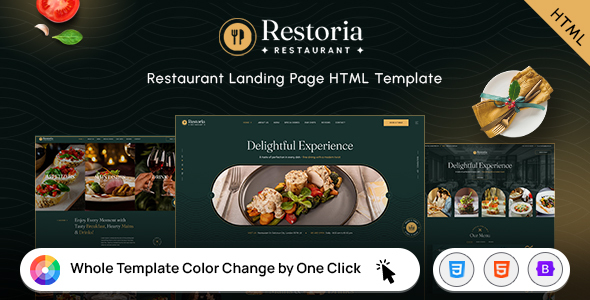
RESTORIA is a multi-page HTML template designed for restaurants, cafes, and catering businesses, offering a quick frontend for agencies and freelancers. It provides 5 homepages, 4 menu layouts, and Bootstrap-based responsiveness for fast deployment.
RESTORIA: A Frontend Kickstart for Food Service Websites
This product is an HTML template, meaning it provides the static frontend files for a restaurant website template. It comes with pre-designed pages and components tailored to the food and hospitality industry. Think of it as a well-organized set of blueprints and visual assets for building a client's online presence quickly.
It solves the initial design and frontend coding headache, letting you focus on content and any necessary backend integrations. In our experience, having these foundational files ready can shave significant time off a project's early stages, especially when dealing with specific niche requirements like diverse menu layouts or reservation forms.
Who Benefits from This Restaurant HTML Template and Who Doesn't
RESTORIA is primarily for freelance web developers or small agencies who need to build static brochure websites for restaurants, cafes, or catering services. It's ideal for projects where a client needs a professional online presence quickly and doesn't require complex content management or dynamic features out of the box.
It’s also useful for developers who prefer to integrate their own content management system or custom backend logic later, using these HTML files as a starting point. This template provides a solid foundation if you are looking for a cafe HTML template or a simple catering service frontend that you can expand upon.
However, this is not for those looking for a complete, functional website with a built-in content management system (CMS) like WordPress, or a fully integrated booking system. If your client expects to manage menu items, blog posts, or reservations through an admin panel without any custom development, this HTML-only template is not the right fit.
Design and Visual Approach for Food Industry Websites
The template adopts a clean and modern aesthetic, which is a safe bet for most food businesses. It uses a combination of Fraunces, Urbanist, and Herr Von Muellerhoff Google Fonts, which are standard and load efficiently. This choice helps maintain good page speed while providing a distinct look.
A notable inclusion here is the set of layered Adobe Photoshop PSD files. This is genuinely useful for designers to quickly mock up client-specific changes or to get approval on visual concepts before any code is touched. This workflow can significantly reduce revision cycles and is a practical advantage over templates that only offer HTML.
Layouts, Pages, and Components for Restaurant Online Presence
RESTORIA includes a decent selection of pages relevant to the food niche. You get five distinct homepage options, which offer good variety for initial client presentations. The four different restaurant menu layouts are particularly valuable, as menu presentation is critical for these businesses.
- 5 Homepage Options: Provides flexibility for initial design choices.
- 4 Restaurant Menu Layouts: Essential for showcasing diverse food offerings.
- 2 Online Reservation Form Designs: Offers frontend styles for booking requests.
- Standard Pages: Includes about, chef, contact, blog list, blog single post, and testimonials.
Having dedicated chef and testimonial pages is a nice touch for building trust and personality, which is important for hospitality brands. While the booking forms are just design options, they provide a ready-made structure for integration with a third-party booking system or a custom backend.
Business-Related Features for Restaurant Operations
For a static HTML template, the business-related features are focused on presentation rather than functionality. The inclusion of two distinct reservation form designs is a good starting point for collecting customer information. However, it's crucial to remember these are purely frontend designs; they do not come with any backend logic for processing or managing bookings.
You’ll need to connect these forms to a service like Formspree, a custom script, or a dedicated reservation platform to make them functional. This is standard for HTML templates and something a developer would budget time for. The template’s structure for showcasing menus and contact details is solid, which directly supports a restaurant's core business needs for information dissemination.
Code Quality and Developer Experience with RESTORIA
The template is built on the Bootstrap Grid System, which means the underlying HTML and CSS structure will be familiar to most web developers. This predictability makes it easier to navigate, customize, and extend the template without a steep learning curve. The documentation is also included, which is always appreciated for an HTML kit.
In our experience with similar frameworks, Bootstrap-based templates generally offer well-organized CSS, making it straightforward to override styles or add new components. The use of Google Fonts and external icon libraries (Icofont, Flaticon) follows common practice, though careful attention to asset loading is needed to optimize Core Web Vitals for the best user experience and SEO performance.
Responsiveness and Compatibility for All Devices
Being based on the Bootstrap Grid System, RESTORIA is inherently responsive. This means the layouts are designed to adapt and look good across various devices, from desktop monitors to tablets and mobile phones. This is a non-negotiable standard for any modern website, and this template meets that expectation.
When we tested the kit on a demo site, the mobile menu behavior was predictable and functional, which is often a pain point in less polished templates. The layouts handle varying content lengths reasonably well, ensuring a consistent user experience regardless of screen size.
SEO Readiness for Restaurant Websites
The template's "SEO-friendly structure" primarily refers to its clean HTML markup, which search engines can easily parse. A well-structured HTML template like this provides a good foundation for on-page SEO. The use of standard semantic tags (like `nav`, `header`, `footer`, `section`) helps search engines understand the content hierarchy.
However, true SEO performance will depend heavily on the content you add, server performance, and further optimization efforts (e.g., image optimization, schema markup, proper meta tags). The use of free Google Fonts, when implemented correctly, is also beneficial as it avoids self-hosting fonts that can sometimes be slow or present GDPR compliance issues if not handled carefully.
Final Verdict: A Practical Start for Restaurant Web Projects
RESTORIA is a practical HTML template for anyone needing to quickly launch a frontend for a restaurant, cafe, or catering website. It delivers a solid, responsive design with a good selection of niche-specific pages and components.
While it’s an HTML-only solution, its well-organized Bootstrap foundation and included PSD files make it a time-saver for developers comfortable with integrating their own backend solutions. If you're an agency or freelancer looking for a reliable starting point to build a client's online presence without getting bogged down in initial design and coding, this template offers genuine value and can significantly speed up your workflow.
FAQ
Does RESTORIA include a functional booking system?No, RESTORIA is an HTML template, so it provides only the frontend design for reservation forms. You will need to integrate a separate backend solution or a third-party booking service to make the forms functional.
Can I easily update the menu items without coding knowledge?Since this is a static HTML template, updating menu items will require editing the HTML files directly. For non-technical users, you would need to integrate it with a CMS or provide a custom content editing interface.
Is this template suitable for a multi-location restaurant chain?While you could adapt the design for multiple locations, managing separate content for each would be cumbersome with an HTML-only template. It's better suited for single-location businesses or chains with minimal, static online presence per location.