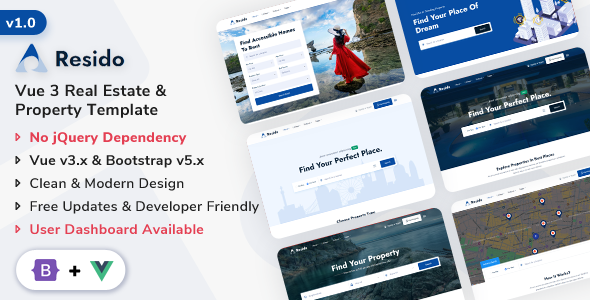
Resido is a Vue.js real estate template with 12+ homepages and a user dashboard, built on Bootstrap. It's ideal for agencies and freelancers needing a fast, modern frontend for property listing websites.
Resido: A Vue.js Frontend for Real Estate Portals
This product is essentially a frontend UI kit for building property listing websites, specifically leveraging Vue.js 3 and Bootstrap 5. It provides a solid visual and structural foundation, designed to get a real estate-focused interface up and running quickly. Think of it as the polished shell for your data, not the engine behind it.
Who Resido Serves Best (and Who Should Look Elsewhere)
Resido is for agencies, freelancers, or in-house development teams already comfortable with Vue.js. If you need to deliver a modern, responsive real estate Vue.js template on a tight deadline, this can save you significant initial design and development time. It's particularly useful if your client's needs align with the clean, modern aesthetic provided.
However, if you're new to Vue.js, this isn't a beginner-friendly starting point; you'll need to understand the framework to customize it effectively. It's also not for projects demanding a deeply unique, custom-built UI that deviates heavily from Bootstrap's conventions, as adapting it might take as much effort as building from scratch. Crucially, this is a frontend-only solution, so it doesn't include any backend logic for property management or user authentication beyond the UI elements.
Design and Layouts for Property Websites
The template offers a good range of pre-built pages, including over a dozen homepage variations and multiple property detail layouts. This provides a strong starting point for typical real estate portal needs, covering everything from agent profiles to search results. The inclusion of a user dashboard UI is a practical touch, offering a ready-made interface for agent or client logins without extra design work.
The design follows a clean, modern aesthetic, which is a safe bet for most real estate businesses. You get options for multi-header layouts and pre-styled modal popups, which are standard but useful components for user interaction and information display on a busy site.
Code Quality and Developer Workflow
From a developer's perspective, the use of Vue.js 3 and Bootstrap 5 is a modern and performant combination. The description mentions a SASS workflow, which means the CSS is organized and easier to manage. This is a big plus for maintainability; changing colors or typography across the entire site is straightforward by adjusting SASS variables, leading to lower long-term maintenance costs for clients.
The explicit mention of "No jQuery Dependency" is excellent. It means the JavaScript is lean and modern, contributing to faster page load times and a smoother user experience. In our experience with similar frameworks, this directly impacts Core Web Vitals positively. Using React Icons and FontAwesome Icons provides a robust and flexible icon set without needing custom SVG work for common UI elements.
Responsiveness and Browser Compatibility
Built on Bootstrap, responsiveness is baked in, meaning the layouts adapt well across various devices out of the box. We noticed the "Great Menu for Small Devices" feature, which usually translates to a well-implemented off-canvas or hamburger menu, crucial for mobile navigation. This attention to mobile experience is standard but important for any modern website, especially for users browsing property listings on the go.
SEO Readiness and Semantic Structure
While a frontend template alone doesn't guarantee top search rankings, Resido provides a good foundation for technical SEO. A clean, semantic HTML structure is key for search engines to understand your content, and modern frameworks like Vue, when implemented correctly, contribute to faster page loads. Faster pages generally mean better user experience and can indirectly influence search engine visibility. The absence of heavy, blocking JavaScript (like jQuery) helps ensure assets load efficiently.
Final Thoughts on Resido's Utility
After building multiple agency sites with tools like this, Resido feels like a genuinely useful starting point for anyone needing a real estate Vue.js template. It solves the workflow problem of spending countless hours on initial UI setup for a niche that has very specific layout demands. While the design is clean and functional, it's not groundbreaking; it's what you'd expect from a well-executed Bootstrap-based template.
What I'd appreciate seeing more of is clearer guidance on how to integrate this frontend with common backend services or APIs, as that's the next logical step for any real-world property portal. However, for its stated purpose as a frontend template, it's a smart investment to save significant development time and get a professional-looking site launched faster.
FAQ
Does Resido include a backend for managing properties or users?No, Resido is a frontend-only Vue.js template. It provides the user interface and visual structure, but you will need to integrate it with your own backend system for data management and user authentication.
Is Resido suitable for a large-scale real estate portal with many listings?Yes, the template provides a solid, scalable frontend foundation. Its SASS architecture and modern Vue.js setup are well-suited for managing complex interfaces, but the overall performance for a large portal will heavily depend on your backend's efficiency and data handling.
Can I easily change the overall look and feel to match my brand?Since Resido is built with Bootstrap and uses a SASS workflow, customizing colors, fonts, and basic styling is relatively straightforward by modifying the SASS variables. For more extensive design changes that deviate significantly from Bootstrap's structure, you'll need a good understanding of Vue.js components and CSS.