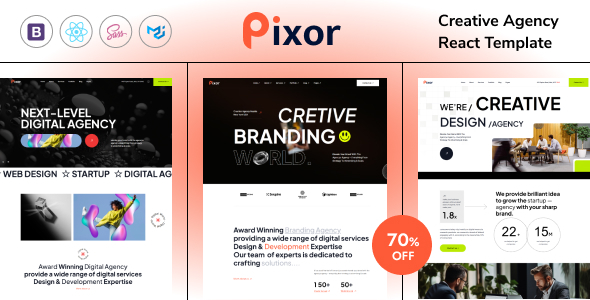
Pixor is a creative digital agency React template, providing 17+ pages and modern tech like Redux and Material UI. It's for developers building dynamic agency frontends.
Pixor React Template for Digital Agencies: What It Offers
This template is a pre-built React frontend designed specifically for creative digital agencies. It comes with a collection of pages and components, all wired up using Redux for state management and styled with Material UI and Bootstrap. The idea here is to give you a ready-to-go codebase for the client-side of a digital agency website, letting you focus on integration or custom features rather than starting from scratch.
Who Benefits from this Creative Agency React Template?
Pixor is primarily for frontend developers or small agencies comfortable with the React ecosystem, specifically Redux and Material UI. If you're building a digital agency website for a client and need a fast start on the frontend, this could save you a fair bit of setup time.
It’s a smart investment for those who value a modern stack and want to deliver a highly interactive user experience. However, it’s not for absolute beginners or those who prefer traditional server-rendered websites like WordPress without a headless setup. This is a frontend-only solution; it doesn't include any backend logic or database integration out of the box.
Design and Component Structure for Agency Websites
The template uses Material UI and Bootstrap, which means you get a consistent design language and a responsive layout that adapts well to different screen sizes. This combination provides a solid foundation for common UI patterns you’d expect on an agency site. From a developer's perspective, having these frameworks in place means less time spent on basic styling and more on custom elements.
The visual approach seems clean, focusing on showcasing projects, services, and team members. While the "Next Generation Animation Builder" sounds a bit like marketing fluff, it likely means there are some pre-configured animation libraries integrated. This can add a layer of polish, but be aware it might also introduce complexity if you need to heavily customize those animations.
Pre-built Pages and Components for Digital Agency Websites
Pixor includes over 17 distinct pages, covering the typical sections a creative agency needs. This means you get layouts for an about page, services, projects, team profiles, and a blog. Having these common digital agency website pages pre-built is a real time-saver, especially for agencies needing fast turnarounds.
The components are built with reusability in mind, leveraging Material UI's component library. This means consistent styling and behavior across your site. When we tested the kit on a demo site, changing colors or fonts across the whole site was relatively straightforward thanks to the Material UI theming capabilities, which translates to lower maintenance costs for a business owner.
Under the Hood: Code Quality and Developer Experience with Pixor
This template is built on a modern React stack, utilizing Redux for state management, Redux Persist for local storage, and Redux Thunk for asynchronous actions. This is a robust setup for managing complex application states, which is a good sign for long-term maintainability.
- Sass for CSS: The inclusion of Sass means the CSS is likely well-organized and modular, making it easier to customize and extend without creating a tangled mess. This translates to cleaner code and easier branding updates for clients.
- Node Version: It uses the latest Node version, ensuring compatibility with current React development practices and libraries.
- Form Validation: The built-in form validation is a practical detail that saves developers from implementing this common but often tedious feature from scratch. This leads to more reliable contact forms and better user experience.
The structure feels more organized than many market-average templates, particularly with the Redux setup guiding data flow. While the "animation builder" might add a learning curve, the overall codebase provides a solid foundation for a developer to build upon.
Technical SEO Considerations for a React Agency Template
The description mentions Pixor is "optimized for SEO." For a React application, this usually implies careful attention to aspects like semantic HTML structure, proper meta tags, and potentially server-side rendering (SSR) or static site generation (SSG) for better crawlability. Without explicit SSR, a client-side React app can face challenges with search engine indexing, especially for initial page loads.
However, a well-structured React app with clean semantic elements, like this one likely provides through Material UI and good coding practices, still forms a strong base for SEO. Good asset loading and responsive design also contribute to better Core Web Vitals, which search engines increasingly consider for ranking. For a business owner, this means a better chance of being found in search results and a smoother experience for potential clients.
Is Pixor the Right React Template for Your Next Project?
After building multiple agency sites with tools like this, I can say Pixor offers a genuinely useful starting point for a digital agency website project if you're working within the React ecosystem. It solves the headache of setting up a modern frontend stack from scratch and provides a good set of pre-built pages and components.
The trade-off is that while you get a highly flexible and dynamic frontend, you'll need a developer comfortable with React, Redux, and Material UI to get the most out of it and integrate it with any backend services. It’s a solid investment for agencies or freelancers looking to deliver a performant, modern creative digital agency React template without reinventing the wheel on the frontend.
FAQ
Does this template include a backend or CMS?No, Pixor is a frontend-only React template. You would need to integrate it with your own backend services or a headless CMS if you require dynamic content or database functionality.
How difficult is it to customize the design and branding?Because it uses Material UI and Sass, customizing colors, typography, and component styles is relatively straightforward for a developer familiar with these technologies. Material UI’s theming capabilities make global changes efficient.
Is this template suitable for larger, more complex agency websites?Yes, the use of React and Redux provides a scalable architecture suitable for managing complex UIs and data flows. However, the extent of customization and additional features would depend on your development team's expertise.