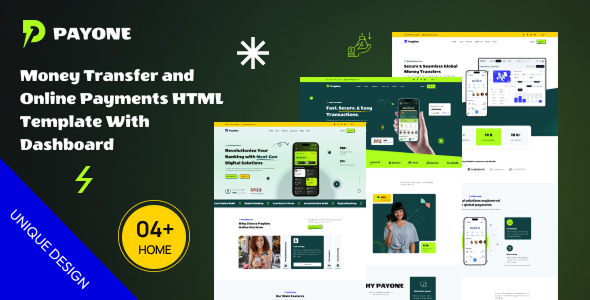
PayOne is an HTML template for online payment systems, digital wallets, and fintech startups. It offers multiple homepages and a user dashboard, ideal for agencies building finance-related frontends.
PayOne: A Frontend Kit for Financial Services
This product is an HTML, CSS, and JavaScript template specifically designed for building the frontend of online payment systems, digital wallets, and banking websites. It’s not a WordPress theme or a full backend solution. What you get is a set of pre-built pages and components, including a significant user dashboard, to accelerate the visual development of a fintech startup website design.
In our experience, templates like PayOne solve the initial headache of designing and coding common financial service interfaces from scratch. It provides a solid visual foundation, saving many hours that would otherwise be spent on basic layout, component styling, and ensuring a consistent look across various pages.
Who Benefits from PayOne and Who Should Look Elsewhere
PayOne is genuinely useful for web developers, agencies, and freelancers who frequently build sites for the financial sector. If you need to quickly prototype or deliver a client-ready frontend for a money transfer platform frontend or a digital banking service, this template gives you a substantial head start.
It is particularly valuable if you plan to integrate a custom backend or a specific payment gateway. You handle the logic, and PayOne handles the presentation. However, this is absolutely not for non-technical users or those expecting a drag-and-drop website builder. It requires coding knowledge to implement, customize, and connect to any dynamic functionality.
Visuals and User Experience for Financial Services
The design approach here is clean and business-focused, which is critical for financial applications. It avoids unnecessary visual clutter, prioritizing readability and a professional feel. The template includes various homepages catering to different aspects like banking, money transfer, and general online payments, offering some flexibility in initial presentation.
From a developer's perspective, the layouts handle typical content well. The structure is predictable, which helps when you need to extend or modify existing sections. Attention to detail is evident in how common elements like forms, tables, and navigation are styled consistently.
Page Variety and Dashboard Functionality
PayOne provides a good number of pages, including four distinct homepages and over 27 inner pages. The standout feature is the included user dashboard, which is essential for any online payment system. It covers typical user flows like transactions, sending money, requesting money, deposits, and withdrawals.
- Homepages: Multiple variations for banking, money transfer, and general online payments.
- User Dashboard: A key component for user-centric financial services.
- Core Pages: About Us, Payment Methods, My Profile, Transactions, Send Money, Request Money, Deposit Money, Withdraw Money, Notifications.
- Utility Pages: Blog, Blog Details, Login, Register, Pricing, Privacy Policy, FAQ, Contact.
This comprehensive set of pages means you are not just getting a few landing pages, but a substantial framework for a functional user experience. This saves significant time compared to building each of these specialized pages from scratch.
Developer-Friendly Code and Structure
Built with Bootstrap and SASS, PayOne offers a solid foundation for developers. The inclusion of SASS files is a major plus, as it allows for efficient styling changes through variables, making global updates like color schemes much faster than sifting through raw CSS. This translates to lower maintenance costs and quicker branding adjustments for a business owner.
The code is described as "user friendly" and "W3C validated," which generally means it adheres to web standards. This helps with cross-browser compatibility and ensures a clean semantic structure, which is beneficial for search engines and accessibility. While the claim "no coding knowledge required" is marketing fluff for a raw HTML template, the organized structure does make it easier for a developer to jump in and customize.
Device Compatibility and Browser Performance
The template is fully responsive, meaning it adapts well to desktops, tablets, and mobile devices. This is a standard expectation today, but it is implemented effectively here. Cross-browser optimization is also mentioned, which means it should render consistently across major browsers like Chrome, Firefox, and Safari.
For a business owner, this ensures a consistent and good mobile experience for their users, which is crucial for engagement and conversion rates, especially in the online payments niche. A well-optimized responsive layout also contributes positively to Core Web Vitals.
Technical SEO Foundation for Fintech Websites
PayOne comes with "SEO friendly code" and W3C validation. This means the underlying HTML structure is clean and semantic, providing a good base for search engine crawlers to understand your content. While an HTML template alone cannot guarantee high rankings, it gives you a proper technical starting point.
A clean code structure helps search engines index your content more effectively, which is important for any online presence, including an HTML template for online payment systems. It means less technical debt to clean up later when you focus on content and keyword strategies.
Is PayOne a Smart Investment for Your Next Project?
If you are a developer or agency tasked with building a frontend for a fintech, banking, or money transfer platform, PayOne is a solid option. It significantly cuts down development time by providing a well-structured, niche-specific set of pages and a comprehensive dashboard. You get a strong visual and technical foundation that you can then integrate with your chosen backend.
The main trade-off is that it is just a frontend. You need the expertise to connect it to a functional backend. However, for what it offers – a polished, industry-focused HTML template with SASS and Bootstrap – it’s a smart investment to accelerate your workflow and deliver professional-looking results faster.
FAQ
Is PayOne a WordPress theme?No, PayOne is a static HTML, CSS, and JavaScript template. It cannot be installed directly into WordPress or any other CMS.
Does this template include a working backend or payment processing?No, PayOne provides only the frontend user interface. You will need to integrate your own backend logic, databases, and payment gateways.
How easy is it to change the template's colors and fonts?Since it includes SASS files, changing colors and typography is relatively straightforward for a developer, typically by modifying a few variables.
Is PayOne suitable for a live, production-ready financial service website?It offers a solid visual and structural foundation, but you must implement robust security measures, server-side logic, and compliance features specific to financial services yourself.