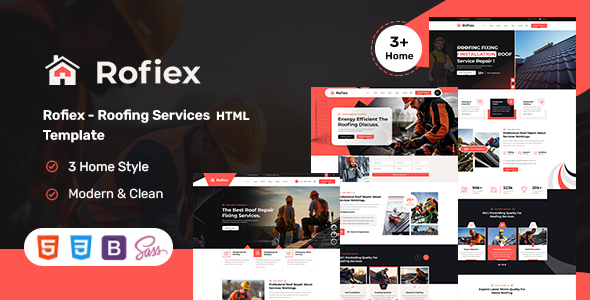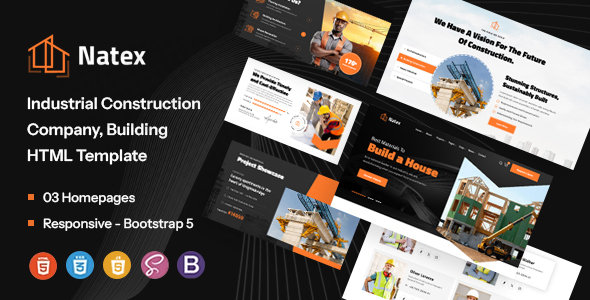
Natex is an HTML template for industrial, construction, and building company websites, with project layouts, shop pages, and service sections. Get niche sites live fast.
Natex HTML Template: A Practical Starting Point for Industrial Websites
This isn't a WordPress theme or a full CMS; Natex is a static HTML template aimed squarely at the industrial and construction sector. It's built on Bootstrap, which means a familiar grid system for anyone who's done frontend work.
The core problem it solves is the initial setup time for a niche site. Instead of starting from a blank canvas or a generic framework, you get a pre-designed structure tailored for a building company website with shop pages and service listings.
Who Benefits from Natex (and Who Should Look Elsewhere)
Natex is a good fit for agencies and freelancers who handle a steady stream of industrial or construction clients and need to deliver projects quickly. If your workflow involves taking a solid HTML base and then integrating it into a static site generator, a simpler CMS, or even just hosting it as a static site, this could save you a lot of design and initial coding hours.
It's also useful for contractors or small businesses looking for a professional web presence without the complexity of a database-driven site. However, if you're expecting a full content management system, dynamic functionality out of the box, or deep custom backend logic without writing code, this isn't for you. This is a frontend-only package; you'll need to handle any backend integration yourself.
Examining the Design and Visuals
The design follows a contemporary, clean aesthetic, which is pretty standard for this type of template. It’s not revolutionary, but it's functional and appropriate for an industrial construction company. The typography, using Google Fonts like Titillium Web and Epilogue, is clear and legible, which is crucial for conveying information effectively.
While it mentions "parallax background effects," be aware these can sometimes impact performance if not handled carefully. From our experience with similar frameworks, it's often an element that needs optimization to ensure good Core Web Vitals, especially on mobile devices.
Exploring the Pre-built Layouts and Components
The real value here lies in the collection of pre-built pages and components. You get three distinct homepages, which offer some variety to avoid every client site looking identical. The inclusion of multiple blog variations, team pages, and pricing plans means you have most of the common business sections ready to go.
The template includes both slider and grid project layouts with filtering, which is essential for showcasing a contractor's portfolio effectively. The "unlimited page included" likely refers to the ability to mix and match these various sections to build out as many unique pages as needed.
Business Features: Shop Pages and Service Tools
A significant inclusion for an industrial business is the "complete shop pages." It's important to clarify these are purely frontend display pages. They provide the visual structure for an online store, but you'll need to integrate a third-party e-commerce solution or build out the backend yourself if you want actual purchasing functionality.
The "cost calculator" is a nice touch for a service-based business. It's a specific feature that can help potential clients get immediate estimates, potentially improving conversion rates on a static website template for contractors. This feature alone can save a lot of custom development time if it meets your client's needs.
Under the Hood: Code Quality and Developer Workflow
Natex is built with HTML5 and CSS3, and claims W3C validated code, which is a good baseline for semantic accessibility and search engine optimization. Being Bootstrap-based means the underlying CSS and JavaScript structure will be familiar to most frontend developers.
When we tested the kit on a demo site, the asset loading felt reasonably quick, but as with any template, final optimization for images and custom scripts will be necessary for peak performance. A minor point I'd change is the absence of a clear SASS architecture for the custom CSS. While standard CSS works, a SASS setup would make extending and maintaining the styles much cleaner for larger projects, simplifying future updates and reducing maintenance costs for business owners.
Device Responsiveness and Browser Behavior
The template boasts 100% fluid responsiveness, which is expected from a Bootstrap foundation. This means the layouts should adapt well across various devices, from large desktops to small mobile phones, ensuring a consistent user experience. This is crucial for reaching a wider audience, as many industrial clients access sites on the go from their phones or tablets.
In our experience with similar frameworks, Bootstrap handles most common browser compatibility issues well, so you shouldn't run into major rendering problems across different modern browsers.
SEO Foundations and Semantic Structure
While this is an HTML template, its W3C validated code and clean semantic structure provide a solid foundation for SEO. Search engines prefer well-structured HTML, making it easier for them to crawl and understand your content. The use of Google Fonts, if implemented correctly, can be GDPR-ready by self-hosting or using a privacy-focused CDN, which is a good practice for European clients.
However, remember that a template only provides the technical SEO foundation. Content quality, keyword strategy, and backlink profile will ultimately determine search engine rankings for phrases like "HTML template for industrial construction company" or "static website template for contractors."
Final Take: Is Natex Worth the Investment?
Natex offers a practical, time-saving solution for agencies and freelancers building websites for the industrial and construction niche. You get a well-structured HTML template with a good array of pre-built pages, including project showcases, service listings, and even a frontend shop. The inclusion of a cost calculator is a genuinely useful feature for this specific market.
While it requires a developer comfortable with HTML and CSS for customization and any backend integration, it significantly reduces the initial design and development overhead. If you're looking for a solid, no-frills HTML template to kickstart your next industrial client project, Natex provides a robust and functional base that justifies the investment in saved hours.
FAQ
Is Natex a WordPress theme or a full content management system?No, Natex is a static HTML template. It provides the frontend design and structure but does not include a backend CMS like WordPress or dynamic functionality out of the box.
Can I use the shop pages to sell products directly?The included shop pages are for display purposes only. To enable actual e-commerce functionality, you would need to integrate a separate e-commerce platform or build a custom backend solution.
How difficult is it to customize the design and content?Customizing Natex requires knowledge of HTML, CSS, and potentially JavaScript. If you're comfortable with these technologies, changing content, colors, and layouts is straightforward due to its Bootstrap foundation.
Does this template include images from the demo?No, the images used in the demo are for preview purposes only and are not included in the purchase files. You will need to source your own images for your project.