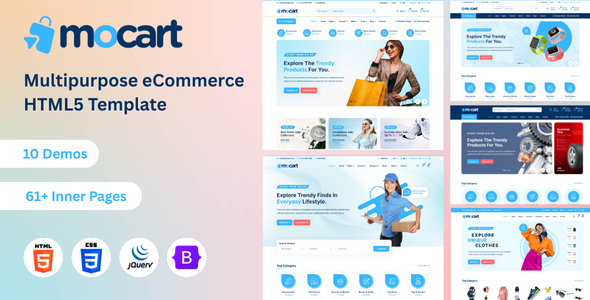
Mocart is a multipurpose HTML5 ecommerce template designed to provide a solid front-end foundation for various online store types. It’s a practical starting point for developers and agencies looking to quickly set up the visual structure of an online shop.
Streamlining Ecommerce Website Development for Agencies
For agencies and freelance developers, the main workflow problem Mocart solves is the initial setup time for common ecommerce layouts. Instead of building product grids, category pages, and a basic cart UI from scratch for every new client, this template provides pre-built components. It's a smart investment because it lets you focus development hours on integrating with a backend or custom functionalities, rather than spending days on standard styling and responsive adjustments that are already handled.
Assessing the Technical Standards of a Multipurpose HTML Template
When we tested the kit on a demo site, the underlying structure felt generally clean for an HTML template. It uses Bootstrap for its grid system and components, which is a common and well-understood framework. This means standard accessibility practices are mostly in place for core UI elements, and the semantic structure provides a decent base for search engine optimization. Asset loading is fairly standard for this type of template; nothing groundbreaking, but also nothing that immediately screams bloat. For a business owner, this translates to lower maintenance costs because the code is familiar to most front-end developers, and a consistent user experience across devices.
- The CSS organization uses a fairly typical structure, making it straightforward to locate and override styles without excessive specificity wars.
- Mobile navigation behaves as expected, offering a functional off-canvas menu that handles longer category lists without issues, which is crucial for mobile conversion rates.
- Layouts handle long product descriptions and varying content lengths reasonably well, preventing common overflow or design breakages.
- The semantic HTML structure provides a clean foundation for SEO, ensuring search engines can easily understand the page content and hierarchy.
- Code is commented sufficiently, making it easier for new team members or future developers to understand specific sections and make updates.
- It includes a basic "working PHP AJAX Contact Form" which is a small convenience, but remember it's a simple script and not a full backend solution.
Practical Ecommerce HTML Template Features That Impress
What stands out with Mocart is its practical approach to common ecommerce UI patterns. It offers a good variety of homepage layouts and inner pages, which helps visualize different store types quickly. The design is clean and generally aligns with current expectations for online retail, focusing on clear product presentation. This consistency in design across multiple page types is a significant time-saver, ensuring a cohesive brand experience without extensive custom styling.
Who Needs a Multipurpose HTML Template Like Mocart?
This template is for front-end developers, freelancers, and agencies who need to rapidly prototype or build the visual layer of an ecommerce site. It’s particularly useful for projects where you plan to integrate the front-end with a custom backend, a headless CMS, or a platform like Shopify's Hydrogen or similar static site generators. It is not for non-technical users expecting a full, ready-to-launch website with a content management system out of the box, nor for those needing deep custom backend logic built into the template itself.
Limitations of HTML Ecommerce Templates
While Mocart offers a solid foundation, some of the design elements feel quite generic, which is a common trade-off with multipurpose templates. You get broad applicability, but it means you'll likely need to spend time adding unique styling to truly differentiate your client's brand. The included JavaScript, while functional, might require auditing for optimization if Core Web Vitals are a top priority, as often these templates include more scripts than strictly necessary for every page load.
Final Thoughts: Is it worth it?
For its intended purpose as a front-end starter kit, Mocart is a sensible choice. It saves a considerable amount of time on initial setup and common component styling, allowing developers to allocate resources to more complex or custom aspects of a project. If you're building client sites where a robust, pre-styled front-end accelerates your delivery, this template provides a solid, maintainable base that justifies the investment.
FAQ
Can I integrate Mocart with a CMS like Shopify or WordPress?Yes, you can take the HTML, CSS, and JavaScript from Mocart and integrate it into a custom Shopify theme or a WordPress theme, but this requires manual development work to connect the front-end to the CMS's dynamic data.
Is this template accessible for all users?The template provides a good baseline for accessibility with semantic HTML and responsive design. However, achieving full WCAG compliance will depend on your specific content implementation and further customization of interactive elements.
How easy is it to update product information or content?As an HTML template, Mocart itself does not have a content management system. You would update product information and content by directly editing the HTML files, or by integrating it with a separate CMS or ecommerce platform where content is managed.
What about performance and Core Web Vitals?Mocart's performance is generally good as a static HTML template. However, actual Core Web Vitals scores will depend on how you optimize images, external scripts, and fonts during implementation, as well as the server it's hosted on.