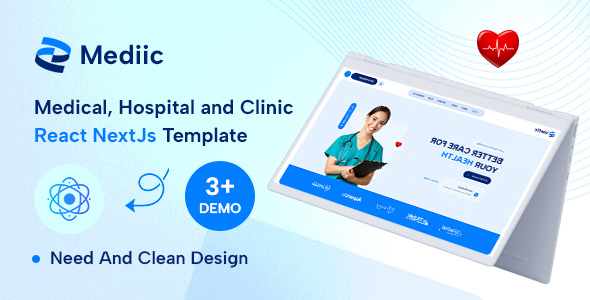
Mediic: A React Next.js template for medical, hospital, and clinic websites, featuring 3+ homepages and 18+ pre-built pages. Ideal for agencies and developers needing a fast frontend for healthcare platforms.
What Mediic React Next.js Template Offers for Healthcare Websites
Alright, so you're looking at Mediic, a React Next.js template aimed squarely at the medical and healthcare sector. Forget the marketing fluff; what this really is, is a solid frontend foundation. It’s not a full-stack solution or a WordPress theme out of the box, but a collection of well-structured React components and pages.
In our experience building agency sites, having a pre-built frontend like this for a specific niche, like a medical clinic website, can save a significant chunk of design and initial development time. It means you aren't starting from a blank canvas for every doctor profile or service page.
Who Should Use Mediic for Their Clinic Website (and Who Shouldn't)
This template is for agencies and freelance developers who are already working with React and Next.js. If you're building custom web applications or integrating with a headless CMS for healthcare clients, this can act as a serious accelerator.
It's particularly useful if you need to quickly spin up a polished, modern frontend for a new clinic or a specific medical service layout. However, if you're a non-developer expecting a drag-and-drop website builder or a complete backend system for appointment management, this isn't it. You need to be comfortable with React development to get value from Mediic.
Design Approach and Layouts for Medical Service Websites
Mediic provides three distinct homepage layouts and a collection of essential internal pages. These include service listings, individual service detail pages, team member profiles, and a blog section. For a medical practice, having dedicated layouts for doctor bios and detailed service descriptions is crucial for informing potential patients.
The template is built on a 1320px grid system, which is a standard width for modern desktop layouts, providing a good base for content organization. It uses free Google Fonts and font-based icons, which are practical choices for maintaining consistent branding and ensuring fast loading without licensing headaches.
Developer Experience and Code Structure in Mediic
When we tested the kit on a demo site, the file structure felt logical. The vendor claims "easily customizable React Next JS files" and "fully layered and organized with proper names," which held up. This means less time hunting for specific components or styling rules, and more time building out client-specific features.
For a business owner, this translates directly into lower development and maintenance costs. A well-organized codebase is easier to update and debug, meaning your medical website template remains current and functional without excessive developer hours.
Using Next.js as the framework is a smart move for performance. It offers server-side rendering or static site generation capabilities, which helps with initial page load times and search engine visibility. This is a significant step up from a basic client-side React app for a public-facing healthcare website design.
Responsiveness and Accessibility Considerations
The template is fully responsive, which is a baseline expectation today. It should adapt well across various devices, providing a consistent user experience whether viewed on a desktop or a mobile phone. This is critical for patient access, especially when searching for medical information on the go.
Given it's a Next.js project, it naturally benefits from features like automatic image optimization and efficient asset loading. These contribute positively to Core Web Vitals, which Google now uses as a ranking factor. A clean semantic structure, typical of well-built React applications, also helps with technical SEO for medical services, making it easier for search engines to understand your content.
Final Thoughts: Is Mediic a Smart Investment for Your Healthcare Project?
If you're a developer or agency looking to accelerate your frontend development for medical, hospital, or clinic websites, Mediic is a solid choice. It provides a clean, well-organized starting point that genuinely saves design and initial coding time.
Its main limitation, which isn't unique to this template, is that it’s purely a frontend. You'll need to factor in the time and cost of integrating it with a backend system for dynamic content, appointment booking, or patient portals. However, for getting a polished, performant healthcare website frontend up and running quickly, this React Next.js template is a smart investment.
FAQ
Does Mediic include a backend for appointment booking or patient management?No, Mediic is a frontend template built with React and Next.js. It provides the visual interface and structure, but you will need to integrate it with a separate backend system or API for any dynamic data, booking functionalities, or patient portals.
Can I easily integrate Mediic with a headless CMS like Strapi or Contentful?Yes, absolutely. Since Mediic is a React Next.js template, it's inherently designed to consume data from APIs, making integration with a headless CMS like Strapi, Contentful, or Sanity quite straightforward for managing your content.
What's the primary benefit of using Next.js for a medical website compared to a standard HTML template?Next.js offers significant performance and SEO advantages through server-side rendering (SSR) or static site generation (SSG), leading to faster page loads and better search engine visibility. It also provides a more robust and maintainable development environment than plain HTML.
Is this template suitable for a large hospital system or just a small clinic?Mediic is best suited for small to medium-sized clinics, individual practices, or specific departmental microsites within a larger hospital system. For a full enterprise-level hospital system, you'd likely need a more custom-built framework, though components from Mediic could still serve as a starting point.