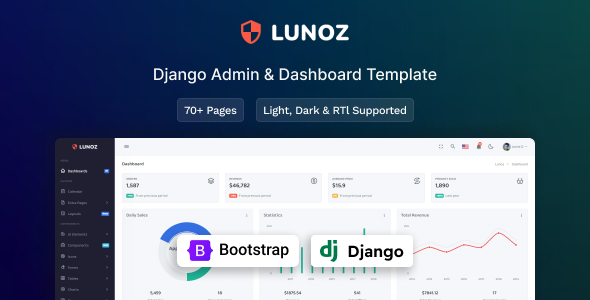
Lunoz is a Django admin dashboard template built with Bootstrap, offering 48+ pages and essential UI components for rapid backend development. It is a solid starting point for agencies and freelancers building custom Django dashboards.
What Lunoz Django Admin Template Offers Developers
This is a Bootstrap-based admin dashboard template specifically designed for Django applications. It aims to cut down the initial development time for backend user interfaces. Instead of building common elements like forms, tables, and navigation from scratch, Lunoz provides a pre-assembled set of these components, integrated within a Django project structure.
The core value here is efficiency. When you are on a tight deadline for a client's internal tool or a SaaS product's admin panel, having a robust foundation like this means you can focus on the unique business logic rather than spending days on UI styling and component integration. This saves development costs and allows for faster project delivery.
Who Lunoz Dashboard is For and Who Should Avoid It
Lunoz is ideal for web developers, agencies, and freelancers who frequently build custom Django applications, particularly those needing a polished admin dashboard or an internal tool interface. If your workflow involves quickly spinning up backend UIs that need to manage data, users, or content, this template provides a significant head start. It is particularly useful for those already comfortable with Bootstrap and Django, looking for a pre-styled framework.
However, it is not for absolute beginners to either Django or front-end development. While it simplifies much of the UI work, integrating it into a complex, existing Django project or customizing it extensively still requires a solid understanding of both frameworks. If you need a completely unique, highly custom design that deviates significantly from Bootstrap's conventions, you might spend more time overriding styles than building from scratch, making it less suitable.
Design and Visual Approach of Lunoz Dashboard
The template features a clean and flat design, which is pretty standard for modern admin interfaces. This approach prioritizes functionality and data readability over elaborate aesthetics. It includes both vertical and horizontal layouts for the main navigation, giving you flexibility in how you want the dashboard to be organized for your users.
You get a good selection of icon sets, including Feather, Material Design, Dripicons, and Font Awesome. This variety means you can usually find appropriate icons without needing to integrate additional libraries, which keeps asset loading lean. The flat design also makes it straightforward to apply your own branding colors and logos through SASS variables, ensuring a consistent look and feel for your client's application.
Pre-built Pages and Components for Django Admin
Lunoz comes with over 48 pre-built pages and a large collection of UI elements. This includes essential pages like login, registration, and error pages, which are often time-consuming to style correctly. Beyond the basics, you will find pages for calendars, team members, invoices, maintenance, FAQs, and pricing. These are common needs for many business applications and can be quickly adapted.
For data handling, it includes both Bootstrap and Datatables tables, along with form validation. There are also integrations for maps, file uploads using Dropify, and the Quill Js editor for rich text content. The template bundles several Bootstrap plugins like Select2 for enhanced dropdowns, date pickers, and color pickers. This extensive collection means you are likely to find most common UI components already styled and ready to be connected to your Django backend logic.
Code Quality and Developer Experience with Lunoz
The template is built with Bootstrap and Django, following standard conventions for both. It offers SASS support, which is a big plus for customization. When we tested the kit on a demo site, the SASS files were organized logically, making it relatively easy to locate and modify variables for colors, fonts, and spacing. This means less time digging through compiled CSS and more time focusing on project-specific styling.
After building multiple agency sites with tools like this, we appreciate a clear file structure. Lunoz provides a familiar setup that doesn't try to reinvent the wheel, making it easy for any developer with Bootstrap experience to jump in. The asset loading feels standard; it is not overly optimized out of the box but provides a good baseline that can be further tuned for Core Web Vitals if needed, which benefits the user experience by keeping the dashboard responsive.
Lunoz Responsiveness Across Devices
Lunoz is designed to be fully responsive across desktops, tablets, and mobile devices. This is a non-negotiable standard for any modern web template, even for internal tools. In our experience, the layouts adapt well, and common elements like navigation menus transform into mobile-friendly versions without major glitches. For instance, data tables, which can be tricky on small screens, typically either scroll horizontally or collapse into a more manageable format.
Ensuring a good mobile experience for an admin panel is crucial for team members who might need to check data or approve actions on the go. Lunoz handles this competently, providing a consistent user interface regardless of the device. This attention to responsive design means lower maintenance costs down the line, as you do not have to build separate interfaces for different screen sizes.
SEO Readiness for Django Admin Panels
While an admin panel is typically not public-facing, good code structure still matters. Lunoz uses clean semantic HTML, which is a good practice for maintainability and accessibility. Even for internal tools, a well-structured document helps screen readers and ensures a more accessible experience for all users. The underlying structure can also contribute to a faster-loading interface, which indirectly impacts user satisfaction and productivity.
The template does not include specific SEO features, as that is generally handled at the application level for public-facing pages. However, its clean base means you are not fighting against bloated or poorly structured code if parts of your Django application eventually need to be exposed to search engines. It provides a solid technical foundation without making any unrealistic ranking promises.
Final Thoughts on Lunoz Django Template
Lunoz is a practical choice for developers and agencies looking to accelerate their Django admin dashboard development. It provides a comprehensive set of pre-built pages and UI components that genuinely save significant time on boilerplate setup and styling. The SASS support and logical structure make it relatively easy to customize to fit specific branding and functional requirements.
While it is a robust starting point, remember it is a template, not a complete application. You will still need to integrate it with your Django views, models, and business logic. However, for anyone needing a solid, well-structured Bootstrap admin panel for Django projects, Lunoz offers a compelling value proposition, allowing you to deliver functional, good-looking backend interfaces faster and more efficiently. It is a smart investment to reduce repetitive front-end work on your next project.
FAQ
Does Lunoz require a deep understanding of Bootstrap to customize?While basic Bootstrap knowledge helps, the SASS files are organized to make common customizations like colors and fonts straightforward by modifying variables, so you do not need to be a Bootstrap expert.
Can Lunoz be easily integrated into an existing Django project?Yes, Lunoz provides a structured set of files that can be integrated into an existing Django project. However, you will need to connect its templates and static assets to your Django application's URLs and views.
Is Lunoz suitable for building multi-user admin panels with different access levels?Lunoz provides the visual framework for an admin panel. Implementing multi-user authentication and different access levels would be handled by Django's built-in authentication system and your application's specific permission logic, which the template supports.