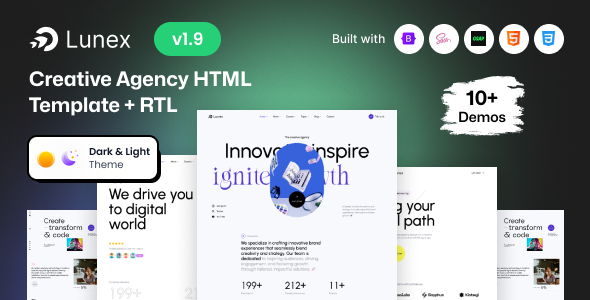
Lunex is an HTML template for digital agencies, startups, and service businesses, featuring 9+ home demos and 21+ inner pages. It’s a solid starting point for agencies needing a quick, professional online presence.
Lunex: A Practical HTML Template for Agency Websites
After building multiple agency sites with various tools, Lunex comes across as a straightforward HTML template aimed at getting a professional digital agency website up without fuss. It focuses on the front-end presentation for service-based businesses, providing a set of pre-built pages that cover typical agency needs.
This isn't a WordPress theme or a full CMS. It’s a collection of HTML, CSS, and JavaScript files that you host yourself. From a developer's perspective, it offers a pre-styled foundation, saving you from coding common sections like hero banners, service blocks, or team pages from scratch.
Who Lunex Serves and Who Should Look Elsewhere
This HTML template for digital agencies is ideal for freelancers or smaller agencies who need to launch client websites quickly, especially if those clients have modest content update needs. If you're comfortable with direct HTML and CSS edits, and your client doesn't require a full content management system for daily updates, Lunex offers a fast track.
It’s also a good fit for developers looking for a clean base to integrate with a static site generator or a custom backend later. However, Lunex is not for beginners who expect a drag-and-drop experience or deep custom backend logic out of the box. If your client needs to edit content daily without touching code, or requires complex integrations like advanced CRMs or custom booking systems, you'll need to build that functionality on top or opt for a different solution entirely.
Design and Visual Approach for Creative Agencies
Lunex provides a clean, modern design that feels appropriate for a creative agency website template. It leans on Bootstrap for its grid system, which means layouts are generally consistent and responsive. The inclusion of a dark/light mode toggle is a nice touch, offering visual flexibility for visitors and showing a bit more attention to user experience than many standard templates.
The visual style is professional, avoiding overly flashy elements that often date templates quickly. Typography is clear and readable, using Google Fonts which are easy to swap out if you need to match specific brand guidelines.
Layouts, Pages, and Components for Digital Services
The template includes 9+ home page demos and over 21 inner pages, which is a solid offering for building client websites quickly. The demos cover various agency types like "Creative Agency," "Digital Agency," "Dev Agency," and "SEO Agency." This variety means you can often find a starting point that's close to your client's specific niche, reducing initial setup time.
- Home Demos: The range of home page layouts provides different visual entry points, from portfolio-heavy to service-focused. This helps in quickly matching a client's primary business goal.
- Inner Pages: Standard inner pages like About Us, Services, Team, and Contact are included. This covers the typical informational architecture for most service businesses.
- Key Components: Common UI elements like sliders (Owl Carousel), popups (Magnific Popup), and animations (GSAP) are integrated. These are standard tools that add a layer of interactivity without requiring custom development for basic effects.
Code Quality and Developer Experience
Lunex is built on Bootstrap, which is a well-understood framework for front-end development. The use of Sass for CSS architecture is a definite plus for developers. It means the styling is organized with variables and mixins, making it much easier to maintain, customize, and ensure consistent branding across the site. For a business owner, this translates to lower maintenance costs and easier future updates.
The code is stated to be W3C-approved, which implies a clean semantic structure. This is good for SEO readiness and overall web standards compliance, meaning search engines can better understand your content, and the site should perform reliably across different browsers. However, like many templates, it does include several JavaScript libraries (Owl Carousel, GSAP, Magnific Popup) which, while functional, can add to the page weight and initial load times if not optimized. We've seen this impact Core Web Vitals on similar frameworks if not managed carefully.
Responsiveness and Compatibility for All Devices
Being built on Bootstrap, the template is inherently responsive. This means the layout adjusts well across desktops, tablets, and mobile phones, providing a consistent user experience regardless of the device. This is a fundamental expectation for any modern website, and Lunex delivers on it. Cross-browser compatibility is also a standard feature, ensuring the site looks and functions correctly in major browsers like Chrome, Firefox, Safari, and Edge.
SEO Readiness and Semantic Structure
The claim of W3C-approved and well-structured HTML code points to a decent foundation for SEO. Clean, semantic HTML helps search engines crawl and understand your content more effectively. While the template itself doesn't guarantee top rankings, it provides the technical groundwork for good on-page SEO. The structure allows for proper heading hierarchies and content organization, which are crucial for search engine visibility.
Final Verdict: A Solid Base for Agency Front-Ends
Lunex is a competent HTML template for digital agencies and service businesses looking for a pre-built front-end solution. It's not revolutionary, but it's a practical choice for developers and agencies focused on efficient client delivery. The variety of demos, organized Sass, and Bootstrap foundation make it a time-saver for getting a visually appealing and responsive site online quickly.
While it lacks a CMS, which is a trade-off for its simplicity and speed, it excels at providing a strong visual and structural starting point. If your workflow involves delivering static sites or integrating with a custom backend, investing in Lunex can genuinely save you significant hours on initial design and front-end development, allowing you to focus on client-specific features or content.
FAQ
Is Lunex easy to customize for specific client branding?Yes, because it uses Sass, you can easily change colors, fonts, and other stylistic elements by modifying variables in the Sass files, which then compile to your CSS.
Does this template include any backend functionality or a content management system?No, Lunex is purely an HTML, CSS, and JavaScript front-end template. It does not include any backend features, database integration, or a content management system like WordPress or Joomla.
Can I use Lunex to build an ecommerce store?Lunex is not designed with ecommerce features like product listings, shopping carts, or checkout flows. While you could technically add these functionalities, it would require significant custom development.
How does Lunex handle accessibility standards?Built on Bootstrap and claiming W3C-approved code, Lunex provides a foundational level of accessibility. However, full accessibility compliance often requires specific content implementation and further testing beyond what a base template provides.
.png)