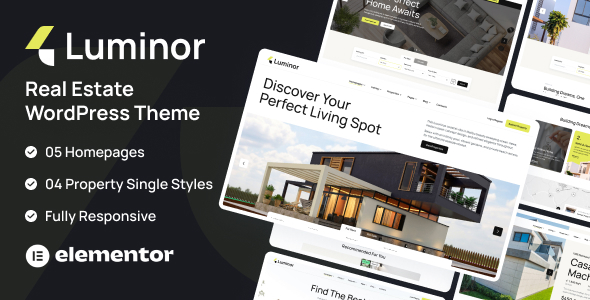
Luminor is a real estate WordPress theme for agencies, agents, and property portals needing a quick launch with extensive property management features. This theme is built for those who prioritize speed and functionality in their property listings.
Luminor Real Estate WordPress Theme: A Developer's Take
When we're tasked with building a real estate website, especially for clients who need to get listings up fast, themes like Luminor immediately catch our eye. This WordPress theme comes packed with features specifically for the real estate niche, aiming to cut down on development time significantly. It's designed to handle everything from individual agent portfolios to larger agency sites and even property directories.
Who is Luminor For and Who Should Skip It
This theme is a solid choice for real estate agencies, individual agents, and property rental businesses that need a functional website with advanced listing capabilities without starting from scratch. If your primary goal is to launch a professional-looking site with robust property search, detailed listings, and agent profiles quickly, Luminor can be a great time-saver.
However, if you're building a highly custom real estate platform with unique backend logic, complex integrations beyond typical property management, or require deep architectural customization, this theme might feel a bit limiting. It's built for a specific workflow, and deviating too far from its intended use could lead to more work than it saves. For those needing extensive custom development for niche real estate applications, exploring a custom build or a more flexible framework might be a better path.
Solving the Real Estate Website Launch Headache
The biggest workflow problem Luminor aims to solve is the sheer time it takes to build a feature-rich real estate site. We found that setting up advanced property searches, multiple listing layouts, agent dashboards, and even frontend property submission forms from scratch can easily consume 30-40 hours of development time. Luminor bundles these essential elements, allowing us to get a functional base up and running in a fraction of that time, often within a day or two, including initial content population.
The inclusion of features like an advanced search with customizable fields, map integrations (Google Maps and Mapbox), and property submission forms directly addresses common client requests. For example, the ability to easily reorder and enable/disable search fields means we can quickly tailor the search experience to a client's specific market without writing custom PHP. This is particularly helpful when building a site focused on a specific type of property, like vacation rentals or commercial spaces, where search filters differ.
Under the Hood: Code, Performance, and Standards
From a developer's perspective, Luminor's code organization is generally clean. It relies heavily on Elementor, which, while offering great visual control, can sometimes lead to bloat if not managed carefully. We noticed that the theme's asset loading is reasonably well handled, with options to optimize images using lazy loading, which is crucial for good Core Web Vitals scores and a better mobile experience for users browsing property listings on the go.
The theme appears to adhere to standard accessibility practices, which is important for any public-facing website. Its semantic structure is also decent, providing a good foundation for SEO. While it doesn't reinvent the wheel in terms of its CSS architecture, it's organized enough for us to make necessary adjustments without getting lost. For instance, finding and modifying styles for specific property listing elements is straightforward.
Real-World Workflow Insights
The one-click demo importer is a standard but always appreciated feature. It gets us to a visual starting point quickly. Customizing colors and fonts through the theme options is also quite intuitive, which is great for client handover. We did find that while the theme offers many listing layouts, some of the more specialized ones, like the half-map or top-map views, require careful content setup to look their best.
One area where Luminor, like many themes in this category, could be improved is in its handling of very long property descriptions or feature lists. Sometimes, the default styling can make these sections a bit dense and harder to read on smaller screens. We often find ourselves adding custom CSS to improve readability for these specific content blocks.
Luminor: A Practical Choice for Property Sites
Luminor offers a pragmatic approach to building real estate websites. It delivers a wealth of niche-specific functionality out-of-the-box, significantly reducing the time and cost associated with custom development. While it might not be the perfect fit for every single edge case in real estate technology, for the vast majority of agencies and agents looking to establish a strong online presence with efficient property management, it's a smart investment that pays for itself in saved development hours and faster client launches.
FAQ
Is Luminor suitable for international property listings with multiple languages?Luminor is compatible with translation plugins like WPML, allowing for multilingual website creation, but requires manual setup for translations.
Can I integrate custom booking forms for rentals directly into Luminor?While Luminor supports general property listings and submissions, integrating complex custom booking forms might require additional plugins or custom development.
How does Luminor handle user-generated content for property reviews and ratings?The theme includes built-in features for property reviews and ratings, allowing users to submit feedback directly on property pages.
What is the process for updating Luminor once a new version is released?Updates are typically managed through the WordPress dashboard via the Envato Toolkit plugin, ensuring you receive new features and security patches.

.__large_preview.png)
.__large_preview.png)