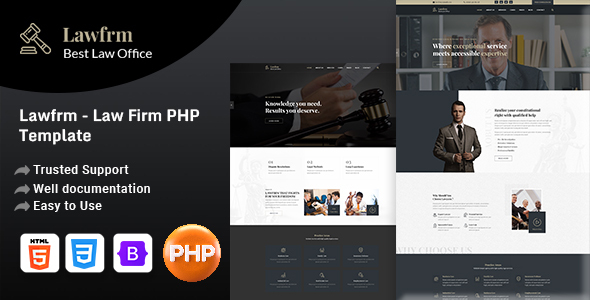
Lawfrm: A responsive PHP template for law firms and legal services. It includes 2 homepages, 18 inner pages, and clean code for agencies and freelancers needing a fast, robust foundation.
Lawfrm PHP Template for Legal Professionals: A Developer's Perspective
This isn't a WordPress theme or a full-blown application framework. Lawfrm is a responsive PHP template, meaning you get pre-built HTML, CSS, and some basic PHP includes to structure a website. It’s specifically designed for law firms, attorneys, and other legal service providers, offering a quick start with relevant page layouts and a professional visual style.
In our experience building multiple agency sites, products like this solve the initial setup headache. You're not starting from a blank file, which can save significant development hours on styling and basic page construction for a legal website template.
Intended Users: Who Benefits from a Law Firm Website Template
Lawfrm is a solid pick for web agencies and freelance developers who regularly build sites for legal clients and prefer to work directly with code. If your workflow involves integrating a static front-end with a custom or lightweight backend, or you simply need a polished, ready-to-go front-end for a client presentation, this template fits well.
However, this is not for everyone. If you're a non-technical business owner looking for a drag-and-drop editor or a comprehensive content management system, this isn't it. This template also isn't ideal for projects requiring deep, custom backend logic without additional development work, as it provides only the front-end structure.
Layouts and Pages: Core Structure for Legal Services
The template provides two distinct homepage versions and 18 inner pages. This covers most of the essential sections a law firm website would need, such as service pages, team profiles, contact forms, and potentially a blog or case studies section. Having these common layouts pre-built means less time spent on basic wireframing and styling.
The inclusion of an Owl Carousel slider is standard for showcasing content. While not groundbreaking, it’s a functional component that works as expected for presenting images or testimonials without custom coding.
Code Quality and Developer Experience: Building on a Solid Foundation
Lawfrm is built on Bootstrap, which provides a familiar and robust framework for most developers. The code is described as valid HTML5/CSS3 and W3C validated, which is a good sign for maintainability and cross-browser compatibility. All files are well-commented, and extensive documentation is included, which genuinely helps when you need to quickly understand the structure or modify specific elements.
When we tested the kit on a demo site, the file organization felt logical. This makes it straightforward to locate and edit CSS for color changes, adjust PHP includes for global elements, or update specific page content. This clean structure contributes to lower maintenance costs and makes future updates easier for any developer taking over the project.
The template uses Google Fonts (Lato, Playfair Display), FontAwesome, and Flaticons for typography and iconography. Loading these assets efficiently is important for performance. While not explicitly stated, a well-built Bootstrap template usually handles asset loading in a way that aligns with standard accessibility practices and helps with Core Web Vitals, leading to a faster mobile experience for site visitors.
Responsiveness and Compatibility: Reaching Clients on Any Device
Being fully responsive and cross-browser compatible is a baseline expectation today, and Lawfrm delivers on this. Based on its Bootstrap foundation, the layouts adapt well to various screen sizes, from large desktops to smaller mobile devices. This ensures that a law firm's online presence looks consistent and functions correctly for all potential clients, regardless of how they access the site.
SEO Readiness: Technical Foundation for Visibility
The claim of "truly SEO Optimized Code" means the template provides a clean, semantic HTML structure. This is crucial because search engines can more easily crawl and understand the content, which is the technical foundation for better search engine visibility. It doesn't guarantee top rankings, but it sets a solid technical stage for any further SEO efforts, contributing to a better chance of ranking for terms like "responsive legal website template."
A clean code base also generally translates to faster load times, which positively impacts Core Web Vitals and overall user experience, a factor search engines increasingly consider for ranking.
Final Verdict: Is Lawfrm the Right Choice for Your Next Legal Project?
Lawfrm is a practical choice if you need to build a law firm site without a CMS and prefer working directly with a well-structured, static template. It saves significant time on initial setup, offering a professional design and essential pages tailored for the legal niche. The clean code, Bootstrap foundation, and good documentation mean developers can get a project off the ground quickly and maintain it efficiently.
While it lacks a built-in content management system, which means content updates require direct code edits, this is also its strength for those who want full control or are integrating with a custom backend. For agencies and freelancers focused on rapid deployment for legal clients, Lawfrm offers a robust and time-saving starting point.
FAQ
Is this template suitable for a small solo practitioner?Yes, if the practitioner has a developer or is comfortable with direct code editing for content updates, it provides a professional and focused online presence.
Can I easily add more custom pages to this template?Yes, since it's a PHP template, you can duplicate existing page files and modify their content and structure using standard HTML and CSS to create new pages.
Does this template include a content management system?No, Lawfrm is a static PHP template and does not come with an integrated content management system; content updates require direct file modifications.
How difficult is it to update content on a Lawfrm site?Updating content requires editing the HTML/PHP files directly. While the code is well-commented, it's a developer-centric process, not a point-and-click interface for non-technical users.