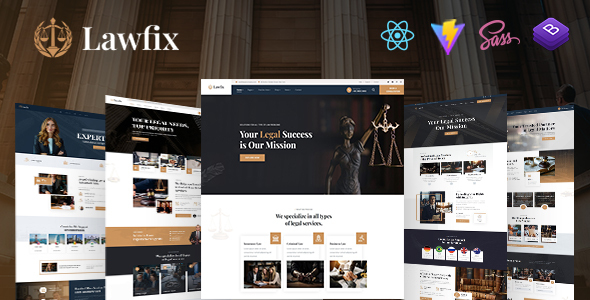
Lawfix is a React template for attorney and lawyer websites, built with React Bootstrap. It's a practical foundation for agencies and freelancers needing a quick start in the legal niche.
Lawfix React Template for Legal Service Websites: A Practical Look
Let's be clear about Lawfix. This isn't a full content management system or a backend framework; it’s a frontend React UI template specifically for law firms and legal professionals. Think of it as a pre-organized collection of React components and page layouts. Its main purpose is to give you a significant head start on the visual and interactive parts of an attorney website development project, preventing you from building every UI element from scratch.
When we tested the kit on a demo site, it felt like a solid base for anyone comfortable with the React ecosystem. It effectively solves the initial styling and component creation headache, especially for those working under tight deadlines.
Who This Legal Niche Template Serves (and Who It Doesn't)
This template is for agencies and freelance developers who regularly build sites for the legal sector and want to accelerate their workflow. If you're building a new website for a law firm, a solo attorney, or a legal service, Lawfix offers a direct shortcut on the frontend. It’s particularly useful if React is already part of your technology stack and you need a quick way to get a client-facing design up and running.
On the flip side, if you're new to React or JavaScript development, this isn't a simple "drag and drop" solution. It requires a developer to integrate it into a project and manage its state. It's also not for someone needing complex backend logic or a full-stack application built-in; it’s strictly a frontend UI kit.
Design and Layouts for Law Firms
Lawfix includes ten distinct home page layouts, which provides good variety for different types of legal practices. While the core structure is consistent, these layouts offer useful starting points. The chosen typography, using DM Sans and Playfair Display, is clean and professional, ensuring good readability—a critical aspect for legal content on any legal service website builder.
The design adheres to standard responsive practices, meaning it adapts well across various devices. This translates to less debugging time and a better mobile experience for potential clients, which can also reduce future maintenance efforts. The retina-ready assets ensure visuals remain sharp on high-resolution screens, which is a standard expectation today.
Reusable Components and Page Structures
The real value of Lawfix lies in its reusable components. Instead of creating a "services offered" block or an "attorney profile" card from scratch, you can pull from Lawfix's library. This component-based approach is efficient, saving significant development hours on initial styling and structural setup, allowing you to focus on content and specific client requirements.
The template provides various predefined web elements that cater to typical legal website needs, such as showcasing practice areas, team members, testimonials, and contact information. This structure promotes consistency across the site and makes future content updates more straightforward for the business owner.
Code Quality and Developer Experience
After building multiple agency sites with tools like this, the use of React JS and React Hooks indicates a modern codebase. The "No Console Errors" claim is a basic but essential quality marker, ensuring a smoother development process without unnecessary distractions.
Built with Bootstrap, the framework is familiar to many developers. While some might prefer a custom CSS architecture, Bootstrap provides a stable, well-documented foundation that speeds up styling. The extensive documentation is crucial for understanding how to customize and integrate components effectively. From our experience, clear documentation significantly reduces the learning curve and future maintenance effort.
The "W3C Validate Code" suggests a clean semantic HTML structure, which is a good baseline for accessibility and basic search engine optimization. However, achieving full semantic accessibility often requires more than just valid HTML; it involves thoughtful ARIA attributes and keyboard navigation, which you’ll still need to verify and implement for your specific project.
SEO Readiness and Performance Considerations
The "Truly SEO Optimized Code" claim typically means the HTML structure is clean and semantic, making it easier for search engines to crawl and understand the content. This is a solid starting point, but remember that effective SEO is an ongoing effort involving content, backlinks, and server performance, not just frontend code.
As a React template, asset loading and initial page render speed are important. While the template offers clean code, how you bundle and optimize your React application will ultimately determine its Core Web Vitals performance. The modern JavaScript and CSS practices within the template provide a decent foundation for optimization, but you’ll need to actively manage this during deployment to ensure fast load times for potential clients.
Final Thoughts on This Legal Template
Lawfix is a practical React template for law firms looking to accelerate their frontend development. It’s not a full-stack solution, but it provides a well-structured, modern UI kit that can save you considerable time and effort in the initial stages of a legal website development project. If you're comfortable with React and need to deliver a professional-looking site for a legal client quickly, this React template for law firms offers genuine value by handling the boilerplate UI work. It’s a smart investment for developers who want to focus on client-specific features rather than foundational component building.
FAQ
Is Lawfix a complete website or just a UI kit?Lawfix is primarily a frontend UI kit, providing pre-built React components and page layouts. It does not include a backend or database functionality; you'll need to integrate it into your own React application.
Can I easily change the branding and colors to match a specific law firm?Yes, since it's built with Bootstrap, customizing colors and basic styling should be straightforward using Bootstrap's theming capabilities or by overriding CSS variables. The documentation should guide you on this process.
Does this template support dynamic content like blog posts or case studies from a CMS?As a frontend template, Lawfix provides the layouts for dynamic content. You would connect these components to your chosen Content Management System (CMS) or API to fetch and display the actual content.
Is this template suitable for a large law firm with many practice areas and attorneys?Yes, its component-based structure and multiple home page layouts make it scalable for larger firms. You can reuse components and build out as many pages as needed to showcase extensive practice areas and numerous attorney profiles.