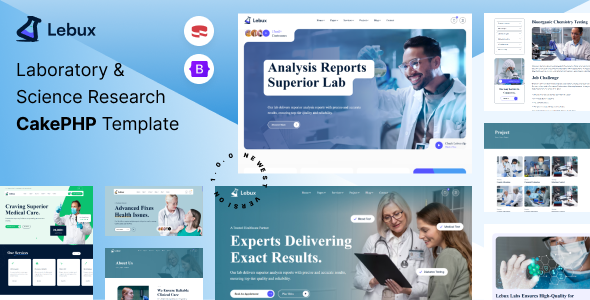
Labux is a CakePHP template for science and research websites, offering 4 homepages and 20 PHP pages for labs, institutes, and academic presentations. It’s a solid starting point for developers building niche-specific sites quickly.
Understanding Labux as a Science Website Template
Alright, so you’re looking at Labux. This isn’t a WordPress theme or a full CMS. What you’re getting here is a front-end template, pre-built with CakePHP and Bootstrap. Think of it as a set of well-structured HTML, CSS, and JavaScript files, all hooked into a basic CakePHP setup.
Its main job is to give you a serious head start if you need to build a website for a scientific institution, a research lab, or even an individual researcher's portfolio. The core problem it solves is saving you the grind of setting up all the boilerplate design and page structures from scratch, especially if your backend is already living in the CakePHP ecosystem.
Who Benefits from This CakePHP Template (and Who Doesn't)
This template is for agencies that need to deploy client sites quickly, especially if those clients are in the science or research sectors. If you’re a freelancer comfortable with CakePHP, this could seriously cut down your development time.
It’s a good choice if you need a pre-built research institute website design that handles common content types like project showcases, team profiles, and publications without reinventing the wheel. Developers looking for a strong frontend base to integrate with an existing CakePHP backend will find value here.
Who should probably skip it? Absolute beginners to web development, anyone unfamiliar with PHP or CakePHP, and definitely anyone expecting a drag-and-drop WordPress experience. The documentation specifies it's not a WordPress theme, so don't even try. It's not for those needing deep custom backend logic without the necessary CakePHP knowledge.
Design and Visual Approach for Research Websites
Labux uses Bootstrap, so the underlying grid and component styling will feel familiar if you’ve worked with Bootstrap before. The design aims for clarity and professionalism, which is crucial for scientific content where information needs to be presented without distraction.
It includes Flaticon and Font Awesome for icons, which is standard practice and gives you a good range of visual assets for things like service listings or contact details. The mention of WOW and AOS animations means there are some scroll-based effects. These can add a bit of polish if used sparingly, but can also be the first thing I strip out if a client wants a super lean site for Core Web Vitals performance.
The template leverages Google Fonts, which is fine, but as a developer, I’d always check how those fonts are loaded to ensure they’re GDPR-ready and not causing unnecessary layout shifts or performance hits. This impacts the overall user experience and can affect page load times for the business owner.
Layouts, Pages, and Components for Scientific Presentations
You get 4 distinct homepages and 20 PHP pages. This variety is genuinely useful. It means you’re not stuck with a single look and can adapt the template for different types of research entities, like a specific lab, a university department, or a larger institute. This flexibility saves you from having to heavily re-architect basic page structures.
The inclusion of blog pages is essential for any modern science or research site. It provides a straightforward way to share discoveries, publish updates, or showcase new lab equipment. Having these ready to go means less time spent on basic content architecture and more on the actual content.
Code Quality and Developer Experience with Labux
Being built on CakePHP and Bootstrap means you're working with established frameworks. The template is described as "developer friendly" and "well documented," which is what you want to hear. In our experience with similar frameworks, good documentation for a CakePHP template for science websites can save days of deciphering someone else's code.
A key detail is that the files are not minified. For a developer, this is a plus. It means the CSS and JavaScript are readable and easier to debug and customize. While minification is good for production, having unminified source files makes the initial setup and modification much smoother, leading to lower maintenance costs in the long run.
The W3C Validated claim is a good baseline for semantic structure, which contributes to better SEO and accessibility. However, I’d still run my own checks. What I'd change? While standard CSS is fine, I often prefer a more organized SASS architecture for larger projects to manage styles more efficiently. But for a template like this, plain CSS is often simpler to jump into for many developers.
Responsiveness and Cross-Browser Compatibility
The template boasts a "fully responsive layout" and "super responsive on all screen sizes." This is an absolute must-have in today's web landscape, not a bonus. It ensures that your scientific content is accessible and readable on everything from a large desktop monitor to a small smartphone. For a business owner, this translates directly to a better mobile experience for their visitors, which is critical for reach.
Cross-browser compatibility is also listed, which means it should render consistently across Chrome, Firefox, Safari, and Edge. Again, this is an expected standard for any template worth its salt, ensuring a broad audience can view the site without issues.
SEO Readiness for a Laboratory Web Development Solution
The W3C Validated structure provides a decent foundation for search engine optimization. Clean, semantic HTML helps search engines understand your content better. The focus on clear presentation for a laboratory web development solution naturally encourages well-structured content, which is always good for SEO.
While the files aren't minified, which might slightly increase initial load times if not addressed in production, having readable code makes it easier for you to implement further SEO optimizations, like adding schema markup or fine-tuning content structure. The overall technical setup suggests it won't actively hinder your SEO efforts from the start, but success will still depend heavily on the content itself and further optimizations.
Final Thoughts on the Labux CakePHP Template
Labux offers a pragmatic starting point for anyone building a science or research website within the CakePHP ecosystem. It saves you the substantial effort of designing and coding core pages and components from scratch, letting you focus on the unique content and functionality your client needs.
The trade-off is that you need to be comfortable with PHP and CakePHP to truly leverage and extend it. It’s not a magic bullet for non-developers, but for a seasoned pro, it’s a solid time-saver. If you're looking for a reliable CakePHP template for science websites that gets you out of the gate quickly, Labux is a sensible investment that can genuinely reduce project hours.
FAQ
Is Labux a full content management system?No, Labux is a frontend template built on CakePHP. It provides the design and page structure, but you'll need to integrate your own backend logic for full CMS functionality.
Can I use Labux with WordPress or other CMS platforms?No, Labux is specifically built with CakePHP and PHP. It is not a WordPress theme and cannot be installed on WordPress or other non-PHP based CMS platforms.
How easy is it to customize the design and content?The template is noted as "easy to customize" and built with Bootstrap, which helps. You'll need familiarity with HTML, CSS, and CakePHP's templating system to make significant changes.
Are the included images part of the download?No, the images used in the demo are for preview purposes only and are not included in the download package. You will need to source your own images.