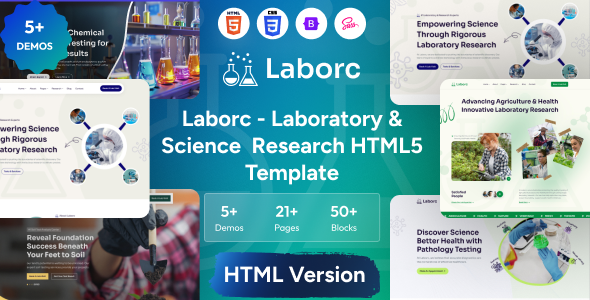
Laborc is a specialized HTML template for laboratory and science research websites. It offers 5+ demos and 30+ pages, ideal for agencies building niche sites quickly.
Laborc: A Practical HTML Template for Research Websites
This template, Laborc, is a straightforward HTML package built for anyone needing a quick frontend for a laboratory or science research website. It provides a set of pre-designed pages and layouts that cover the common sections for these specific niches. Think of it as a well-organized starting point, not a full application.
In our experience, using a focused HTML template like this can significantly cut down initial development time. You get a ready-made visual structure that you can then integrate into a CMS or use as a static site. It solves the problem of designing a niche-specific layout from scratch, especially for areas like bio-research or pathology labs.
Who Benefits from This Laboratory Science Research HTML Template
This template is for agencies and freelance developers who frequently build websites for the science and research sector. If you need to launch a client site quickly, or if you're looking for a solid frontend foundation that you can later hook up to a custom backend or a headless CMS, Laborc is a good fit.
It is particularly useful for those building a pathology lab site fast, or a research center's online presence without needing complex interactive elements out of the box. However, if your project requires deep custom backend logic, a content management system from day one, or extensive dynamic features without any development effort, this HTML template is not for you. It provides the visual shell, not the operational engine.
Design and Visual Approach for Science Research Websites
Laborc aims for a clean and modern aesthetic, which is appropriate for professional science and medical fields. The "pixel perfect design" claim generally means the layouts are crisp and follow a consistent grid, which helps maintain a credible image for a laboratory website. The use of Google Fonts, specifically Sora, provides a contemporary and readable typeface that fits the niche.
While the term "unique design" is often subjective, the overall presentation seems to avoid common overused patterns, offering a fresh but still familiar feel. This is a good balance for clients in research who need to convey professionalism without being overly flashy. The visual hierarchy helps guide users through scientific content or service offerings effectively.
Layouts and Pages for Research and Lab Services
The template includes over 30 HTML files and 5 pre-built demos. This means you get a good range of page types commonly found on a research or laboratory website. You will likely find layouts for:
- Service pages outlining different lab testing services.
- Dedicated sections for research projects and findings.
- About Us and Team pages for showcasing scientific staff.
- Contact forms and location information.
Having these pre-built pages saves considerable time. Instead of building each section from scratch, you're mostly populating content and making minor style adjustments. This makes it easier to present complex information, like detailed research methodologies or specific lab equipment, in an organized way.
Code Quality and Developer Experience
The template states it uses valid HTML5 and CSS3, which is a fundamental expectation for any modern web project. From a developer's perspective, this means the code should be relatively clean, well-structured, and less prone to browser compatibility issues. This also contributes to better semantic accessibility, which is important for all users and for search engines.
The claim of "well documented" is crucial for an HTML template. Good documentation means less time spent figuring out how the original developer intended things to work, making customization much smoother. When we test kits like this on a demo site, the ease of finding and modifying CSS variables or understanding the overall file structure is a key factor in its utility. For this kind of pure HTML offering, you're essentially getting a well-organized set of static files. Changing colors or fonts involves direct CSS edits, which is standard.
Responsiveness and Compatibility for All Devices
Laborc is described as 100% responsive and mobile-friendly, along with cross-browser optimization. This is non-negotiable for any website today. In practice, this means the layouts should adapt gracefully across various screen sizes, from large desktop monitors to tablets and smartphones. For a research institution, ensuring content is readable and accessible on any device is critical for reaching a broad audience, including scientists on the go or potential collaborators.
Good responsiveness also indirectly supports Core Web Vitals, as a well-structured mobile experience contributes to better user interaction metrics. The fact that it's just HTML and CSS, without heavy JavaScript frameworks, often means it starts with a good performance baseline, as asset loading is typically lighter.
SEO Readiness for Laboratory Websites
While an HTML template itself doesn't guarantee top search rankings, its underlying structure plays a big role. Valid HTML5 and CSS3, combined with a clean semantic structure, provide a solid foundation for search engine optimization. Search engines can easily crawl and understand the content hierarchy, which is essential for a laboratory science research HTML template to rank for relevant keywords.
The template uses Google Fonts, which load efficiently and are generally GDPR-ready if configured correctly. The focus on clean code means less bloat, which can contribute to faster page load times – a significant factor for SEO. You still need to manage your content, meta descriptions, and schema markup, but the template gives you a good starting point.
Final Thoughts on Laborc
Laborc is a solid, no-frills HTML template for anyone needing to build a laboratory or science research website quickly. It delivers on its promise of a clean, responsive frontend with a good selection of pre-built pages tailored to the niche. For agencies or freelancers, this can genuinely save dozens of hours on initial design and setup, allowing you to focus on content and any required backend integration.
The primary trade-off is that it is strictly a frontend template; you'll need to handle CMS integration or any dynamic functionality separately. However, for a straightforward, professional online presence in the science sector, this template offers excellent value and a practical starting point. It’s a smart investment if your workflow involves building out static or semi-static sites for this specific industry.
FAQ
Can I easily integrate this HTML template with a CMS like WordPress?Yes, you can integrate it, but "easy" is relative. It provides the frontend HTML and CSS, which you would then need to manually convert or port into a WordPress theme structure, or use it with a headless CMS.
Is this template suitable for a specific type of lab, like a bio-research facility or a pathology lab?Absolutely. The demos and page layouts are designed with various research and medical lab contexts in mind, making it well-suited for a bio-research facility, a pathology lab, or any similar scientific institution.
What level of technical skill is required to customize this HTML template?You will need a good understanding of HTML and CSS to customize this template effectively. Basic JavaScript knowledge might also be helpful for any interactive elements, as it is a pure HTML/CSS package.
Does this template include any backend functionality for managing research data or appointments?No, as an HTML template, Laborc provides only the frontend visual structure. It does not include any backend functionality for data management, user accounts, or appointment scheduling; those features would need to be developed or integrated separately.