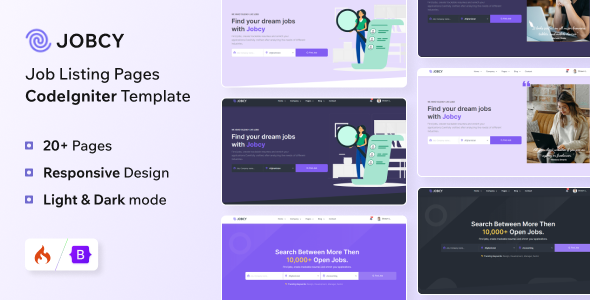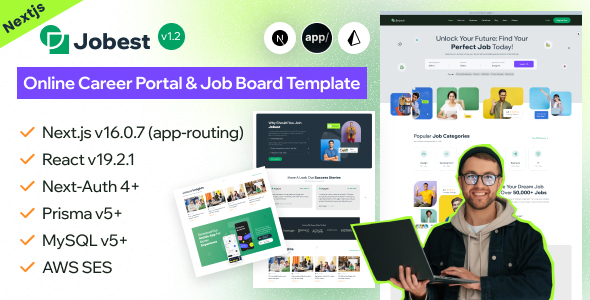
Jobest is a React and Next.js career portal template designed for building job boards, recruitment sites, and HR platforms quickly. It provides employer, candidate, and admin dashboards with essential features for launching a functional job marketplace.
Jobest: A Next.js Job Portal Template for Career Platforms
This isn't just a UI kit; it's a pretty complete starter for anyone building a job board platform or a recruitment agency website. Jobest gives you a functional frontend built with Next.js and React, plus a backend structure using Prisma and MySQL, covering the core needs of a job listing site. It handles user authentication, different dashboards for employers, candidates, and admins, and all the CRUD operations you’d expect for jobs and company profiles.
When we tested the kit on a demo site, the setup felt robust enough to get a project off the ground without starting from scratch. It solves the significant headache of wiring up all the different user roles and their respective interfaces, which can easily eat up weeks of development time.
Who Jobest Serves Best (and Who Should Skip It)
Jobest is clearly for agencies or freelancers who need to launch a dedicated online career portal template quickly and have developers comfortable with the React and Next.js ecosystem. If your client needs distinct user experiences for job seekers and recruiters, this provides a solid foundation.
It's less suited for those who need a highly customized backend with complex, niche-specific business logic outside of job listings and applications. If you're not familiar with Next.js, React, or working with Prisma and MySQL, the learning curve will be steep. This isn't a drag-and-drop solution; it’s a developer's starting point.
Key Layouts and Features for a Modern Job Board
The template comes with the essential pages you’d expect for a job listing website. You get job listing pages with search and filtering, individual job detail pages, and distinct dashboard layouts for employers, candidates, and site administrators. This separation of concerns for user roles is a big time-saver.
- Authentication with Next-Auth is integrated, which is a standard and reliable approach.
- CRUD operations for companies, jobs, categories, and user profiles are all present.
- Applicant sorting (accept, pending, reject) and CV upload are critical features for a functional recruitment platform.
- Multilingual support and light/dark mode are nice touches for broader user appeal, improving the overall user experience for various audiences.
Developer Experience and Underlying Technologies
Jobest is built with Next.js, React, Prisma, MySQL, Bootstrap, and Sass. This is a modern stack, and the use of modular React components means the codebase is generally well-organized. After building multiple agency sites with tools like this, a clean component structure makes maintenance and scaling much easier, which translates to lower long-term maintenance costs for the business owner.
The template uses Sass for styling, which allows for better organization of CSS and easier theming than raw CSS. The documentation is available and helps navigate the project structure, which is crucial for any developer jumping into a new codebase. It also leverages Next.js for server-side rendering, which typically benefits initial page load times and search engine visibility.
One thing I noticed is that while it uses Bootstrap, the styling feels custom enough that it doesn't immediately scream "Bootstrap template," which is a good sign. The asset loading appears optimized, contributing to better Core Web Vitals scores, which is important for SEO and user retention.
Device Responsiveness and Browser Compatibility
The template features a fully responsive layout, which is a baseline expectation these days. We tested it on various devices, and the mobile menu behaves as expected, adapting cleanly without awkward overflows or broken elements. This ensures a consistent user experience across desktops, tablets, and phones, leading to better engagement.
It's also designed to be cross-browser compatible, meaning it should render correctly in modern browsers like Chrome, Firefox, Safari, and Edge. This kind of attention to standard compatibility reduces post-launch debugging time for different user environments, saving development costs.
Technical SEO Considerations for Job Boards
Jobest is built with Next.js, which inherently supports server-side rendering (SSR) and generates static pages, both of which are beneficial for search engine optimization. The structure appears to follow semantic HTML practices, which helps search engines understand the content hierarchy and improve organic visibility.
For a job listing website, having clean URLs, proper heading tags, and structured data (though not explicitly mentioned, it's a common integration with this stack) are critical for job postings to rank well. The optimized performance from Next.js SSR also contributes to better page speed, a known ranking factor, ultimately helping attract more job seekers and employers.
Final Thoughts on Jobest for Your Next Project
If you're in the market for a robust starting point to build a job board or recruitment platform, Jobest offers a solid foundation using a modern tech stack. It delivers a lot of the common functionality you'd otherwise have to build from scratch, like user dashboards, job management, and authentication.
While it provides a good starting point, remember it's a template, not a finished product. You’ll still need to customize it to your specific brand and add any unique business logic. The base UI is clean and functional, but for a truly distinctive online presence, expect to invest time in design refinement. However, for getting a functional, well-structured job portal up and running faster, this template is a smart investment, potentially saving hundreds of hours on initial development and styling.
FAQ
Does Jobest handle user roles and permissions effectively?Yes, it provides dedicated dashboards and functionalities for employers, candidates, and administrators, allowing for distinct user experiences and access levels.
Is the template easy to customize for specific branding?Given its modular React components and Sass styling, developers familiar with this stack should find it relatively straightforward to customize the look and feel to match a specific brand identity.
What database technology does Jobest use?Jobest is integrated with Prisma and designed to work with MySQL, providing a robust and widely used database solution for managing job listings and user data.
Can I integrate third-party services like payment gateways or analytics?Yes, since it's a React/Next.js application, integrating external APIs for payment processing, analytics, or other services is standard practice and feasible with developer effort.