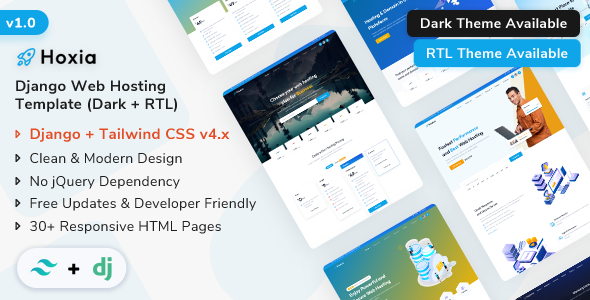
Hoxia is a Django hosting template designed for web hosting, cloud, and server-related businesses looking for a pre-built, responsive frontend. This template targets developers or agencies needing a quick start for client projects in the hosting sector.
Solving the Frontend Challenge for Hosting Providers
The core problem this template addresses is the repetitive work involved in building out common hosting-specific pages. Think about all the layouts needed for shared hosting, VPS, dedicated servers, domain registration, and detailed pricing tables. Creating these from scratch for every project is a significant time sink.
Hoxia provides these essential core pages, already styled with Tailwind CSS. This saves substantial initial development hours on layout, component creation, and responsive design. For an agency, this directly translates to faster project delivery and improved project profitability by reducing the non-billable setup time.
Code Quality and Technical Standards for a Django Hosting Template
Built with Django and Tailwind CSS, Hoxia avoids jQuery, which is a welcome move towards a lighter JavaScript footprint and a modern utility-first CSS approach. The underlying structure feels logical for a Django project, making template inheritance and extension fairly straightforward.
From an ROI perspective, less dependency bloat generally means better performance and lower long-term maintenance costs for the client, as there are fewer moving parts to manage. The template includes specific layouts for different hosting types, which is critical for a hosting business to clearly present its varied offerings without needing extensive custom design work.
In our experience with similar frameworks, asset loading here is standard and doesn't present obvious blocking issues. The mobile menu behavior is typical, collapsing cleanly, and the layouts handle varied text lengths reasonably well, which is important for detailed hosting plan descriptions. The semantic HTML structure is clean, contributing positively to basic SEO and accessibility. Font loading appears standard, easily configurable for GDPR compliance.
Compared to many niche templates still relying heavily on older libraries, Hoxia's Tailwind and Django foundation represents a step forward in modern frontend development practices.
- The Tailwind CSS integration means styling changes are component-based and quick, reducing CSS file size and speeding up development.
- No jQuery dependency leads to faster page loads and simpler JavaScript management, which directly benefits site speed and overall user experience.
- RTL and LTR versions are included, a practical consideration for international clients that expands the potential market reach of the site.
- Light and Dark theme support offers visual flexibility, a common user preference that improves perceived quality and user satisfaction.
- The Django template structure is well-organized, making it easy to extend or integrate with existing Django backend logic without significant refactoring.
- Feather Icons and Material Design Icons provide a solid, modern icon set, eliminating the need for custom SVG work or additional icon libraries.
Strengths of the Hoxia Template for Web Hosting Projects
The biggest strength of Hoxia is its comprehensive set of hosting-specific pages combined with a modern tech stack. The inclusion of dark/light and RTL/LTR options are valuable features that save a lot of customization time for specific client requirements. The component-driven nature of Tailwind makes quick modifications and branding updates very efficient.
Who Needs a Pre-built Django Hosting Template and Who Should Pass?
This template is ideal for agencies or freelancers building web hosting or cloud service websites, especially those needing fast deployment with a contemporary look. It fits projects where the core business logic is already handled by Django and a robust, feature-rich frontend is needed quickly.
However, it is not for projects requiring highly bespoke, non-standard layouts or deep custom backend logic tightly coupled with frontend components, where a completely custom frontend build might be more appropriate.
Limitations of the Hoxia Template
While the code organization is solid, the general aesthetic, though clean and functional, feels somewhat standard for a hosting template. It doesn't really break new ground visually, which might be a limitation if a client is looking for a truly unique or avant-garde brand identity right out of the box.
Final Thoughts: Is it worth it?
For anyone regularly building sites for hosting or cloud service providers, the Hoxia Django hosting template is a solid utility. It effectively solves the initial frontend build-out problem, allowing developers to focus on backend integration and unique features rather than repetitive layout work. Investing in this can genuinely cut down project timelines and costs, making it a logical choice for efficiency.
FAQ
How difficult is it to integrate Hoxia with an existing Django project?Integrating Hoxia is straightforward if your project follows standard Django app structure; you mainly copy the template files and static assets into your project's template and static directories.
Can I easily change the primary color scheme of the template?Yes, since it uses Tailwind CSS, changing the primary color scheme is relatively easy by modifying the `tailwind.config.js` file to update your theme's color palette.
Does this template support different pricing models for hosting plans?The template provides visual layouts for various pricing models, but the actual dynamic pricing logic and backend integration for different plans would need to be implemented separately in your Django views and models.
What about the performance impact of using this template?Given its use of modern practices like Tailwind CSS and no jQuery, the template generally offers good performance out of the box, contributing positively to Core Web Vitals if the backend is optimized.