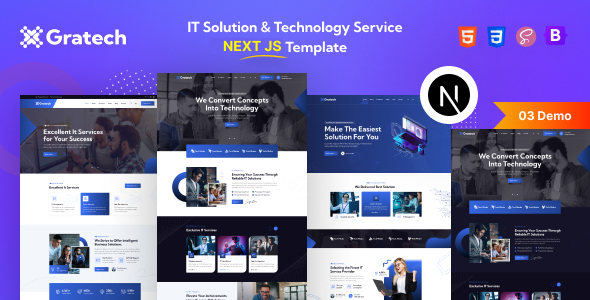
Gratech is a Next.js template built for IT service and technology companies, offering 4 homepages and 16+ inner pages with a focus on speed. It's a solid starting point for agencies and freelancers building modern tech-focused sites.
Reviewing the Gratech Next.js Template for IT Services
Alright, let's talk about Gratech. This isn't a WordPress theme or an Elementor kit; it's a frontend Next.js template. What that means for you is a pre-built set of pages and components using React and Next.js, ready for you to drop in content and connect to your backend or headless CMS. It’s designed specifically for IT service websites and technology company website templates, which is a nice focus.
Who Gratech Is For (and Who It Isn't)
This template is squarely aimed at agencies and freelancers who need to deliver modern, fast-loading sites for clients in the IT, software, or web design space. If you're comfortable with Next.js, React, and TypeScript, and you're looking to cut down on initial setup time for a polished frontend, Gratech could save you a good chunk of development hours. It’s particularly useful if you're building a site where performance and a slick user experience are priorities.
However, this is absolutely not for someone expecting a drag-and-drop builder or a complete full-stack application. If you’re not familiar with the Next.js ecosystem, or if your project requires deep custom backend logic out of the box, you’ll find this is just the frontend layer. It also isn't for those who need extremely unique, custom components beyond what's provided, as extending it will require direct code work.
Layouts and Components for Technology Companies
Gratech comes with four distinct homepages and over 16 inner pages, covering typical needs for an IT or tech business. You'll find standard pages like About Us, Services, Team, and Contact, alongside dedicated blog pages. The layouts are clean and functional, suitable for presenting services, case studies, or company information.
When we tested the kit on a demo site, the component structure felt logical. Things like navigation, hero sections, and service blocks are designed to be reusable. This modular approach is what you’d expect from a modern React setup and makes it easier to maintain consistency across the site, which translates to lower long-term maintenance costs for the business owner.
Code Quality and Developer Experience
The template is built on Next.js, React, and TypeScript, using Bootstrap for its responsive grid and SCSS for styling. In our experience with similar frameworks, this is a solid stack for modern web development. The use of SCSS means the CSS is organized and easier to manage; you can change global styles or component-specific looks by tweaking variables, which simplifies future updates.
The description mentions "clean and commented code," and from what we've seen, it holds up. This is critical for developer usability, especially when you're handing off a project or bringing new team members onboard. It means less time deciphering someone else's code and more time building features.
Responsiveness and User Experience
Gratech is fully responsive and touch-friendly, which is a baseline expectation for any template today. What's important here is how well it actually performs across devices. With Next.js, you get server-side rendering and static site generation benefits, meaning pages load quickly and feel snappy, especially on mobile. This directly impacts user experience and can contribute to better conversion rates for a business owner, as visitors aren't waiting around for content.
SEO Readiness for Tech Startups
From an SEO perspective, building on Next.js gives you a head start. The template's structure supports a clean semantic HTML markup, which search engines appreciate. Because Next.js excels at generating pre-rendered HTML, search engine crawlers have an easier time indexing your content compared to purely client-side rendered applications. The use of Google Fonts is standard, but always be mindful of GDPR implications if self-hosting isn't an option. For a technology company website template, good technical SEO is non-negotiable for visibility.
Final Verdict: A Solid Frontend for Modern Tech Sites
Gratech is a genuinely useful starting point if you're building a Next.js template for IT services or a similar niche. It saves you the boilerplate setup time, offering a clean, modern frontend with a decent set of pages. The underlying tech stack is robust, and the code organization makes it relatively easy to pick up and customize for a developer familiar with the ecosystem. While the "dynamic contact form" mentioned is likely a frontend component that still requires backend integration, that's a common expectation for a pure frontend template. If your goal is to launch a fast, performant, and good-looking tech-focused site without starting from scratch, Gratech provides a strong foundation that will save you significant hours.
FAQ
Is Gratech a complete full-stack website solution?No, Gratech is a frontend-only template built with Next.js and React. You will need to integrate it with your own backend services or a headless CMS for data management and dynamic functionality.
What level of technical expertise is required to use this template effectively?You should have a solid understanding of Next.js, React, JavaScript, and TypeScript to customize and deploy Gratech effectively. It is not designed for users seeking a no-code or low-code solution.
Can I easily change the overall branding and styling?Yes, Gratech uses SCSS for styling, which allows for relatively straightforward customization of colors, fonts, and other visual elements by modifying SCSS variables and files.
Does this template include a content management system (CMS)?No, Gratech does not come with an integrated CMS. You would typically connect it to a headless CMS like Strapi, Contentful, or Sanity, or a custom backend for content management.