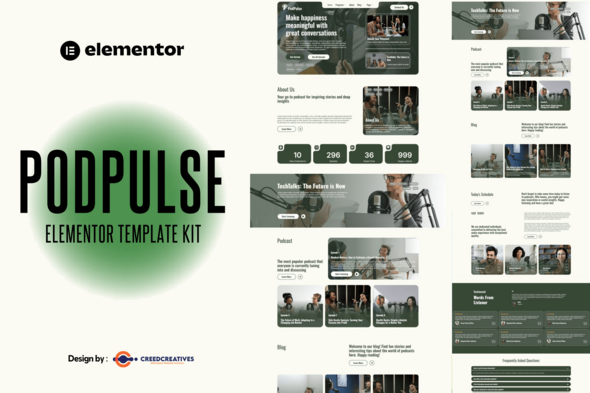
Gabut offers a focused Elementor template kit for podcasters and audio creators, featuring 16+ pages and key plugins to build a professional podcast website fast.
Gabut Podcaster Elementor Kit: A Practical Overview
Alright, so you're looking at the Gabut Elementor Template Kit, designed specifically for podcasters. What this really means is you get a collection of pre-designed Elementor pages and blocks, all styled to fit the aesthetic of a podcast or audio content site. It's not a full WordPress theme, but rather a set of blueprints you import into Elementor, typically running on a lightweight base theme like Hello Elementor.
The core problem this kit solves is the time sink of starting a niche site from scratch. Instead of spending hours laying out episode pages, host profiles, or a simple blog, you import these ready-made sections. For anyone building a podcast website without coding, this approach can shave off a significant chunk of design and layout work.
Who Benefits from this Podcaster Template Kit (and Who Doesn't)
This Elementor template kit is genuinely useful for freelancers and small agencies who need to deliver a functional, good-looking podcast site quickly and on a budget. It's also a solid option for individual podcasters or small businesses who want to manage their own online presence without hiring a full-stack developer or diving deep into custom code.
However, it's not for everyone. If you're a developer needing deep custom backend logic, a highly unique design that breaks Elementor's grid, or absolute minimal page weight for extreme performance metrics, you're likely better off building from the ground up. This kit relies on Elementor and a few extra add-ons, which inherently adds some overhead compared to a hand-coded solution.
Layouts, Pages, and Components for Audio Content Creators
The kit comes with over 16 templates, which is a decent starting point. You get the usual suspects: Homepage, About Us, Contact, Blog, FAQ, and a 404 page. What's more relevant for a podcast site are the dedicated Podcast, Program, Program Detail, and Host pages.
Having these specific layouts means you don't have to invent how to display episode lists or individual show notes. The inclusion of Header, Footer, and various Subscribe and Contact Form blocks also means you can assemble a complete site without much fuss.
- The Podcast and Program Detail pages are key for showcasing individual episodes and show information, which is essential for any podcast website.
- Host pages are great for building audience connection by highlighting the people behind the mic.
- The Subscribe Form blocks are a practical addition, making it easier to integrate email list building.
Code Quality and Developer Experience
After building multiple agency sites with tools like this, the code quality here is largely dictated by Elementor itself and the required third-party plugins (ElementsKit Lite, RTMKit Addons, RTMForm Builder). Elementor tends to produce a fair amount of DOM elements, which can impact Core Web Vitals if not managed well. However, for a template kit, the structure is generally clean within Elementor's framework.
The reliance on Elementor's global styles for fonts and colors is a standard practice and a practical benefit. This means if your client decides to change their brand color, you only do it once in Elementor's site settings, and it updates everywhere, saving time and ensuring consistent branding across the site. The asset loading, while dependent on Elementor and the extra plugins, feels pretty standard for this type of setup; you'll want to implement caching and optimization plugins on the server side for best performance.
SEO Readiness for Podcasters
From an SEO perspective, this kit provides a clean semantic structure for content within Elementor's capabilities. Headings are generally used correctly, and the layouts provide ample space for relevant text content, which is crucial for search engines to understand your podcast's niche and topics. While Elementor itself doesn't guarantee top rankings, a well-structured template like Gabut gives you a solid foundation to add your unique, keyword-rich podcast content.
Ensuring your podcast episodes have detailed show notes on their respective "Program Detail" pages is where the real SEO work for a podcast site happens, and this kit offers the layout to support that. You'll still need to focus on good copywriting and technical SEO best practices like image optimization and meta descriptions, but the template won't hinder you there.
Final Verdict: Is Gabut a Smart Investment for Your Podcast Project?
Look, if you need to get a podcast website up and running quickly, without diving into custom design or heavy coding, the Gabut Elementor Template Kit is a smart investment. It delivers a focused design specifically for audio content creators, saving you significant time on initial setup and styling.
While it requires specific Elementor add-ons, which is pretty standard for these kits, the global styling options and pre-built niche pages make it a practical choice. Just be aware that the demo images aren't included and require separate licensing, which is a common but important detail. For agencies and freelancers looking for an efficient way to launch a podcast presence, this kit is a solid option that gets the job done without unnecessary fuss.
FAQ
Does this Elementor kit require Elementor Pro?No, the Gabut template kit is designed to work with the free version of Elementor, which helps keep project costs down.
Can I easily change the branding colors and fonts?Yes, the kit utilizes Elementor's global theme style settings, allowing you to customize fonts and colors from one central place for consistent branding.
How does this kit handle adding new podcast episodes?The kit provides "Program" and "Program Detail" page templates, which you can duplicate and populate with new episode content to easily add and display new podcasts.
Will this template kit affect my website's loading speed?Any Elementor-based site, especially with additional plugins, can have a moderate impact on loading speed; however, proper server-side optimization and caching can significantly improve performance.