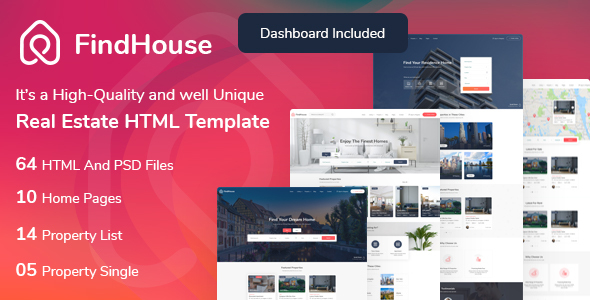
FindHouse is an HTML template for real estate websites, offering numerous homepages and listing layouts. It's best suited for agencies and developers needing a quick start on a visually rich property site.
FindHouse: A Real Estate HTML Template for Quick Site Builds
Alright, let's talk about FindHouse. This is an HTML template built for real estate businesses. If you're looking to get a property website up and running fast, especially one with a lot of visual elements and property listings, this could be worth a look. It comes with a hefty collection of HTML files, including ten different homepage variations and a wide array of property listing and single property pages.
The core problem this template aims to solve is the time spent on initial design and layout for real estate sites. Instead of building from scratch, you're getting a pre-designed structure that covers most common real estate needs. This can save you significant hours on styling and setting up common elements like property grids, agent profiles, and search filters.
Who Should Consider FindHouse and Who Should Look Elsewhere
This template is a good fit for agencies and freelancers who need to deliver functional, good-looking real estate websites on a tight schedule. If your clients want a polished online presence with lots of property listings and agent directories without needing complex custom backend functionality, FindHouse offers a solid foundation. It's also useful for developers who are comfortable working with HTML, CSS, and JavaScript and want to customize a template rather than build every page from zero.
However, if you're working on a project that requires deep integration with a custom content management system, a unique backend logic, or extensive dynamic features beyond standard property listings, this HTML template might not be the best choice. It's also not ideal for those who prefer a drag-and-drop website builder experience or need a theme with a built-in framework for complex application development. Developers who need a highly modular or component-based structure for rapid, iterative development might find the sheer volume of static HTML files a bit overwhelming to manage for very large projects.
Layouts and Visual Presentation for Property Sites
FindHouse offers a lot of pre-built pages, which is its main selling point. You get over 64 HTML files covering everything from multiple homepage styles to various property listing layouts (grid, list, map, parallax, slider) and single property views. There are also dedicated sections for agents, agencies, and even dashboard pages for users to manage their properties or profiles. This extensive collection means you're likely to find a layout that fits your specific needs without much modification.
The design itself leans towards a clean aesthetic, which is standard for real estate templates. It uses Bootstrap for its grid system, which is a well-established practice. The inclusion of various sliders like Owl Carousel and Slick Slider means you get animated carousels for property images or featured listings, a common requirement for real estate sites to showcase properties effectively.
eCommerce Functionality and Business Features
Interestingly, FindHouse includes shop pages. This means if you plan to sell services related to real estate, like premium listings or consultation packages, you have basic eCommerce functionality built-in. This includes shop listings, single product pages, cart, checkout, and order confirmation pages. While not as robust as a dedicated eCommerce platform, it's a useful addition for smaller shops or businesses that want to integrate a simple sales channel into their real estate portal.
The inclusion of pricing and comparison pages also adds to its business utility. This can be helpful for agencies that offer different service tiers or want to allow users to compare different property types or packages side-by-side. It's a practical feature for conversion-ready funnels.
Code Structure and Developer Experience
Based on the structure, this template uses standard HTML5 and CSS3. It's built on Bootstrap, which is a common and understandable framework for many developers. This means the CSS is likely organized in a way that's familiar, making it easier to override styles or add your own. The documentation is mentioned as being thorough, which is crucial when working with a template of this size.
From a practical standpoint, when you're dealing with this many HTML files, the organization of assets like images, CSS, and JavaScript is key. A clean structure with well-commented code makes it manageable to update and maintain. The template aims for a "clean and simple design," which often translates to more straightforward CSS, reducing the chances of style conflicts when you start customizing. It also claims cross-browser compatibility, which is standard but always good to see explicitly stated.
Responsiveness and Browser Compatibility
The template is advertised as fully responsive, meaning it should adapt to different screen sizes from desktops to mobile devices. This is a non-negotiable standard for any modern website. When testing, you'd want to check how the complex layouts, especially those with multiple columns or maps, reflow on smaller screens. The use of Bootstrap's grid system typically ensures a good baseline for responsiveness, but the specific implementation of elements like sidebars or complex forms needs careful review on various devices.
Cross-browser compatibility is also listed, covering major browsers like Edge, IE9+, Firefox, Safari, Opera, and Chrome. This is a standard expectation for HTML templates, ensuring a consistent experience for most users. It’s important to verify this on actual devices or through browser testing tools during development.
SEO Readiness and Structure
The template uses valid HTML5 and CSS3, which is the foundation for good SEO. Semantic HTML structure is crucial for search engines to understand your content. While the template doesn't promise specific ranking improvements, having clean, semantic markup is a significant advantage for SEO. The inclusion of features like Google Maps customization and Google Fonts also suggests an awareness of performance and integration best practices that can indirectly benefit SEO.
For a real estate website, having well-structured property listings with appropriate headings and meta descriptions is vital. The template provides multiple page structures, and developers can further optimize these for search engines by ensuring unique titles, meta descriptions, and schema markup for properties. The focus on clean design also helps with Core Web Vitals, as less bloat generally means faster loading times.
A Practical Take on FindHouse
FindHouse offers a lot of pre-built pages and design options for real estate websites, which can significantly speed up project timelines. It's a solid choice if you need a visually appealing foundation and are comfortable with HTML and CSS customization. The sheer volume of included pages means you'll likely find exactly what you need, or close to it. The inclusion of shop pages and dashboard functionality adds extra value for certain types of real estate businesses.
One area where this template feels standard, rather than exceptional, is its reliance on multiple distinct slider plugins (Owl Carousel, Slick Slider, MaxImage Slider). While functional, managing and potentially optimizing multiple slider libraries can sometimes add complexity. In our experience with similar frameworks, a single, well-integrated slider solution is often easier to maintain long-term. However, for getting a site launched quickly with rich visual elements, this is a minor point.
FAQ
Is FindHouse suitable for beginners who have never built a website before?
No, this is an HTML template. While it includes many pre-designed pages, you will need basic knowledge of HTML, CSS, and JavaScript to customize and implement it effectively.
How easy is it to integrate FindHouse with a backend CMS like WordPress or a custom application?
This is a static HTML template. Integrating it with a CMS or backend requires significant development work to convert the HTML structure into dynamic templates and connect it to your database and application logic.
Does FindHouse include any backend functionality or a content management system?
No, FindHouse is purely a front-end HTML template. It provides the visual design and structure but does not include any backend functionality or a CMS for managing content.
Can I use the shop pages for a full-fledged online store?
The shop pages provide the front-end structure for an online store. For a complete eCommerce solution, you would need to integrate this with a backend system that handles inventory, payments, and order processing.