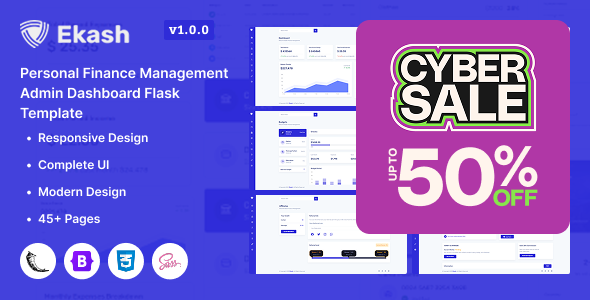
Ekash is a Flask admin dashboard template for personal finance management, with pages for wallets, budgets, and transactions. Ideal for developers building finance web applications.
Ekash: A Frontend Flask Dashboard for Financial Apps
Ekash offers a solid frontend starting point for building various financial web applications, from personal finance management dashboards to investment tracking interfaces. It's a Flask-based admin template packed with over 150 UI components, interactive charts, and data tables. The core value here is getting a significant head start on the visual layer of complex data-driven applications.
When we tested the kit on a demo site, the pre-designed pages for Wallets, Budgets, Goals, and Transaction History stood out immediately. These aren't just generic layouts; they address common needs in the finance niche, saving considerable time compared to building these specific views from scratch. This focus on niche-specific elements is what makes a template genuinely useful.
Who Needs This Flask Finance Dashboard Template?
This template is best suited for solo developers or small agencies looking to rapidly prototype or build the frontend of a personal finance management dashboard or a similar financial application. If your workflow involves a Flask backend that needs a polished, pre-built interface, Ekash can cut down development time significantly.
However, it's important to understand who should not use this. Ekash is strictly a frontend template; it does not come with an integrated Flask ORM or any pre-configured backend logic for data persistence. If you need a full-stack solution out of the box or a drag-and-drop WordPress theme, this is not it. It also requires a basic understanding of Flask and frontend technologies to integrate effectively.
Core Pages and UI Components for Financial Dashboards
Ekash includes a comprehensive set of pages and components that cater well to financial applications. Beyond the dedicated Wallets, Budgets, and Transaction History pages, you get authentication pages (login, registration, password reset), which are standard but well-implemented. The template also provides multiple dashboard variations, including layouts for CRM, eCommerce, Cryptocurrency, and Investment tracking, showing its versatility beyond just personal finance.
The library of over 150 UI components, alongside various data tables and chart examples, means you have most elements you'd need to visualize complex financial data. The inclusion of both light and dark modes is a nice touch, offering user customization and improving readability in different environments. For a business owner, this means a better user experience, potentially increasing engagement with their financial tool.
Developer Experience and Code Structure for Ekash
Ekash is built on Flask, Bootstrap, and Pure JavaScript. In our experience with similar frameworks, this combination offers a predictable and widely understood foundation. The description mentions "clean and well-commented code" and "W3C Validated Code," which are always welcome. This translates to easier maintenance and fewer headaches when you or another developer needs to modify or extend the template.
The modular layout is a practical benefit, allowing developers to pick and choose components without unnecessary bloat. While the asset loading feels standard, not particularly optimized for Core Web Vitals out of the box, the clean structure means you can implement optimizations yourself without fighting the code. For a non-technical business owner, this clean code structure means lower long-term maintenance costs and easier updates as web standards evolve.
Mobile Responsiveness and Browser Compatibility
The template is designed to be fully responsive and retina-ready, ensuring it looks good and functions across desktops, tablets, and mobile phones. Cross-browser compatibility is also stated, which is a baseline expectation for any modern web project.
The practical benefit here is straightforward: your financial application will provide a consistent user experience regardless of the device or browser your users prefer. This reduces potential user frustration and support requests, allowing the business to focus on its core services.
Technical SEO Foundation for Your Finance Application
While an admin dashboard isn't typically a public-facing SEO target, the underlying code quality still matters. A clean, semantic HTML structure, as implied by "W3C Validated Code," provides a solid technical SEO foundation. This means that if parts of your application were ever to become public, search engines could easily crawl and understand the content.
Good heading hierarchy and proper use of HTML elements contribute to better accessibility and can indirectly support better performance metrics like Core Web Vitals, which Google increasingly considers. This lays the groundwork for any future public-facing pages or marketing efforts related to your financial web application.
Final Take: Is Ekash Worth It for Your Finance Project?
Ekash is a genuinely useful frontend Flask dashboard template for developers focusing on financial applications. It solves the workflow problem of building niche-specific UI elements from scratch, saving considerable development hours. The pre-built pages for wallets, budgets, and transactions, combined with a robust set of UI components and chart options, provide a strong head start.
The trade-off is that it’s strictly a frontend kit, so you'll need to handle all your Flask backend logic and database integration independently. While the design is clean and functional, it's not going to win awards for groundbreaking aesthetics, but it gets the job done efficiently. One thing I would change is to see a more explicit SASS architecture for easier, deeper theme customization beyond just Bootstrap variable overrides, which would simplify advanced branding efforts. If you're building a personal finance management dashboard or a similar tool and need a solid, well-structured frontend to plug your Flask backend into, Ekash is a smart investment that will accelerate your project.
FAQ
Does Ekash include a database or backend logic?No, Ekash is a frontend template built with Flask, Bootstrap, and JavaScript. You will need to integrate your own database and backend logic for data storage and processing.
Can I use this template with other backend frameworks?While designed for Flask, the frontend HTML, CSS, and JavaScript components are standard. You could adapt them for use with other backend frameworks, but it would require manual integration.
How easy is it to customize the design beyond basic colors?The template is built on Bootstrap, so basic customization like colors and fonts is straightforward using Bootstrap's theming capabilities. For more extensive design changes, you'll need a good understanding of CSS and potentially SASS.
Is Ekash suitable for a multi-user application?Yes, the template includes authentication pages (login, registration) which are essential for multi-user applications. However, managing user roles and permissions would be part of your custom backend implementation.