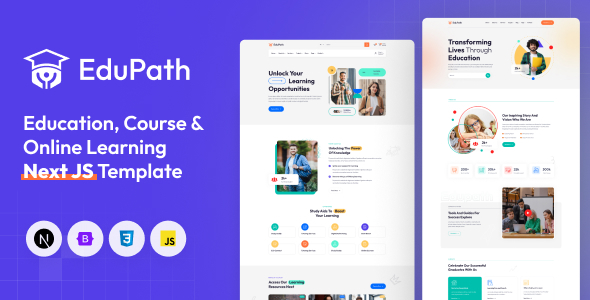
Eduport is a Next.js education template for building course platforms and LMS websites, offering 11 demos, student/instructor dashboards, and e-commerce pages for a modern React foundation.
Eduport: A Next.js Front-End for Education Platforms
This Eduport template is a front-end kit built with Next.js and React, specifically for education-focused websites like online courses or training centers. It provides a strong starting point for the visual and interactive parts of an online learning platform.
In our experience building agency sites, dedicated front-end templates like this save significant time. You get a ready-made UI addressing common education site needs, letting your team focus on custom business logic rather than basic component styling.
Who Benefits from this React Course Platform Starter?
This template is genuinely useful for agencies and freelancers building education platforms who are comfortable with React and Next.js. If you need to launch an attractive, high-performance front-end quickly, Eduport offers a solid base.
It’s also a good fit for in-house development teams standardizing their front-end stack for educational products. The component-oriented architecture allows for collaborative development.
However, this is not for those seeking an all-in-one solution with a full backend LMS system included. If your team isn't familiar with modern JavaScript frameworks like React or Next.js, the learning curve will be steep.
Comprehensive Layouts for Online Learning and LMS Websites
Eduport comes with 11 distinct home page demos, suitable for various education website types, from minimal course landing pages to complex online academies. This variety helps quickly spin up different concepts for clients.
You get multiple course card styles, grids, lists, and detailed course pages, which are crucial for any education platform. Dedicated dashboard pages for both instructors and students are a major time-saver, covering common user flows from the start.
The template also provides shop pages, various well-designed forms (like "Become an Instructor" or "Book a Class"), and standard utility pages such as About Us, Contact, Blog, Pricing, and Authentication. This set of components reduces boilerplate UI development.
E-commerce Functionality and User Dashboards for Education
For an education platform, handling payments and user management is key. Eduport includes shop pages, laying out the front-end for selling courses or related products. This simplifies integration with your chosen e-commerce backend.
The instructor and student dashboard pages are well-thought-out for the niche, providing clear interfaces for managing courses and profiles. This attention to specific user roles creates a more engaging learning environment, leading to better user retention for business owners.
Developer-Friendly Architecture and Modern Front-End Practices
From a developer's perspective, Eduport uses a utility and component-oriented code architecture, similar to Bootstrap. This makes customization and extension straightforward. The code is well-commented, aiding in identifying and adapting blocks for specific needs.
SASS for dynamic color schemes is a practical benefit, allowing quick, sitewide branding changes by adjusting a few variables. This saves hours compared to manual CSS tweaks, leading to lower maintenance costs and faster client feedback.
It uses Gulp for automation, a reliable tool for managing assets and streamlining workflow. Fewer third-party plugin dependencies generally lead to a lighter codebase and better performance.
- SASS architecture for easy global styling changes.
- Well-commented code aids understanding and customization.
- Component-oriented structure promotes reusability and maintainability.
Solid Responsiveness and Cross-Device Behavior
The template handles responsiveness competently across different screen sizes, ensuring a good user experience on any device. The mobile menu behavior is clean and intuitive, a common pain point in less polished templates.
Layouts generally hold up well even with longer text content, which is important for course descriptions and blog posts. This attention to detail means less time spent on cross-device debugging.
Semantic Structure for Search Engine Optimization
Eduport's underlying semantic HTML structure provides a good foundation for search engine optimization. A clean, well-structured codebase helps search engines understand your content better.
Next.js itself aids SEO by enabling server-side rendering or static site generation, ensuring content is readily available to crawlers. This can positively impact initial page load times and overall discoverability for education course platforms.
Is Eduport a Smart Investment for Your Next Education Project?
After building multiple agency sites, I consider Eduport a solid choice if you need a modern, React-based front-end for an education or LMS website. It effectively addresses common UI challenges in this niche, offering a robust starting point that saves significant development hours.
The main trade-off is that, as a static template, the backend logic for course management, user authentication, and e-commerce is entirely up to you. However, for teams comfortable with Next.js and React, this flexibility is often preferred for integration with custom APIs or headless CMS solutions.
While not a magic bullet, it genuinely solves the problem of quickly building an appealing and functional front-end for online learning platforms. If you're looking for a high-quality Next.js education template, Eduport is definitely worth considering.
FAQ
Does Eduport include a backend LMS system?No, Eduport is a static front-end template built with Next.js and React. It provides all the user interface components, but you will need to integrate your own backend for LMS functionality, user authentication, and data management.
Is this template suitable for someone new to React or Next.js?This template is best suited for developers already familiar with React and Next.js. While the code is well-structured, a foundational understanding of these frameworks is necessary for effective customization and integration.
How easy is it to change the overall branding and colors?Changing the branding and color scheme is straightforward thanks to its SASS architecture. You can modify a few variables in the SASS files to quickly apply sitewide color changes, which is a significant time-saver for client projects.
What are the performance implications of using this template?Built with Next.js, the template is designed for good performance. Next.js inherently supports server-side rendering or static site generation, contributing to faster initial page loads and a positive impact on Core Web Vitals.