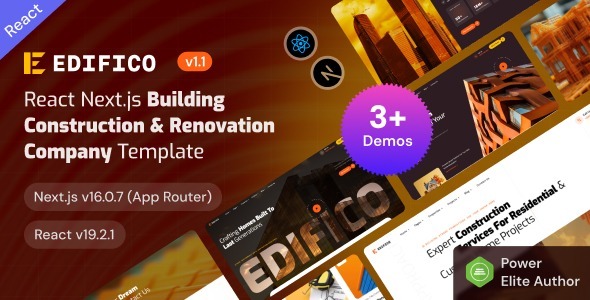
Edifico is a React Next.js template designed for construction, renovation, and architecture firms looking to launch a client site quickly using a modern tech stack.
Streamlining the Frontend Build for Construction Businesses
Building a marketing website for a local construction or renovation company often involves repetitive setup for common pages like services, projects, and team. This Edifico React Next.js template offers a pre-built structure that handles these frontend needs, allowing developers to focus on unique client content and specific requirements. It saves significant initial setup time, which is particularly valuable for agencies working with tight deadlines on a building company frontend solution.
Technical Foundation and Practical Development Insights
The template is built with Next.js, React, TypeScript, Bootstrap, and Sass, notably without jQuery. This is a modern, maintainable stack that contributes to long-term project health and can mean lower maintenance costs for the business owner. The Next.js App Router and server components are a solid choice for good Core Web Vitals, translating to better search engine performance and a smoother user experience. The clean semantic structure is standard, aiding search engine visibility.
From a developer's perspective, the Sass architecture is reasonably organized into partials, making global style changes or component-specific overrides straightforward. Moving the files into a new project is a standard `git clone` and `npm install` process. Changing primary colors is mostly a matter of adjusting Sass variables. Compared to many older construction website templates that still rely on less optimized stacks, Edifico's choice of modern frameworks is a clear advantage for performance and developer experience, making it a viable agency client project starter.
- Next.js App Router: Provides server-side rendering and static site generation, which is great for initial page load speed and search engine indexing, translating to a better experience for visitors.
- TypeScript: Helps catch errors early in development, leading to more stable code and reducing potential bugs for the end-user.
- Sass structure: The styling is organized into partials, making it easier to find and modify specific component styles or global variables without digging through monolithic CSS files.
- No jQuery: A lighter JavaScript footprint means faster page loads and less potential for conflicts, resulting in a snappier site for visitors.
- Component-based: Using React means UI elements are modular, simplifying updates and ensuring consistency across the site.
Edifico's Strengths for Rapid Project Deployment
The primary strength of Edifico is its readiness for a construction or renovation company website. It covers essential pages like services, projects, and team, providing a solid starting point. The included demo variations offer enough flexibility to quickly adapt to different branding needs without requiring a complete redesign, which is beneficial for fast client turnarounds.
Who Edifico Serves Best (and Who Should Look Elsewhere)
This template is well-suited for agencies building client sites with tight budgets and timelines, or small to medium-sized construction firms needing a quick, modern online presence. It's a good fit for someone looking for a robust frontend solution for building company marketing. It is not for projects requiring highly bespoke UI/UX that deviate significantly from common patterns, or those needing complex, custom backend integrations beyond what a typical marketing site demands.
Areas Where Edifico Meets Expectations (but Doesn't Exceed Them)
While the design is clean and functional, it's not groundbreaking. It uses Bootstrap as its primary UI framework, which means it inherits a certain aesthetic that, while widely accepted, can feel standard. The documentation is adequate for basic setup but might require more digging if you need to deeply customize specific components or integrate complex third-party services beyond the provided structure.
Final Thoughts: Is it worth it?
For a developer or agency tasked with delivering a modern, performant website for a construction or related business quickly, Edifico provides a strong foundation. It significantly cuts down on initial setup and styling time, allowing more focus on content and client-specific refinements. Considering the development hours saved on the frontend, it's a sensible investment for efficiency and rapid project deployment.
FAQ
How does Edifico handle image optimization for project galleries?
The template leverages Next.js image component capabilities, which can automatically optimize images for different screen sizes and formats, contributing to faster loading project pages.
Is the template designed with accessibility in mind for all users?
It follows standard semantic HTML practices and responsive design principles, which are foundational for accessibility. Further WCAG compliance might require project-specific auditing and adjustments.
Can I easily integrate a third-party CRM or project management tool?
As a frontend template, it provides the UI. Integration with external APIs for CRM or project management would be a custom development task, leveraging React's data fetching capabilities.
What is the typical maintenance overhead for a site built with Edifico?
With its modern stack (Next.js, React, TypeScript), maintenance overhead is relatively low compared to older frameworks. Regular updates for dependencies and content changes are the primary ongoing tasks.