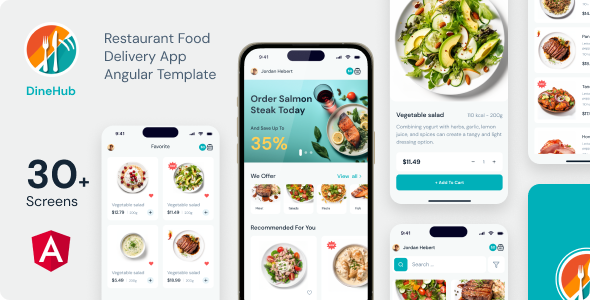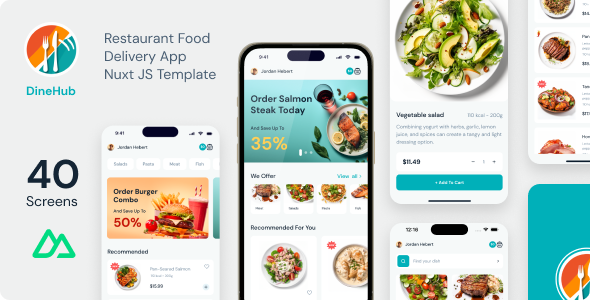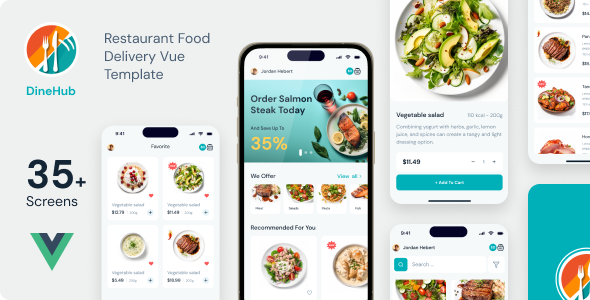
DineHub is a Vue-based Progressive Web App for restaurant food delivery, offering a pre-built mobile app frontend. It's a solid starting point for agencies and freelancers needing to quickly launch food service platforms.
DineHub: A Vue PWA for Restaurant Food Delivery
Alright, let's talk about DineHub. This isn't a WordPress theme or a drag-and-drop builder. What you're getting here is a pre-built frontend for a restaurant food delivery PWA, crafted with Vue. The core idea is to give developers a significant head start on projects needing an app-like experience without native app overhead.
It solves the common workflow problem of starting a food service app from scratch, where you'd spend weeks on basic UI, navigation, and PWA manifest setup. This package gets you past that initial grind, letting you focus on unique business logic and backend integration for your client.
Who Needs This Vue Mobile App Template?
This is squarely aimed at agencies and freelance developers who regularly build custom web applications, particularly in the food and hospitality niche. If you're comfortable with Vue, SCSS, and JavaScript, and need to deliver a production-ready mobile frontend fast, this is a solid fit.
It's ideal for those building a food service app needing strong mobile function, offline capabilities, and search engine discoverability. You get a well-structured base to extend.
Who should probably skip this? If you're new to Vue or front-end development, this isn't a beginner's kit. It's also not for someone looking for a full-stack solution with a pre-built backend, though the creators do offer a separate Laravel backend version. You'll need to handle your own API integration here.
Design Language and User Experience
The design here is clean and functional, exactly what you’d expect for a modern food delivery PWA. It uses DM Sans, a free Google Font, which helps keep the overall asset footprint light and ensures good readability across devices. The onboarding screens are a nice touch, providing a familiar app-like introduction for users.
While not groundbreaking aesthetically, the visual approach is practical and conversion-focused. It provides a solid foundation easily branded with client colors and logos using SCSS support. This means less time fighting with inline styles, more time on features, and lower maintenance costs for clients.
Core Components and PWA Features
DineHub comes with a set of well-structured Vue components, which is crucial for maintainability and scalability. When we tested the kit on a demo site, component organization felt logical, making UI element modification easier.
Key features revolve around its PWA nature:
- Performance: Leveraging caching and efficient resource management means fast load times and smooth interactions. This directly impacts user retention and reduces bounce rates, a clear business benefit.
- Offline Accessibility: Service workers enable the app to function even without a constant internet connection. This is a big deal for users in areas with spotty service, improving their overall experience.
- Cross-Platform Compatibility: It works across various devices and operating systems. You build once and deploy everywhere, avoiding separate native app development and saving significant budget.
- App-Like Experience: Features like push notifications and home screen installation provide that familiar native app feel, which can boost user engagement.
Developer Experience and Code Structure
From a developer's perspective, this project feels well-considered. It's built with Vue and uses Pinia for state management, which is a common and robust choice in the Vue ecosystem. The clean code promise holds up; it's readable and follows standard Vue conventions, making it easier to onboard new developers.
SCSS support is a must-have for any serious project, allowing for efficient styling and theme customization. Asynchronous data loading is standard for modern apps, ensuring a snappy user interface even with slow network conditions. This contributes positively to Core Web Vitals, improving SEO and user experience.
The included Figma file is a practical bonus for designers or teams needing to mock up further customizations. It helps ensure consistency between design and development, reducing workflow friction.
SEO Readiness for Food Service Apps
One often-overlooked benefit of a restaurant food delivery PWA is its inherent SEO-friendliness compared to native apps. Unlike a traditional app store listing, PWAs are indexable by search engines. This means your food service platform can be discovered through regular web searches, driving more organic traffic and potential customers.
The clean semantic structure that typically comes with well-built Vue applications also contributes to better search engine understanding. While specific SEO optimization is always on the developer, the foundation here is solid for discoverability and enhancing online presence for your food service app.
Final Thoughts on DineHub for Food Delivery Projects
After building multiple agency sites with tools like this, I can say DineHub offers a genuinely useful starting point for anyone building a food delivery app frontend. It's not a magic bullet that builds the entire system, but it significantly cuts initial development time for the user-facing application.
The focus on PWA benefits means you're building a modern, performant, and accessible application from the get-go. While the default design is perfectly functional, you might find yourself wanting to add more unique visual flair to stand out in a crowded market. That said, the SCSS structure makes such customizations straightforward for a Vue developer looking to tailor a food service app.
If your goal is to deliver a robust, app-like food service experience quickly, and you have the Vue expertise to back it up, DineHub is a smart investment. It handles many of the common headaches, allowing you to focus on what makes your client's offering unique.
FAQ
Does DineHub include a backend for managing orders and menus?No, this specific product is a frontend-only Progressive Web Application. You will need to integrate it with your own existing API or a separate backend solution.
Is it easy to change the branding and colors to match my client's restaurant?Yes, with SCSS support and well-structured components, a developer familiar with Vue and CSS can easily customize the styling and branding to fit specific client requirements.
Can users place orders when they are offline?While the PWA offers offline accessibility for browsing content due to service workers, placing or processing new orders will still require an active internet connection to communicate with your backend system.
What level of Vue development knowledge is needed to use this effectively?You should be comfortable with Vue, its component structure, and state management libraries like Pinia to effectively customize and extend DineHub for a production environment.