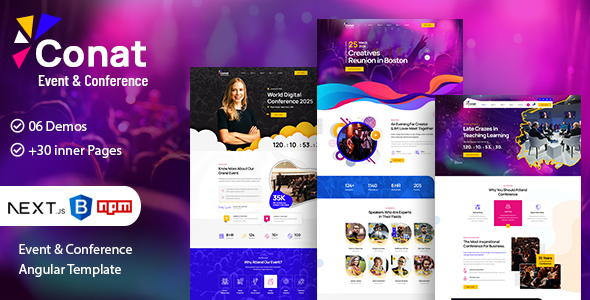
Conat: A Next.js template for event and conference websites. It offers 7 demos, 20+ pages, and integrates Bootstrap. Launch event sites fast for agencies and freelancers.
Conat: A Next.js Template for Event Website Development
This Conat template is a Next.js starter kit built for event and conference websites. It provides a solid foundation for anyone needing to spin up an event presence quickly, from a single-day workshop to a multi-track conference. If your goal is to launch a functional, good-looking event site without starting from scratch, this template aims to cut down your initial development time significantly.
Who Benefits Most from this Next.js Event Template?
Conat is primarily for web development agencies and freelance developers who regularly build event-specific sites for clients. If you’re familiar with Next.js, React, and component-based development, you’ll find this a practical starting point. It’s particularly useful for projects requiring a quick turnaround where the client needs a professional online presence for a marriage event, office gathering, or a birthday celebration.
However, if you're a complete beginner with no coding experience looking for a drag-and-drop event planning website builder, this isn't for you. Similarly, if your project demands highly custom backend logic for complex ticketing, seating charts, or deep CRM integrations out of the box, you’ll need to build that functionality on top of this template. It provides the front-end structure, not a full-stack event management system.
Visual Design and User Experience Considerations
The template comes with 7 different demos, including one-page layouts, which is a decent variety for an event management template. The design aesthetic is generally clean, relying on Bootstrap and Material UI for its component styling. This combination provides a lot of flexibility in terms of UI elements, but it's worth noting that using both frameworks can sometimes lead to a slightly larger bundle size if not optimized properly. For a business owner, this means a generally consistent look and feel across different devices and browsers, which is a standard expectation these days.
The responsiveness has been tested on real devices, which is a good sign. In our experience, this usually translates to fewer surprises when clients view their sites on various phones and tablets. The sticky header is a practical touch for navigation on longer pages, keeping key links accessible as users scroll.
Included Pages and Component Structure
Conat includes over 20 pre-built pages, covering common needs like service pages, about us, pricing, and various event-specific layouts. This means you don't have to design every single page from scratch, saving a lot of initial setup time.
- The variety of pages and one-page layouts offers flexibility for different event types.
- It includes essential components like Image and Video sections, which are standard for showcasing event details.
- Having custom page templates means you can easily create new pages with consistent styling.
From a developer's perspective, the promise of "easy to find folder" and "clean commented code" is a big plus. When we test similar frameworks, clear file organization and comments drastically reduce the learning curve and maintenance effort, which translates to lower ongoing costs for the business owner.
Event Management Specific Features
For an event-focused site, features like Login, Sign Up, Forgot Password, and Checkout are crucial for attendee registration and payment. Conat includes these foundational pages, which means you won't have to build these common user flows from scratch. This solves a significant headache for developers tasked with setting up basic user authentication and a purchasing path for tickets or registrations.
While it provides the UI for these features, remember you'll need to integrate your own backend logic for actual user management and payment processing. The template sets up the front-end structure for a conversion-ready funnel, which is a smart investment for any event-based business.
Developer Experience and Code Organization
This template is built on Next.js with Node, leveraging modern JavaScript practices. The inclusion of Bootstrap and Material UI, along with React-slick for carousels, means developers have access to well-established UI libraries. The "clean commented code" and "easy to find folder" structure are important for maintainability. After building multiple agency sites with tools like this, we know that well-organized code reduces debugging time and makes it easier to onboard new team members or hand off projects.
The template also mentions custom CSS readiness, which is standard but always appreciated for fine-tuning styles without fighting the core framework. The use of Google Fonts and custom font support ensures good typography options, which is a basic expectation for any professional site.
Device Compatibility and Responsive Behavior
The template is fully responsive and "fits all device perfectly," which is a baseline expectation for any web project today. This means your event schedules, speaker profiles, and registration forms will display correctly and be usable on anything from a large desktop monitor to a small smartphone. This ensures a consistent user experience regardless of how attendees access your site, which is vital for maximizing registrations and engagement.
Cross-browser compatibility is also listed, meaning it should work across different web browsers like Chrome, Firefox, and Safari without major issues. This saves developers the tedious task of extensive cross-browser testing, allowing them to focus on content and specific event details.
Technical SEO Foundations for Event Sites
Conat is described as "SEO-friendly," which in the context of a Next.js template typically means a clean semantic structure and fast page loads. Next.js inherently provides good performance characteristics, which positively impacts Core Web Vitals. A well-structured HTML document, which we expect from a template like this, helps search engines understand your content, making it easier for potential attendees to find your event through relevant search queries like "conference website development" or "Next.js event management template."
The template provides the technical groundwork for good SEO, but actual ranking success will still depend on quality content, proper keyword usage, and off-page SEO efforts. It doesn't make any ranking promises, which is the correct, honest approach.
The Bottom Line: Is Conat a Smart Investment?
Conat is a solid choice if you need a Next.js front-end for an event or conference website and want to accelerate your development process. It provides a good set of pre-built pages and components, decent design flexibility, and a foundation for user authentication. For agencies needing fast turnarounds on client event sites, this template can genuinely save significant development hours, especially on initial setup and styling.
The main limitation is that it’s a front-end template, not a full-fledged event management system with integrated booking and payment processing. You'll need to connect it to your own backend services. However, if you understand this trade-off and are comfortable with Next.js, Conat offers a pragmatic, time-saving starting point that's well worth considering for your next event project.
FAQ
Does this template include a full event booking system?No, Conat is a front-end template providing the user interface for event pages, registration forms, and user authentication. You will need to integrate your own backend system for full booking, payment processing, and event management logic.
Is Conat suitable for large-scale, multi-day conferences?Yes, the template's flexible page layouts and component structure make it a good foundation for large conferences. However, for complex schedules, speaker management, or session tracking, you would need to build or integrate additional features on top of the provided framework.
How difficult is it to customize the visual design without a drag-and-drop builder?Customizing Conat requires familiarity with React, Next.js, and CSS/SCSS, as it's a code-based template. While it doesn't have a visual drag-and-drop editor, its reliance on Bootstrap and Material UI means many design changes can be made efficiently by modifying component props or custom CSS.
What kind of hosting is recommended for a Next.js template like Conat?For optimal performance and ease of deployment, a serverless platform like Vercel or Netlify is highly recommended for Next.js applications. These platforms are designed to host Next.js sites efficiently, providing excellent speed and scalability for your event website.